

On this page
When you weigh a scoop of limestone or a magnesium ribbon in the school lab, you are rarely weighing a 100% pure reactant. Dust, moisture, and unreactive minerals add to the total mass on the balance.
Stoichiometry calculates the quantities of reactants and products in a chemical reaction (Wikipedia). However, balanced chemical equations only tell you how *moles of pure substances* relate to one another. If you plug the mass of an impure sample straight into a mole calculation, your answer will be wrong because the impurities have different molar masses and do not take part in the reaction.
To fix this, you use percentage purity.
What is percentage purity?
Percentage purity, or mass fraction, compares the mass of the pure component to the total mass of the mixture (Wikipedia)). It is the mass of the pure substance divided by the total mass of the sample, multiplied by 100.
You can write this as a simple formula: Pure mass = (Percentage purity / 100) × Total sample mass
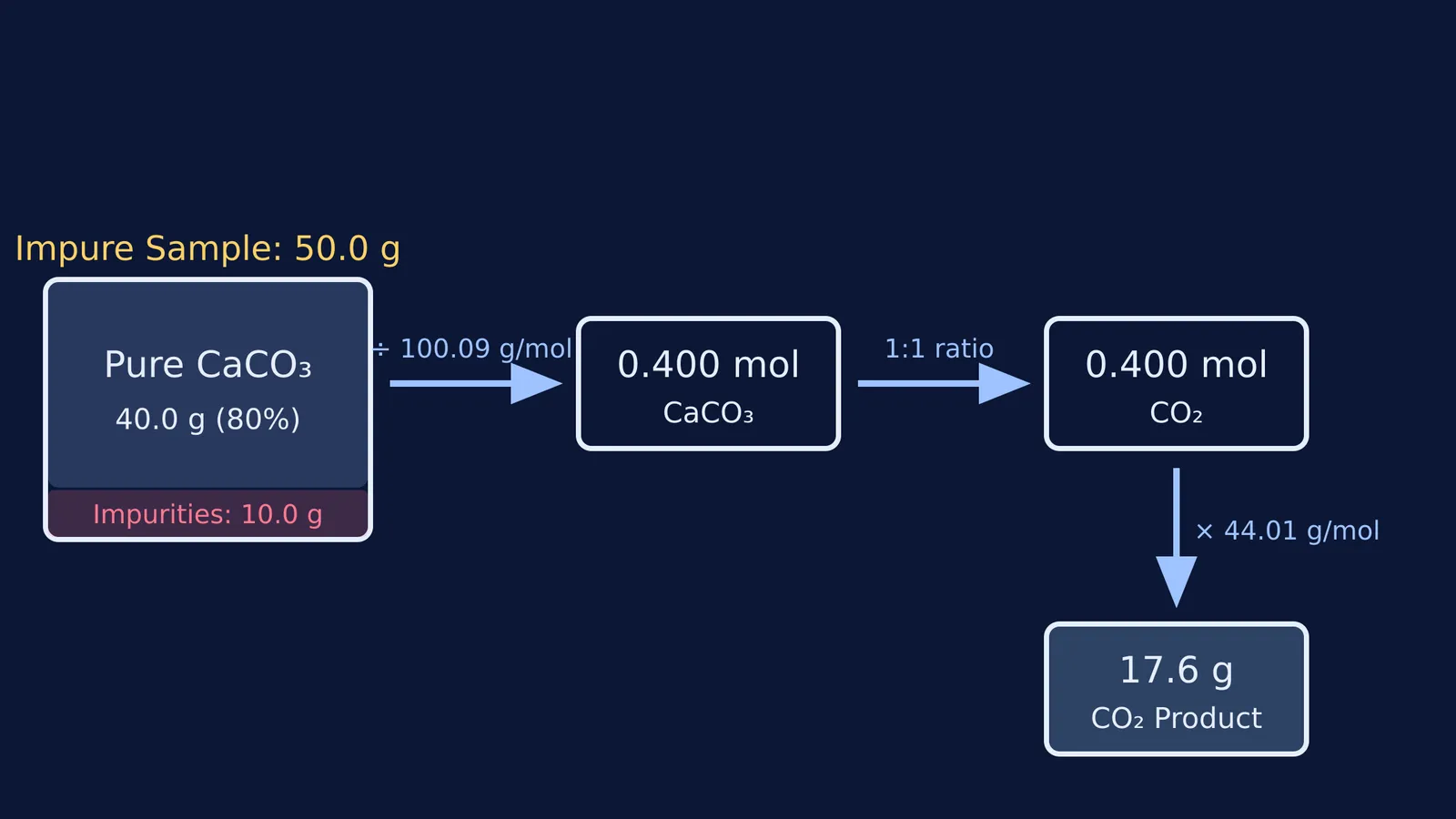
For example, if you have 50.0 g of a limestone sample that is 80% pure calcium carbonate (CaCO₃), the mass of the pure CaCO₃ is 0.80 × 50.0 g = 40.0 g. The remaining 10.0 g is unreactive dirt or other minerals.
How to solve stoichiometry with impure sample percentage purity?
Most percentage purity problems give you the mass of an impure starting material and ask how much product it will form. The process is always the same: find the pure mass first, convert to moles, use the mole ratio, and convert back to mass (Wikipedia).
Let's look at heating that 50.0 g sample of 80% pure limestone to see how much carbon dioxide (CO₂) it gives off.
Write the balanced equation:
CaCO₃ → CaO + CO₂ This tells you that 1 mole of CaCO₃ produces 1 mole of CO₂.
Find the pure mass:
As calculated above, 80% of 50.0 g gives 40.0 g of pure CaCO₃.
Convert the pure mass to moles:
The molar mass of calcium carbonate (CaCO₃) is 100.09 g/mol (Wikipedia). Moles of CaCO₃ = 40.0 g / 100.09 g/mol = 0.400 mol.
Use the mole ratio to find product moles:
From the equation, the ratio is 1:1. So, 0.400 mol of CaCO₃ produces 0.400 mol of CO₂.
Convert product moles to mass:
The molar mass of carbon dioxide (CO₂) is 44.01 g/mol (Wikipedia). Mass of CO₂ = 0.400 mol × 44.01 g/mol = 17.6 g.
If you find yourself stuck on the sequence of these steps or applying the mole concept, the Fermi Concept Library holds lessons on every fundamental chemistry idea, linking moles, mass, and equations in a complete map.
How to find percentage purity from product mass?
Sometimes, exams like JEE or NEET test this backwards. You are given the total mass of the impure sample and the final mass of the product, and you have to find the starting percentage purity (Wikipedia)).
Imagine you have a 10.0 g impure sample of magnesium (Mg) ribbon. When burned completely in oxygen, it yields 12.0 g of magnesium oxide (MgO). What is the percentage purity of the original magnesium sample?
Write the balanced equation:
2Mg + O₂ → 2MgO The molar mass of MgO is 40.30 g/mol (Wikipedia), and the molar mass of Mg is 24.305 g/mol (Wikipedia).
Find the moles of the product:
Moles of MgO = 12.0 g / 40.30 g/mol = 0.298 mol.
Use the mole ratio to find the moles of pure reactant:
The ratio of Mg to MgO is 2:2 (which simplifies to 1:1). So, you started with 0.298 mol of pure Mg.
Convert moles of pure reactant to mass:
Pure mass of Mg = 0.298 mol × 24.305 g/mol = 7.24 g.
Calculate the percentage purity:
The total sample weighed 10.0 g, but only 7.24 g of it was actually magnesium. Percentage purity = (7.24 g / 10.0 g) × 100 = 72.4%.
By writing down what you know and working through the moles of the pure substance, these problems become straightforward. When you need help working through a specific numerical, the Fermi Problem Library provides a step-by-step solver that explains the reasoning rather than just printing an answer.
Common mistakes to avoid
Skipping the balanced equation: The mole ratio connects the reactant to the product. If the ratio is not 1:1, you will get the wrong moles of product.
Applying percentage purity to the product: If a problem states the reactant is impure, it only affects the starting mass. Unless the problem specifically mentions percentage yield, assume the pure reactant converts fully into the product.


