On this page
This chapter punishes small slips: a wrong ploidy, the wrong end of the embryo sac, a misplaced example. Learn the chapter as one story, anther to seed, then test yourself with numbers and diagrams.
What does the NEET syllabus include in this chapter?
The official NEET (UG) 2026 syllabus is a National Medical Commission document dated 22 December 2025, and it places this topic under Unit 6, Reproduction (syllabus PDF). It covers flower structure, male and female gametophytes, pollination types, agents and examples, pollen-pistil interaction, outbreeding devices, double fertilisation, endosperm, embryo, seed and fruit, apomixis, parthenocarpy, polyembryony, and why seeds and fruits matter.
The matching text is Chapter 1 of the NCERT Class 12 Biology book, marked "Reprint 2026-27" (NCERT chapter PDF). Read it line by line first.
Which NCERT facts do you need to know cold?
Summarised from the NCERT chapter.
Anther wall (outside in): epidermis, endothecium, middle layers, tapetum. The tapetum feeds the developing pollen, and its cells often have more than one nucleus.
Microsporogenesis: meiosis turns each pollen mother cell into a tetrad of four microspores that mature into pollen grains.
Pollen at release: in more than 60 per cent of flowering plants, pollen is shed 2-celled (vegetative and generative); in the rest the generative cell has already divided, so it is 3-celled.
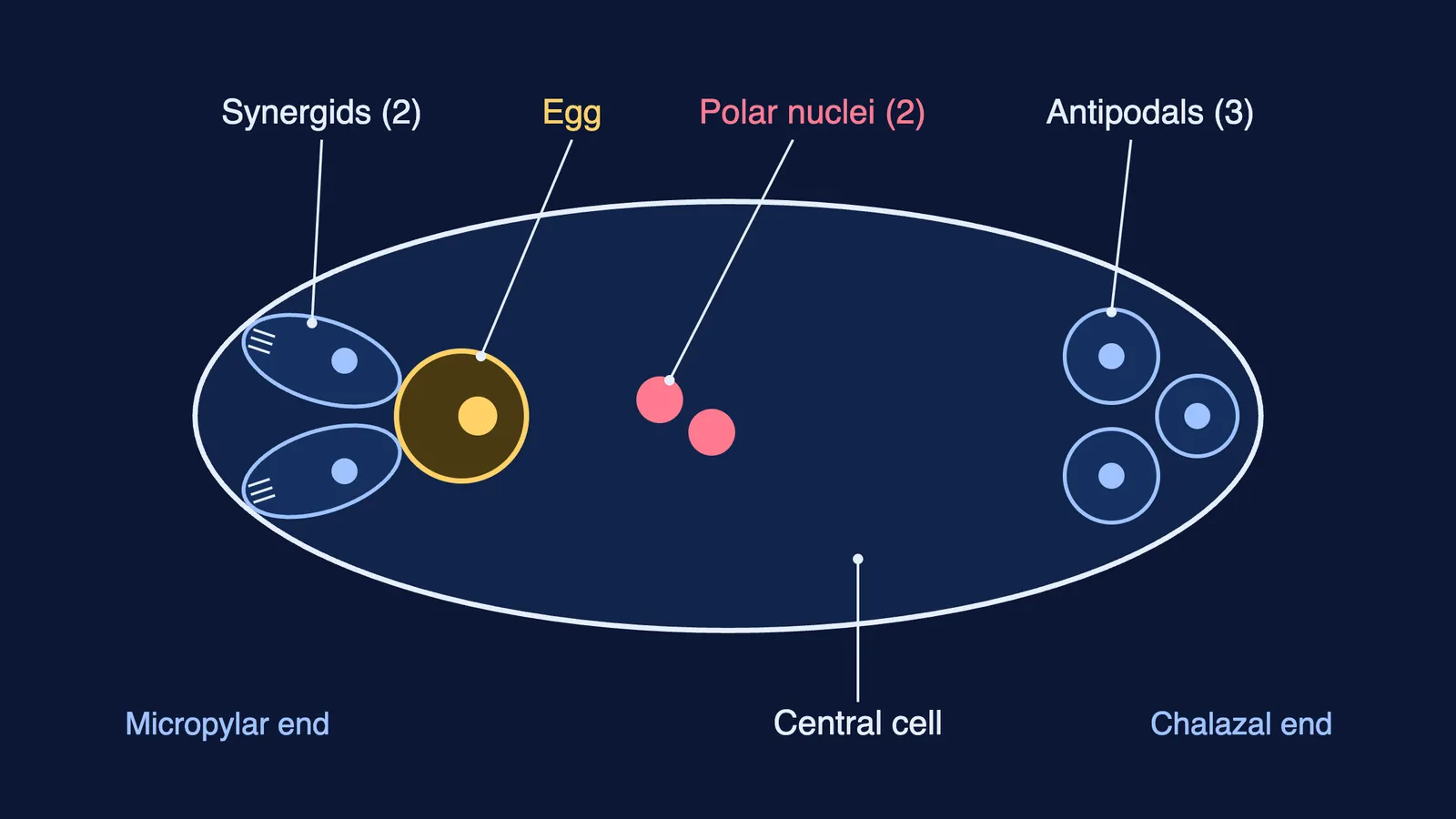
Embryo sac: one functional megaspore undergoes three free-nuclear mitoses to give 8 nuclei in 7 cells: 3 antipodals at the chalazal end, an egg and 2 synergids at the micropylar end, and one large central cell holding 2 polar nuclei.
Pollination types: autogamy (same flower), geitonogamy (another flower on the same plant, genetically like selfing) and xenogamy (a different plant, the only type bringing genetically different pollen).
Outbreeding devices: timing mismatch between pollen release and stigma readiness, anther and stigma at different positions, self-incompatibility, and unisexual flowers. Monoecy (castor, maize) blocks autogamy only; dioecy (papaya) blocks both autogamy and geitonogamy.
Pollen-pistil interaction: from pollen landing on the stigma to the tube entering the ovule; the pistil chemically accepts or rejects pollen, and the synergids' filiform apparatus guides the tube.
Double fertilisation: one male gamete fuses with the egg (syngamy, giving a 2n zygote); the other fuses with the two polar nuclei (triple fusion, giving the 3n primary endosperm nucleus, PEN).
Endosperm and embryo: endosperm forms first, usually free-nuclear then cellular (tender coconut water is free-nuclear); the dicot embryo goes proembryo, globular, heart-shaped.
Seeds: non-albuminous seeds use up their endosperm (pea, groundnut); albuminous seeds keep some (wheat, maize, barley, castor). Leftover nucellus is perisperm (black pepper, beet).
Apomixis and polyembryony: apomixis gives seeds without fertilisation (some Asteraceae and grasses); in many Citrus and mango varieties, nucellus cells grow into extra embryos (polyembryony).
The one-megaspore embryo sac above is called the Polygonum type and occurs in most flowering plants (Li and Yang, Frontiers in Plant Science, 2020). Redraw the hero diagram from memory until every label lands correctly.
How do you work out ploidy and counts?
Take a plant with 2n = 24, so n = 12. For each structure ask: parent plant, meiosis, or fusion?
Parent tissue (nucellus, megaspore mother cell, integuments that become seed coat): 24.
Meiosis products and their mitotic descendants (megaspore, egg, synergids, antipodals, each polar nucleus, male gametes): 12.
Zygote and embryo, from egg plus one male gamete: 12 + 12 = 24.
Primary endosperm nucleus and endosperm, from two polar nuclei plus one male gamete: 12 + 12 + 12 = 36.
An embryo grown from a nucellus cell: 24, a genetic copy of the mother.
A second classic: how many meioses make 100 seeds, if every ovule and pollen grain succeeds? Each seed needs one embryo sac from one megaspore mother cell: 100 female meioses. Each also needs one pollen grain, and one pollen mother cell gives four: 100 / 4 = 25 male meioses. Total: 125.
When a count goes wrong, the step-by-step solver in the Fermi Problem Library explains the reasoning rather than printing an answer.
What are the common traps?
Egg apparatus at the chalazal end. It sits at the micropylar end.
Geitonogamy as genetic cross-pollination. The pollen is from the same plant.
Monoecy preventing geitonogamy. Among unisexual conditions, only dioecy does; self-incompatibility also rejects same-plant pollen.
Endosperm as 2n, or a nucellar embryo as n.
Swapping albuminous and non-albuminous examples, or calling perisperm endosperm.
For pollination, read pollination vs fertilisation: the steps in between and our guide to wind and water pollination adaptations.
How should you plan your practice?
Day 1: read the NCERT chapter, then list every named example on one page.
Day 2: draw the anther section, pollen grain, ovule and embryo sac from memory; correct them in a second colour.
Day 3: build ploidy tables for 2n = 16 and 2n = 20.
Day 4: write true/false statements on outbreeding devices and seed types, with one-line reasons.
Day 5: timed mixed questions; name the trap behind each mistake.
If one idea such as triple fusion keeps slipping, the Fermi Concept Library has every concept in biology, each with its own lesson. Next, take on our Human Reproduction plan for NEET.