

On this page
Abiotic pollination relies on chance. When a plant depends on wind or water to transport its pollen, it cannot target specific plants the way a bee does. Instead, it must adapt its structure to maximize the probability of successful fertilization. Abiotic pollination is completely different from relying on insects or birds because the agents—wind and water—are non-living and unpredictable.
What are the adaptations of wind pollinated flowers?
Wind pollination, or anemophily, is the most common abiotic method. Roughly 12% of all plant species globally—including major crops like corn, wheat, and rice, as well as almost all gymnosperms like pines and firs—rely on the wind.
Because wind is unpredictable, these plants share several key structural adaptations:
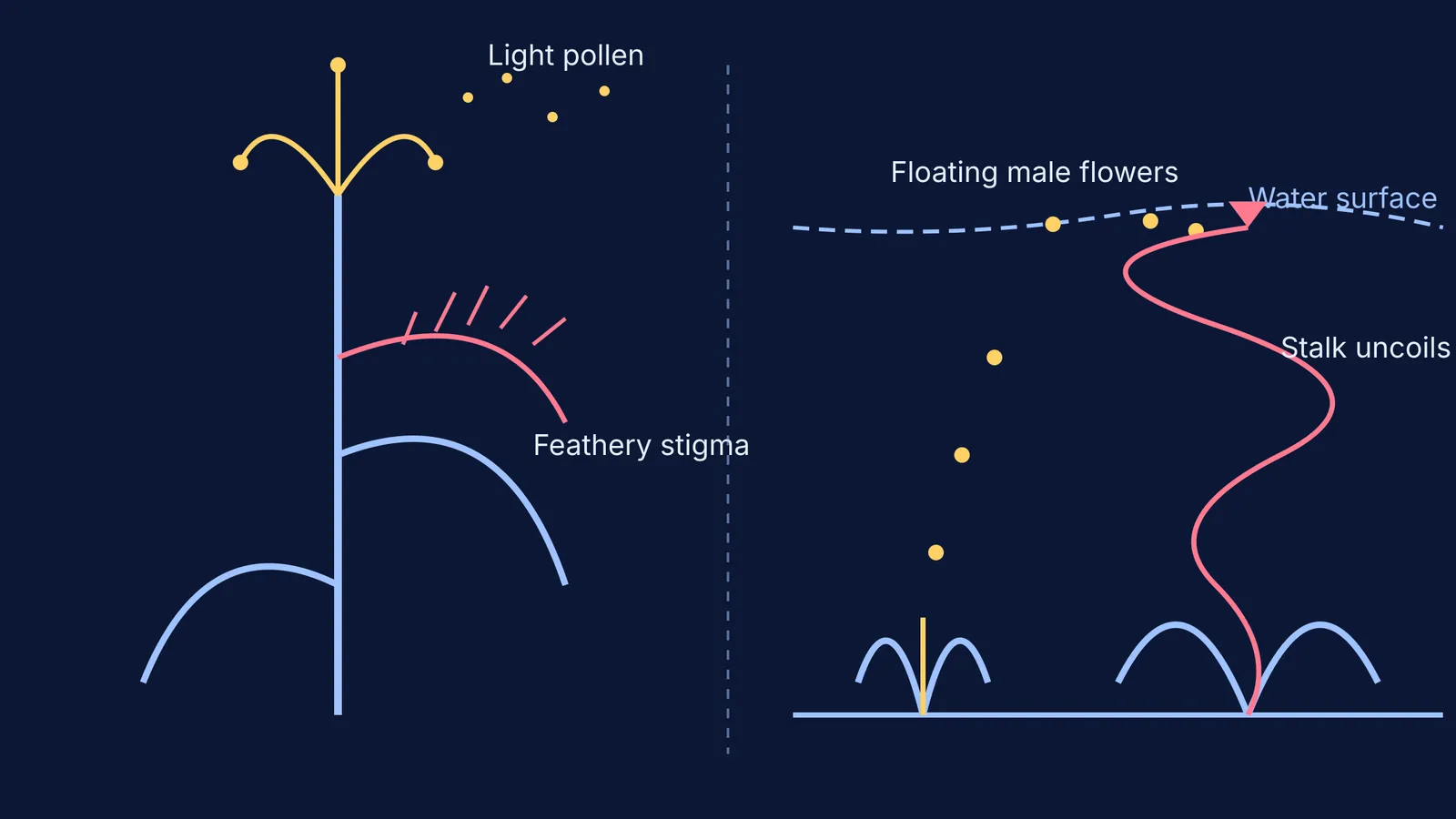
Light, non-sticky pollen: The pollen grains are typically between 20 and 60 micrometres in diameter, allowing them to remain airborne over long distances.
Exposed stamens: The male parts of the flower hang outside the petals so that even a slight breeze can catch the pollen.
Feathery stigmas: The female reproductive parts are large and often feathery to increase the surface area for trapping airborne pollen.
Massive pollen production: They produce enormous quantities of pollen to offset the fact that most will never reach a female flower.
Separate male and female flowers: Wind-pollinated species frequently have male and female structures on separate plants to promote outcrossing and reduce the likelihood of inbreeding.
A classic example is the corn plant. The elongated structures in the cob (the silks) are actually stigmas and styles that wave in the wind to trap pollen grains.
What are the adaptations of water pollinated flowers?
True water pollination, or hydrophily, is quite rare. It is limited to about 18 genera of submersed angiosperms (flowering plants).
Water-pollinated plants have evolved distinct strategies to survive in their environment. Most notably, their pollen is often protected from wetting and damage by a specialized waxy or mucilaginous coating. Furthermore, their floral parts are adapted to either float on the surface or remain buoyant enough to drift with underwater currents.
How do Vallisneria and Zostera pollinate?
Water pollination generally happens in two ways: at the surface or completely submerged. NEET and other biology exams frequently test the difference between these two strategies.
In *Vallisneria*, a freshwater plant, pollination occurs at the surface. The female flower develops on a long stalk that uncoils to reach the water's surface. Meanwhile, the male flowers detach from the plant entirely and float upward. They are carried passively by water currents until they bump into the female flowers.
In contrast, marine seagrasses like *Zostera* pollinate entirely underwater. The female flowers remain submerged. To maximize the chance of capture in a three-dimensional aquatic environment, *Zostera* produces long, ribbon-like pollen grains. These elongated ribbons drift passively through the water until they snag on a submerged stigma.
Why do these flowers lack bright colours and nectar?
Plants that rely on insects or birds spend significant energy producing bright petals, nectar, and fragrances to attract them. Wind and water do not need to be attracted. Consequently, anemophilous and hydrophilous flowers are typically small, inconspicuous, and lack nectar entirely. Their evolutionary energy is instead spent on producing millions of pollen grains.
Keeping all these botanical strategies straight can be challenging when preparing for exams. The Fermi Concept Library helps you learn the "why" behind biological adaptations, building a solid foundation so you do not have to rely on rote memorisation. When you understand the mechanics of why *Zostera* needs ribbon-like pollen while corn needs feathery stigmas, the facts stick naturally.
If you are revising plant reproduction, you might also find our guides on Apomixis and polyembryony: seeds without fertilisation or the Green, brown and red algae: the three algae classes compared helpful.


