On this page
Human Reproduction looks like a long list of names, but it rests on three timelines: how gametes form, what happens on which day of the menstrual cycle, and the path from fertilisation to implantation. Learn them in order and the names fall into place.
Is Human Reproduction in the NEET syllabus?
Yes. The NEET (UG) 2026 syllabus issued by the National Medical Commission, linked from the official NEET (UG) website, lists Human Reproduction under Biology Unit 6, Reproduction. It covers the reproductive systems, microscopic anatomy of testis and ovary, gametogenesis, the menstrual cycle, fertilisation, development up to the blastocyst and implantation, with only an elementary idea of pregnancy, placenta, parturition and lactation. It lists topics, not marks. Check neet.nta.nic.in for any change before NEET (UG) 2027.
In the NCERT Class 12 Biology book (Reprint 2026-27), this is Chapter 2, between Sexual Reproduction in Flowering Plants and Reproductive Health. Chapter 2 has seven sections, 2.1 to 2.7; build your notes on them.
How do spermatogenesis and oogenesis differ?
The counts come from NCERT Chapter 2. A spermatogonium is diploid with 46 chromosomes. A primary spermatocyte finishes meiosis I to give two secondary spermatocytes with 23 chromosomes each, and meiosis II gives four haploid spermatids, which become sperms by spermiogenesis. Spermatogenesis begins at puberty, when GnRH rises; LH then acts on Leydig cells (androgens) and FSH acts on Sertoli cells.
Oogenesis runs on a different clock. Oogonia form only in the fetal ovary, enter prophase I and pause there as primary oocytes. After losses before puberty, 60,000-80,000 primary follicles remain in each ovary. Meiosis I is completed in the tertiary follicle and is unequal: one large secondary oocyte and a tiny first polar body. What leaves the ovary at ovulation is the secondary oocyte. If the cell-division steps feel shaky, revise our guide to preparing cell cycle and cell division for NEET first.
Worked example. From 100 primary spermatocytes you get 400 spermatids. From 100 primary oocytes you get at most 100 ova; the second polar body forms only after sperm entry. Do not write three polar bodies per oocyte: NCERT says it is not certain whether the first polar body divides again.
What happens on which day of the menstrual cycle?
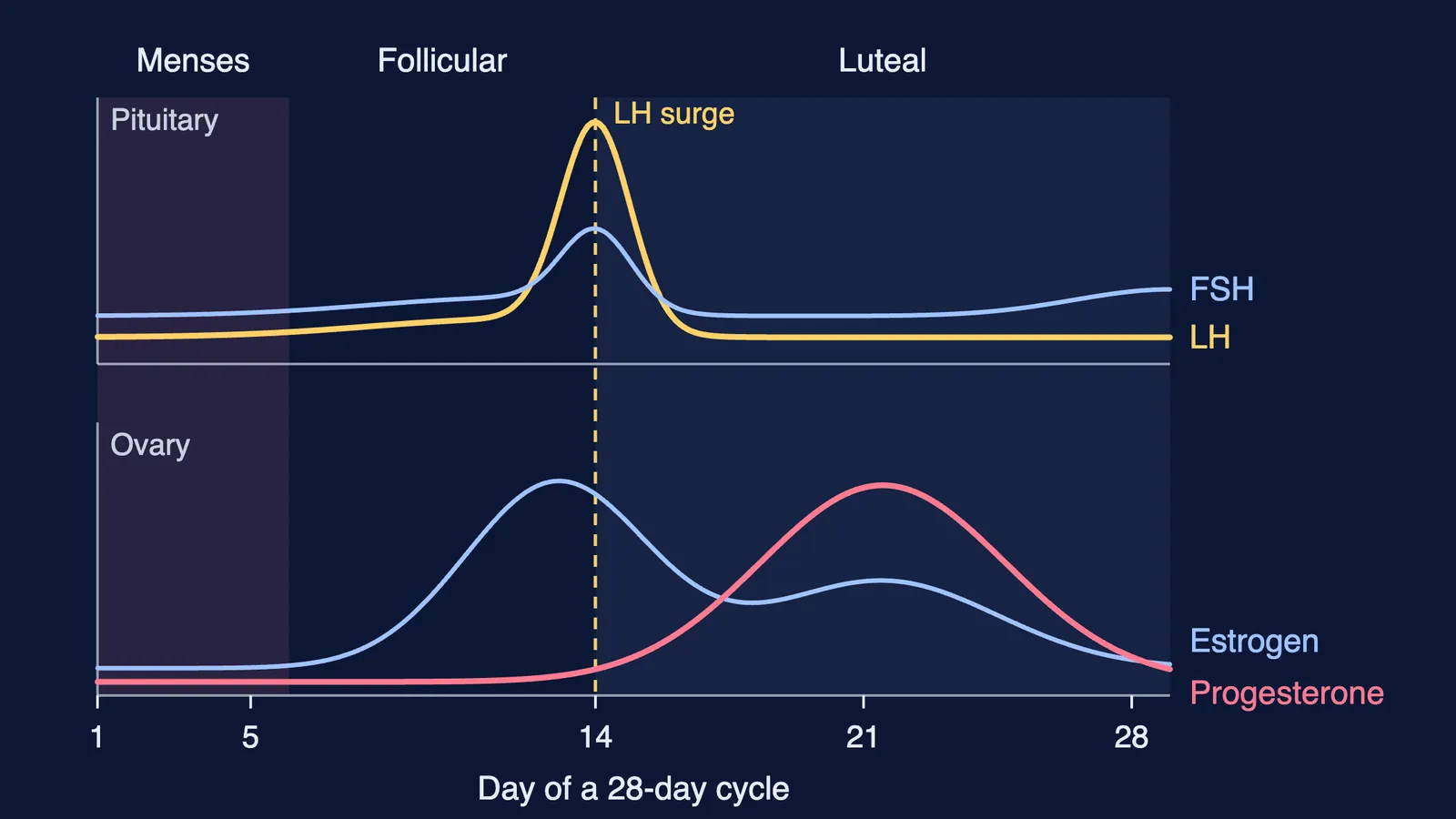
NCERT gives an average cycle of about 28/29 days, with menstrual flow lasting 3-5 days (NCERT section 2.4). In the follicular phase a Graafian follicle matures, the endometrium regenerates, and rising LH and FSH stimulate estrogen from the growing follicles. Both LH and FSH peak around day 14, and the LH surge causes the Graafian follicle to rupture: ovulation. In the luteal phase the corpus luteum secretes large amounts of progesterone, which maintains the endometrium. Without fertilisation, the corpus luteum degenerates and the next menstruation begins.
How do fertilisation and implantation work?
Fertilisation happens in the ampullary region of the fallopian tube, and only if sperm and ovum reach it at the same time (NCERT section 2.5). A sperm's contact with the zona pellucida triggers changes that block other sperms; our post on how the zona pellucida stops polyspermy explains how. Sperm entry makes the secondary oocyte finish meiosis II, giving a second polar body and a haploid ootid, whose nucleus fuses with the sperm's to make a diploid zygote.
Cleavage gives blastomeres; 8 to 16 of them form a morula, which becomes a blastocyst. The trophoblast attaches to the endometrium, the inner cell mass becomes the embryo, and embedding in the endometrium is implantation. For the elementary part: the placenta makes hCG, hPL, estrogens and progestogens; relaxin comes from the ovary late in pregnancy; in parturition, oxytocin from the maternal pituitary strengthens uterine contractions.
Which traps cost marks in this chapter?
Forgetting that ovulation releases a secondary oocyte (NCERT's 'ovum'), whose meiosis II finishes only after sperm entry.
Swapping Leydig cells (androgens, LH) and Sertoli cells (nutrition, FSH).
Placing fertilisation in the uterus: it happens in the ampullary region.
Saying the inner cell mass attaches to the uterus: the trophoblast does.
Giving progesterone to the follicular phase: it comes from the corpus luteum after ovulation.
Our assertion-reason practice on human reproduction drills the timing and hormone traps.
What is a good one-week plan for Human Reproduction?
Day 1: sections 2.1 and 2.2; label both systems from memory.
Day 2: section 2.3; write both gametogenesis flowcharts with chromosome numbers.
Day 3: section 2.4; sketch the four hormone curves across the cycle without looking.
Day 4: section 2.5; write ampulla to implantation as a numbered chain.
Day 5: sections 2.6 and 2.7; list each hormone with its source.
Day 6: mixed questions from previous papers; mark every error by section.
Day 7: reread only the sections where you lost marks.
If one link will not stick, the Fermi Concept Library gives every biology concept its own lesson and its place in the map. And if you do not know where to begin, Fermi's AI tutor works out what you already know and builds a plan for the session.