On this page
Eight original JEE Main-style questions on Solutions, easy to hard. Each has the working and a trap: the wrong option most students pick, and why. Q4 and Q8 are numerical-value questions.
What does this Solutions set cover, and how should you use it?
Solutions is Unit 5 of chemistry in the official Syllabus for JEE (Main) - 2027: concentration terms, Raoult's law and deviations, the four colligative properties, molar mass from them, and the van't Hoff factor. The JEE (Main) 2027 information bulletin awards +4 for a correct answer and −1 for a wrong one, in both sections, so a trap costs 5 marks against a correct answer.
All constants come from the NCERT Class 12 Solutions chapter (reprint 2026-27): Kf = 1.86 K kg mol⁻¹ for water and 20.00 K kg mol⁻¹ for cyclohexane, and R = 0.083 L bar mol⁻¹ K⁻¹. Strong electrolytes dissociate fully unless stated.
Allow 16 minutes, on paper.
Write units beside every number.
Read every trap line, even after a right answer.
New to the chapter? Read our guide on how to prepare Solutions for JEE Main.
Easy: concentration, Raoult's law and deviations
Q1 (easy). A 3.00 M aqueous solution of methanol (CH₃OH, 32 g mol⁻¹) has a density of 0.976 g mL⁻¹. Its molality, in mol kg⁻¹, is closest to:
(A) 3.07
(B) 3.41
(C) 3.00
(D) 2.93
Answer: (B). 1 L weighs 976 g and holds 96 g (3.00 mol) of methanol. Water = 976 − 96 = 880 g, so molality = 3.00/0.880 = 3.41 mol kg⁻¹. Trap: (A), from dividing by the mass of the whole solution (0.976 kg) instead of the solvent.
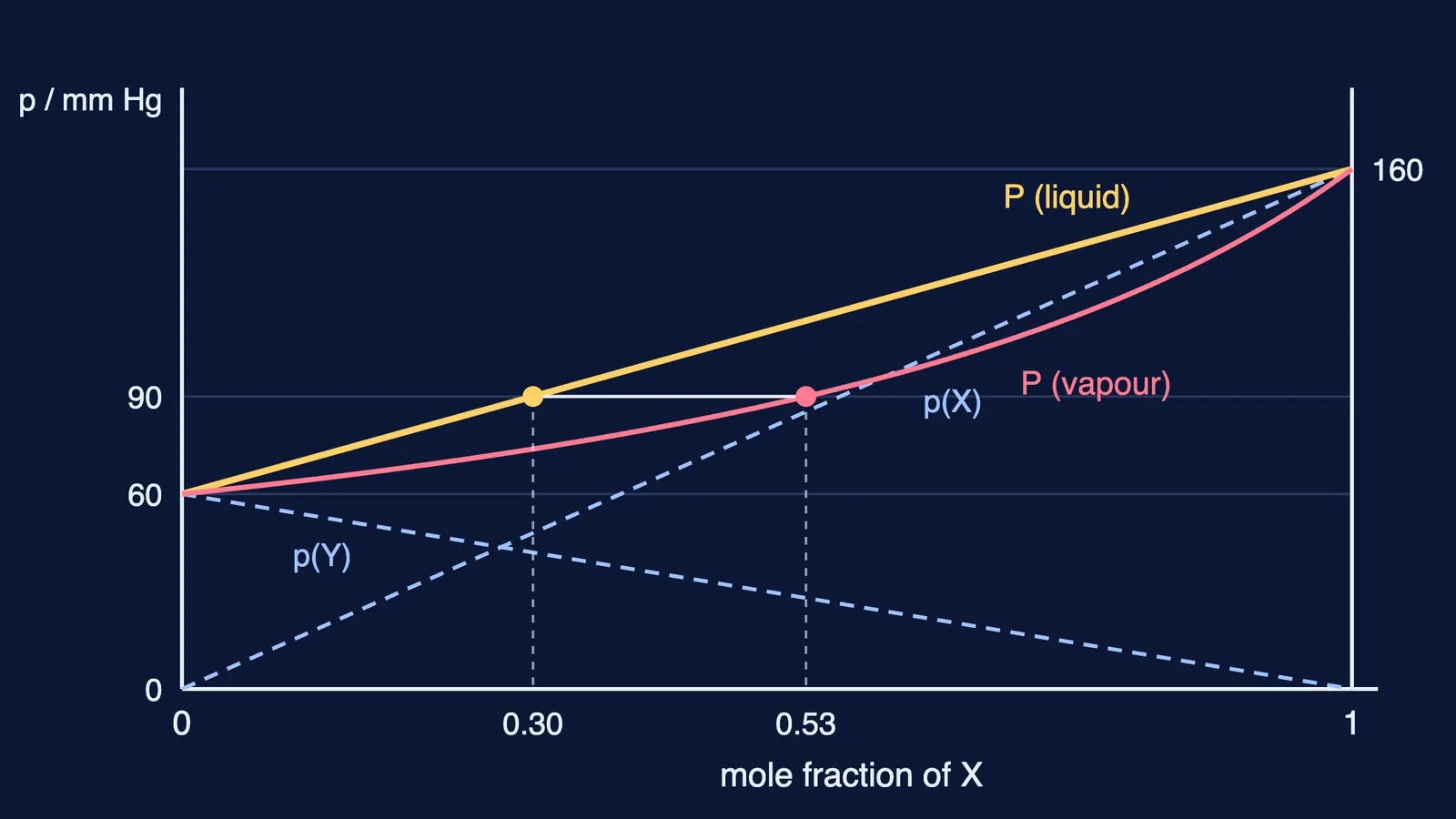
Q2 (easy). Liquids X and Y form an ideal solution. At a fixed temperature p°X = 160 mm Hg and p°Y = 60 mm Hg. For a liquid with mole fraction of X = 0.30, the mole fraction of X in the vapour is:
(A) 0.30
(B) 0.73
(C) 0.53
(D) 0.47
Answer: (C). pX = 0.30 × 160 = 48 and pY = 0.70 × 60 = 42, so P = 90 mm Hg. By Dalton's law, yX = 48/90 = 0.53. Trap: (A), which assumes vapour and liquid share a composition; the vapour is richer in the more volatile liquid.
Q3 (easy). Nitric acid and water form an azeotrope. Which statement about it is correct?
(A) It is a minimum boiling azeotrope, as mixing breaks hydrogen bonds.
(B) It is a maximum boiling azeotrope, because the mixture shows a large negative deviation from Raoult's law.
(C) Fractional distillation separates it into the pure liquids.
(D) Its vapour is richer than the liquid in the more volatile component.
Answer: (B). This is NCERT's example of a maximum boiling azeotrope. An azeotrope's liquid and vapour share one composition, so (C) and (D) fail. Trap: (A), the ethanol-water case (large positive deviation).
Medium: which colligative numbers catch you out?
Q4 (medium, numerical). How many grams of glycerol (C₃H₈O₃, 92 g mol⁻¹) must be dissolved in 1.5 kg of water to lower its freezing point by 3.72 K?
Answer: 276. m = ΔTf/Kf = 3.72/1.86 = 2.00 mol kg⁻¹. In 1.5 kg that is 3.00 mol, or 3.00 × 92 = 276 g. Trap: 184, which finds the mass for 1 kg and forgets to scale to 1.5 kg.
Q5 (medium). 0.50 g of a synthetic polymer is dissolved to make 250 mL of solution at 27 °C. The osmotic pressure is 1.66 × 10⁻³ bar. The molar mass of the polymer, in g mol⁻¹, is:
(A) 30
(B) 3.0 × 10⁴
(C) 2.7 × 10³
(D) 3.0 × 10⁶
Answer: (B). M = wRT/(πV) = (0.50 × 0.083 × 300)/(1.66 × 10⁻³ × 0.250) = 3.0 × 10⁴ g mol⁻¹. Trap: (A), from putting V = 250 instead of 0.250 L.
Q6 (medium). At one temperature, 0.10 M aqueous NaCl and 0.15 M aqueous glucose are separated by a membrane only water can cross. Then:
(A) Water flows from the NaCl side to the glucose side.
(B) Water flows from the glucose side to the NaCl side.
(C) No net flow, because the solutions are isotonic.
(D) Solute particles cross; water does not.
Answer: (B). Compare i × C: 2 × 0.10 = 0.20 M of particles for NaCl against 0.15 M for glucose. Water moves towards the higher osmotic pressure. Trap: (A), from comparing 0.10 with 0.15 and forgetting that NaCl gives two ions.
Hard: association and dissociation from colligative data
Q7 (hard). Ethanoic acid (60 g mol⁻¹) is 80% dimerised in cyclohexane. A solution of 1.20 g of the acid in 100 g of cyclohexane lowers the freezing point by:
(A) 0.80 K
(B) 2.40 K
(C) 4.00 K
(D) 5.60 K
Answer: (B). Without association, m = 0.020/0.100 = 0.200 mol kg⁻¹ and ΔTf = 20.00 × 0.200 = 4.00 K. For dimerisation, i = 1 − x/2 = 0.60, so ΔTf = 2.40 K. Trap: (A), from writing i = 1 − x, as if each associating molecule vanished instead of pairing up.
Q8 (hard, numerical). At 300 K, a solution of 3.0 g of urea (60 g mol⁻¹) per litre is isotonic with a 0.020 M solution of a salt MX₂. Find the percentage dissociation of MX₂.
Answer: 75. Isotonic means equal osmotic pressure at the same temperature, so i × 0.020 = 3.0/60 = 0.050 and i = 2.5. MX₂ gives three ions, so i = 1 + 2α and α = 0.75. Trap: 150, from dividing i − 1 by 1, as if MX₂ gave two ions.
What should you do with your mistakes?
Sort each miss into one bin: mass basis and units (Q1, Q4, Q5), vapour pressure and deviations (Q2, Q3), or particle counting (Q6, Q7, Q8). For the first bin, our walkthrough on converting mole fraction to molality and molarity. For association, see our worked example on the van't Hoff factor for ethanoic acid.
If the whole method breaks down rather than one step, the Fermi Problem Library has worked problems with a step-by-step solver that explains the reasoning rather than printing an answer.
Retry your misses in three days, answers covered.