

On this page
You dissolve a known mass of acetic acid in benzene, measure how far the freezing point drops, and work out the molar mass. The formula CH3COOH says 60 g/mol. Your answer comes out close to 120, as in a Purdue University practice problem. Benzene has changed how many particles are in the solution, and colligative properties count particles, not molecules on paper.
Why does acetic acid show double its molar mass in benzene?
The NCERT Class 12 chemistry chapter on Solutions explains that molecules of ethanoic (acetic) acid dimerise in benzene because of hydrogen bonding, and that this normally happens in solvents of low dielectric constant.
In each dimer, the O-H of one molecule hydrogen-bonds to the C=O of the other, and the same happens the other way round. The result is a ring held together by two hydrogen bonds: 2 CH3COOH ⇌ (CH3COOH)2.
Freezing-point depression depends on the number of solute particles. If every molecule pairs up, the solution has half as many particles. The same NCERT chapter states that if all the acid molecules associate, the depression is half the normal value, so the molar mass you calculate from it is twice the expected value. NCERT calls a molar mass that is lower or higher than the expected value an abnormal molar mass.
A practice problem from Purdue University's general chemistry pages puts numbers on this: 0.60 g of acetic acid in 200 g of benzene lowers the freezing point from 5.53 °C to 5.40 °C. With K_f = 5.12 °C/m for benzene, that works out to 120 g/mol, which the page puts down to dimers held together by hydrogen bonds.
For why carboxylic acids pair up so readily, see our explainer on why carboxylic acids boil higher than alcohols, which covers the same hydrogen-bonded dimer.
What is the van't Hoff factor for association?
NCERT defines the van't Hoff factor i as normal molar mass divided by abnormal molar mass. Equivalently, it is the observed colligative property divided by the calculated one, or the moles of particles after association or dissociation divided by the moles before. Van't Hoff introduced this factor in 1880.
In case of association, i is less than one; for dissociation it is greater than one. NCERT gives i for ethanoic acid in benzene as nearly 0.5, against close to 2 for aqueous KCl.
For dimerisation with degree of association x, start with 1 mol of acid. You are left with (1 − x) mol of single molecules and x/2 mol of dimers, so:
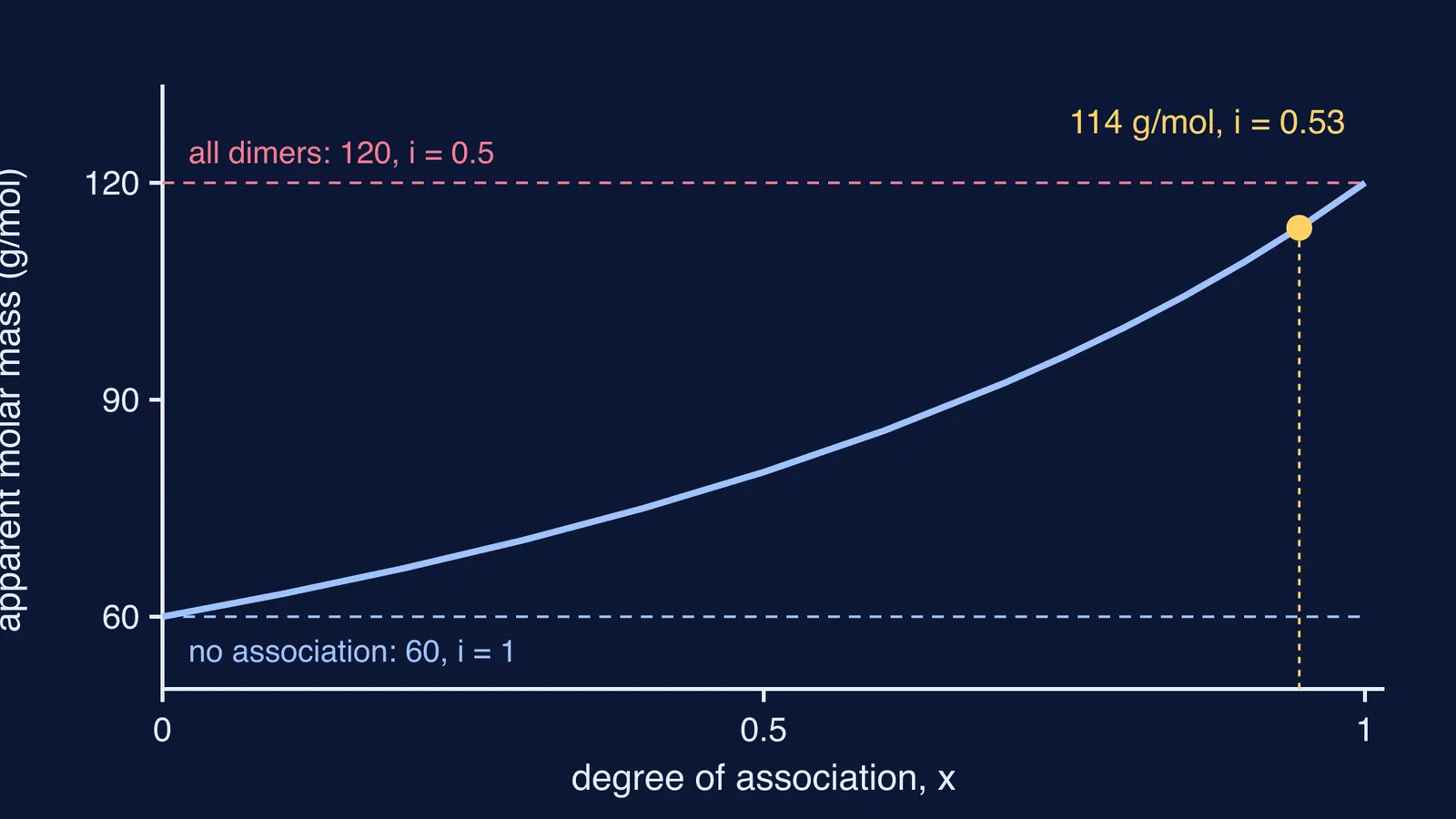
i = 1 − x/2
x = 2(1 − i)
apparent molar mass = 60 ÷ i
How do you find the degree of association from freezing-point data?
Try a typical exam-style problem. 0.2 g of acetic acid is dissolved in 20 g of benzene, and the freezing point falls by 0.45 K. Take K_f for benzene as 5.12 K kg/mol, the value NCERT uses in Example 1.10 of its Solutions chapter. Find the percentage association.
Apparent molar mass: M = (K_f × w2 × 1000) ÷ (w1 × ΔT_f) = (5.12 × 0.2 × 1000) ÷ (20 × 0.45) = 1024 ÷ 9 ≈ 113.8 g/mol.
Van't Hoff factor: i = 60 ÷ 113.8 ≈ 0.527.
Degree of association: x = 2(1 − 0.527) ≈ 0.945.
Answer: about 94.5% of the acid is in dimer form.
NCERT's own Example 1.12 does the same thing for benzoic acid in benzene. Using K_f = 4.9 K kg/mol, it gets an experimental molar mass of 241.98 g/mol against a normal 122 g/mol, which means 99.2% association. For a refresher on step 1 by itself, see finding molar mass from freezing-point depression.
Why doesn't acetic acid dimerise in water?
NCERT ties dimerisation to solvents of low dielectric constant, and water is not one of them. Water can hydrogen-bond to the acid itself, and a small fraction of the acid ionises. In NCERT's Example 1.13 in the same chapter, acetic acid in water gives i = 1.041, a degree of dissociation of 0.041. So the same compound has i near 0.5 in benzene and just above 1 in water. The solvent decides.
A five-point checklist for abnormal molar mass questions
Write the equilibrium first: 2A ⇌ A2 for dimers, AB ⇌ A+ + B− for dissociation.
Count particles per starting mole: 1 − x/2 for dimers; 1 − x(1 − 1/n) if n molecules join.
Decide which ratio you need: i = normal ÷ abnormal molar mass, never the reverse.
Check that your units match: grams with 1000 for molality, and ΔT in K (a change of 1 °C is a change of 1 K).
Run the sign check in the callout above before you write the final answer.
If you get stuck on one, the Fermi Problem Library has worked problems with a step-by-step solver that explains the reasoning rather than printing an answer. If the gap is in the idea itself, the Fermi Concept Library has a lesson for each concept. You can also start with our overview of colligative properties.


