

On this page
"Give reason: carboxylic acids have higher boiling points than alcohols of comparable molar mass" is a classic one-line question in Class 12 chemistry. It is really about how molecules hold on to each other; once you see the picture, you can answer without memorising.
What is the boiling point gap between acetic acid and propan-1-ol?
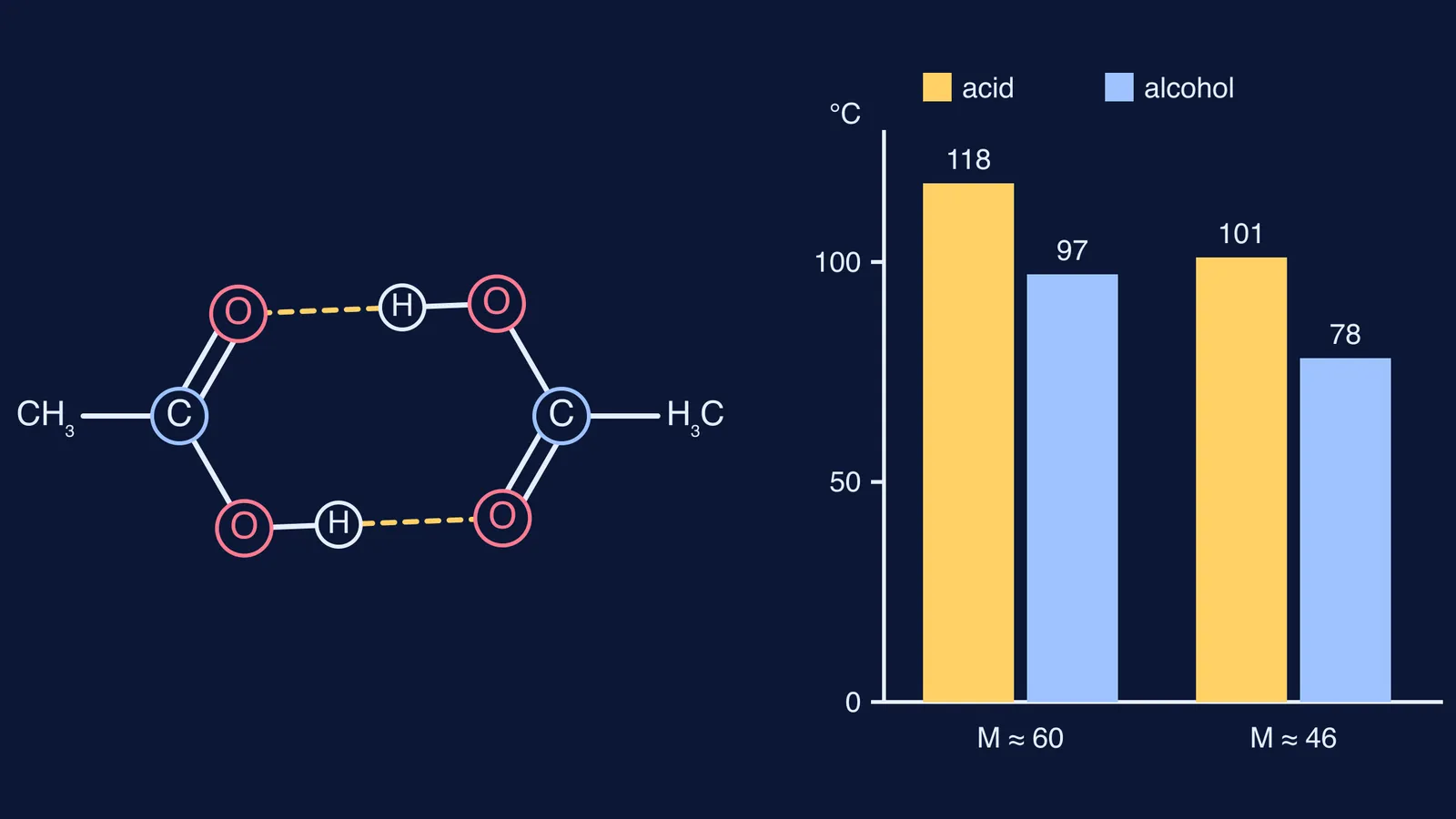
The fair test is to compare molecules of almost the same mass, so that size and dispersion forces are roughly equal and only the functional group differs. Acetic acid has a molar mass of 60.05 g/mol and propan-1-ol 60.10 g/mol, according to PubChem's computed properties.
Acetic acid boils at 117.9 °C at 760 mmHg, a value PubChem lists from the CRC Handbook of Chemistry and Physics (PubChem: acetic acid).
Propan-1-ol boils at 97.2 °C, a value PubChem lists from the Hazardous Substances Data Bank (PubChem: 1-propanol).
That is a gap of about 21 °C for the same mass. The lighter pair shows the same pattern: formic acid boils at 101 °C (PubChem: formic acid) and ethanol at 78.24 °C (PubChem: ethanol), both with a molar mass close to 46 g/mol.
Why do carboxylic acids have higher boiling points than alcohols?
Boiling means pulling molecules apart from their neighbours and sending them into the gas. The stronger and more numerous the attractions between molecules, the more heat it takes.
An alcohol has one O-H group. In the liquid, each molecule typically donates one hydrogen bond and accepts one, so alcohol molecules link into loose chains and networks in which any single link can break and re-form.
A carboxylic acid group, -COOH, carries both a hydrogen-bond donor (the O-H) and a strong acceptor (the C=O oxygen) on the same carbon. Two acid molecules can face each other so that each O-H points at the other's C=O. That gives two hydrogen bonds per pair, closing an eight-membered ring called a cyclic dimer.
The NCERT Class 12 chemistry chapter on aldehydes, ketones and carboxylic acids (section 8.8) puts it this way: carboxylic acids are higher boiling liquids than aldehydes, ketones and even alcohols of comparable molecular masses, because of more extensive association through intermolecular hydrogen bonding. The same section adds that these hydrogen bonds are not broken completely even in the vapour phase, and that most carboxylic acids exist as dimers in the vapour phase or in aprotic solvents.
How strong is the acetic acid dimer?
Researchers have measured this in the gas. Ondřej Socha and Martin Dračínský note in a 2020 paper in Molecules that gaseous acetic acid is known to form cyclic dimers with two strong hydrogen bonds (Socha and Dračínský, 2020).
The same paper reports that earlier infrared, vapour-density and thermal-conductivity experiments put the dimerization enthalpy at about -15 kcal/mol, and earlier NMR experiments at about -18 kcal/mol (Socha and Dračínský, 2020). Converted, -15 kcal/mol is roughly -63 kJ/mol for the pair. Their own gas-phase NMR measurements gave about -15.4 kcal/mol and agreed closely with quantum-chemical calculations based on this simple dimer model, with a slight mismatch only at low temperatures.
How do you write this answer in an exam?
Use this four-line template for any "give reason" question on boiling points:
Name the comparison fairly: "Compared with an alcohol of similar molar mass, for example propan-1-ol..."
State the force: "...carboxylic acid molecules are held by intermolecular hydrogen bonds."
Say why it is stronger: "Each -COOH group both donates (O-H) and accepts (C=O), so two molecules form a cyclic dimer joined by two hydrogen bonds."
Close the logic: "More energy is needed to separate these molecules, so the boiling point is higher."
Can you rank these four compounds by boiling point?
Try ranking these before you look at the answer: propan-1-ol, acetic acid, ethanol, formic acid.
Step 1: group by molar mass. Acetic acid and propan-1-ol sit near 60 g/mol; formic acid and ethanol near 46 g/mol.
Step 2: within each group, the acid wins because of dimers.
Step 3: between groups, check the data rather than guessing.
The PubChem values linked above give acetic acid (117.9 °C) > formic acid (101 °C) > propan-1-ol (97.2 °C) > ethanol (78.24 °C). Notice that formic acid, though lighter, still edges past propan-1-ol, a sign of how much the paired hydrogen bonds matter.
What should you revise if hydrogen bonding still feels shaky?
If donors and acceptors are not yet clear, revise them first; boiling points, solubility and acidity all lean on them.The Fermi Concept Library covers every concept in chemistry, each with its own lesson and its place in the map, so you can see how hydrogen bonding connects to the ideas around it.
When you want practice, the Fermi Problem Library has worked problems with a step-by-step solver that explains the reasoning rather than printing an answer, which suits "give reason" questions like this one.
Next step: redo the four-compound ranking from memory tomorrow, and write the four-line answer without looking.


