On this page
Most kinetic theory marks in NEET are lost to small slips: a temperature left in Celsius, a square root forgotten, a vibrational mode counted as half a share. These 8 original questions are built around those slips and run from easy to hard.
The NEET (UG)-2026 syllabus from the National Medical Commission lists Kinetic Theory of Gases as Physics Unit 9: the equation of state, work done on compressing a gas, pressure, rms speed, degrees of freedom, equipartition, specific heats and mean free path. Every question stays inside that list and inside NCERT Class 11 Physics, Chapter 12 Kinetic Theory (Reprint 2026-27), with compression work from Chapter 11 Thermodynamics. Take R = 8.3 J mol⁻¹ K⁻¹ and k_B = 1.38 × 10⁻²³ J K⁻¹ unless a question says otherwise.
How should you use this kinetic theory practice set?
As in NEET-UG 2026, each question has four options with one correct answer, scored +4 if right and −1 if wrong, per the NTA information bulletin. So practise the way you will be marked.
Hide the answers and allow about a minute per question.
Before any arithmetic, write the temperature in kelvin and the volume in cubic metres.
Commit to one option, then check the working and the trap line, even for questions you got right.
Write down every trap that caught you and redo those questions after three days.
New to the chapter? Start with our guide on how to prepare Kinetic Theory of Gases for NEET, then come back.
Easy: can you use PV = nRT and the meaning of temperature?
Q1 (easy). A sealed 8.3 L steel cylinder holds oxygen at 27 °C and 3.0 × 10⁵ Pa. What mass of oxygen does it contain?
(A) 16 g (B) 32 g (C) 356 g (D) 32 kg
Answer: (B). n = PV/RT = (3.0 × 10⁵ × 8.3 × 10⁻³)/(8.3 × 300) = 1.0 mol, and O₂ has M = 32 g/mol, so 32 g. Trap: (C) uses T = 27, and (D) leaves the volume in litres.
Q2 (easy). Helium (M = 4 g/mol) and methane (M = 16 g/mol) share a container at 350 K. What is v_rms(He) / v_rms(CH₄)?
(A) 1 (B) 2 (C) 4 (D) 1/2
Answer: (B). v_rms = √(3RT/M), so at equal T the ratio is √(16/4) = 2. Trap: (C) forgets the square root; (A) mixes this up with average kinetic energy, which is the same for both.
Q3 (easy). What is the average translational kinetic energy of a nitrogen molecule at 127 °C?
(A) 2.6 × 10⁻²¹ J (B) 5.5 × 10⁻²¹ J (C) 8.3 × 10⁻²¹ J (D) 1.4 × 10⁻²⁰ J
Answer: (C). NCERT gives the average kinetic energy of a molecule as (3/2)k_BT for any ideal gas. At 400 K: 1.5 × 1.38 × 10⁻²³ × 400 = 8.3 × 10⁻²¹ J. Trap: (D) is (5/2)k_BT, which adds rotation; the question asks only for translation.
Medium: can you link molecules to pressure, speed and γ?
Q4 (medium). The molecules of an ideal gas in a 2.0 L vessel have a total translational kinetic energy of 450 J. What is the pressure?
(A) 7.5 × 10⁴ Pa (B) 1.5 × 10⁵ Pa (C) 2.25 × 10⁵ Pa (D) 150 Pa
Answer: (B). NCERT's result PV = (2/3)E gives P = 2 × 450 / (3 × 2.0 × 10⁻³) = 1.5 × 10⁵ Pa. Trap: (A) uses 1/3 instead of 2/3, carrying the factor from P = (1/3)nm⟨v²⟩ without noting that E has a ½ in it.
Q5 (medium). Nitrogen is at 27 °C. To what temperature must it be heated for the rms speed of its molecules to rise by 50%?
(A) 61 °C (B) 177 °C (C) 402 °C (D) 675 °C
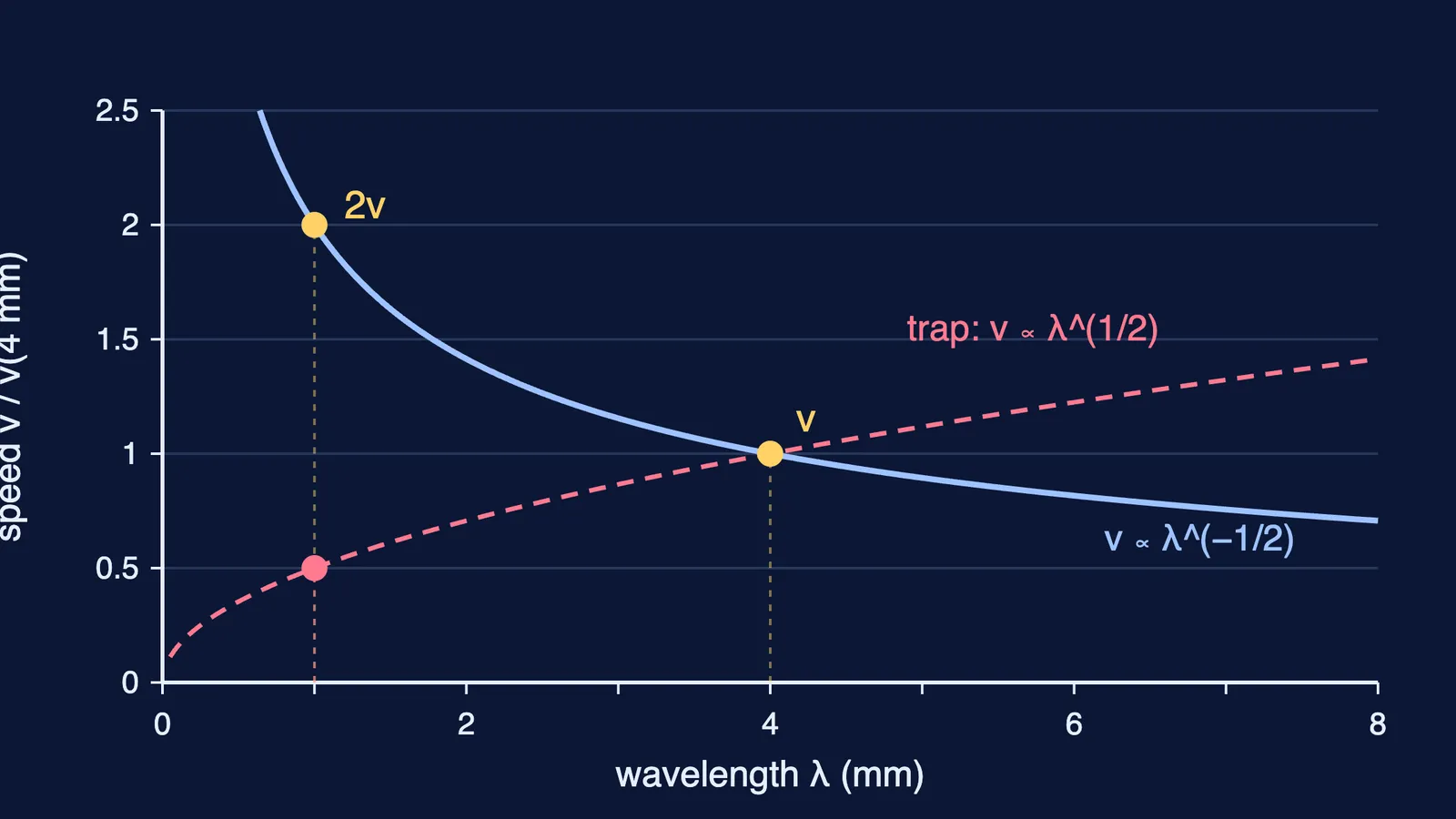
Answer: (C). v_rms ∝ √T, so 1.5 times the speed needs 1.5² = 2.25 times the temperature: 2.25 × 300 K = 675 K, which is 402 °C. Trap: (D) is correct in kelvin but the options are in Celsius; (B) multiplies T by 1.5 instead of 2.25; (A) scales the Celsius value.
Q6 (medium). At high temperature, the molecules of a diatomic gas vibrate as well as translate and rotate (one vibrational mode). What does equipartition predict for γ = Cp/Cv?
(A) 7/5 (B) 4/3 (C) 9/7 (D) 5/3
Answer: (C). A vibrational mode has kinetic and potential energy, so it carries k_BT, not ½k_BT. Cv = (3/2 + 1 + 1)R = (7/2)R, Cp = (9/2)R, γ = 9/7, as in NCERT Section 12.6. Trap: (B) gives the vibration only ½k_BT.
Hard: mean free path and compression work
Q7 (hard). Gases A and B are at the same temperature. A's molecules have 1.5 times the diameter of B's, and A is at twice B's pressure. What is the ratio of mean free paths, l_A / l_B?
(A) 1/3 (B) 4/9 (C) 2/9 (D) 9/2
Answer: (C). NCERT gives l = 1/(√2 nπd²), and n = P/k_BT, so l ∝ T/(Pd²). Ratio = 1/(2 × 1.5²) = 1/4.5 = 2/9. Trap: (A) uses d instead of d²; (B) ignores the pressure difference.
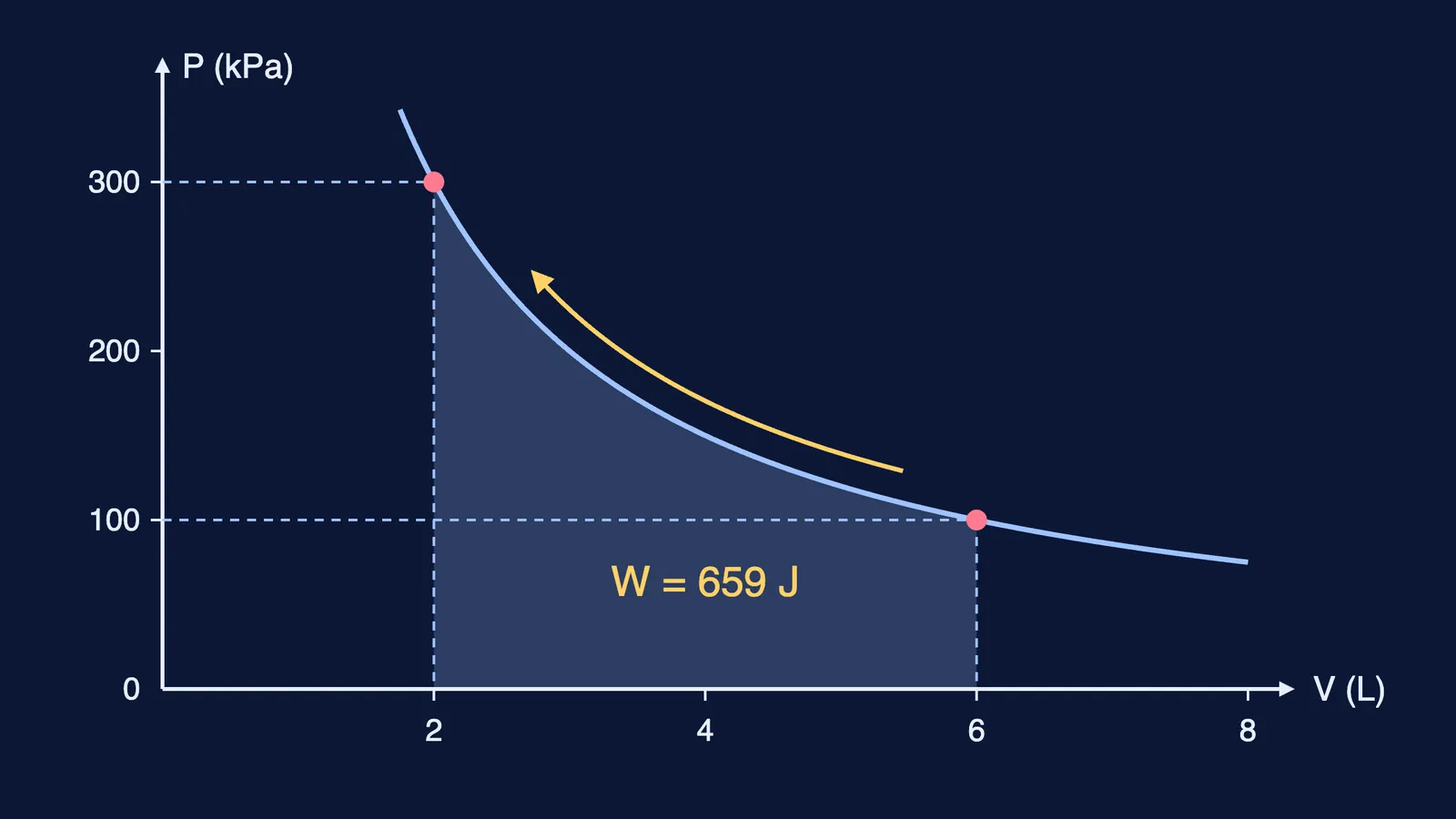
Q8 (hard). An ideal gas at 1.0 × 10⁵ Pa occupies 6.0 L. It is compressed slowly at constant temperature to 2.0 L. How much work is done on the gas? (ln 3 = 1.099)
(A) 286 J (B) 400 J (C) 659 J (D) 1200 J
Answer: (C). For an isothermal change, NCERT's Chapter 11 gives the work done by the gas as μRT ln(V₂/V₁); the work done on it is the negative of that. With μRT = P₁V₁ = 600 J, work on the gas = 600 × ln(6/2) = 659 J. Trap: (B) treats the pressure as fixed at 1.0 × 10⁵ Pa, (D) uses the final 3.0 × 10⁵ Pa, and (A) uses log base 10.
What should you do after this set?
Score yourself at +4 and −1, then sort your misses: units, kelvin, a missing square or root, or a wrong count of degrees of freedom. If a method keeps going wrong, the Fermi Problem Library has worked problems with a step-by-step solver that explains the reasoning rather than printing an answer.
For the derivations behind these formulas, read our Kinetic Theory notes for Class 11 Physics. For more work done on gases, try Thermodynamics Class 11 physics: first-law signs and PV cycles.