On this page
Eight original questions on the carbonyl chapter, in JEE Main style and ordered from easy to hard. Each has a worked solution and a trap line naming the wrong option most students pick, and why. Q3 and Q7 are numerical-value questions: the answer is a whole number.
How should you use this practice set?
Unit 17 of the NTA's Syllabus for JEE (Main) - 2027 lists, for aldehydes and ketones, nucleophilic addition and relative reactivity, HCN, NH₃ derivatives, Grignard reagents, oxidation, Clemmensen and Wolff-Kishner reduction, α-hydrogen acidity, aldol, Cannizzaro and haloform reactions, and tests that tell aldehydes from ketones. For carboxylic acids it lists only acidic strength and the factors behind it. Every question below stays inside that list.
All facts and pKa values come from Unit 8 of NCERT Class 12 Chemistry Part II, 2026-27 reprint.
Give yourself 20 minutes, on paper, without notes.
Before choosing an option, draw the structure of every compound named in the question.
Read all eight trap lines, even for questions you got right.
If the chapter still feels like a list of name reactions, start with our guide on how to prepare aldehydes, ketones and carboxylic acids for JEE Main.
Easy: do you know which carbonyl reacts and which test it passes?
Q1 (easy). Which order of reactivity towards HCN is correct, most reactive first?
(A) butanal > methanal > butanone > pentan-3-one
(B) methanal > butanal > butanone > pentan-3-one
(C) pentan-3-one > butanone > butanal > methanal
(D) methanal > butanal > pentan-3-one > butanone
Answer: (B). Each alkyl group on the carbonyl carbon crowds the incoming nucleophile and pushes electron density into that carbon. Methanal has none, butanal one, and both ketones two, with pentan-3-one's two ethyl groups bulkier than butanone's methyl and ethyl. Trap: (C), from reading the +I effect of alkyl groups as helpful. It makes the carbon less electrophilic, so more alkyl means slower addition.
Q2 (easy). A compound gives a yellow precipitate when warmed with iodine and sodium hydroxide, but no silver mirror with Tollens' reagent. It could be:
(A) ethanal
(B) propanal
(C) pentan-3-one
(D) pentan-2-one
Answer: (D). Pentan-2-one is a methyl ketone (CH₃CO–), so it gives iodoform, and as a ketone it does not reduce Tollens' reagent. Trap: (A). Ethanal does contain CH₃CO– and gives iodoform, but it is an aldehyde, so it also gives the silver mirror.
Q3 (easy, numerical). How many of these give a positive iodoform test: ethanol, methanol, propan-2-ol, propan-1-ol, propanal, butan-2-one, pentan-3-one, 1-phenylethanol, acetophenone, ethanal?
Answer: 6. NCERT Unit 8 notes that the test detects CH₃CO– and also CH₃CH(OH)–, because hypoiodite first oxidises that alcohol group to CH₃CO–. The carbonyl positives are ethanal, butan-2-one and acetophenone; the alcohol positives are ethanol, propan-2-ol and 1-phenylethanol. Trap: 3, which counts only the carbonyl compounds. Our post on the haloform reaction mechanism shows each step.
Medium: can you predict the product before you look at the options?
Q4 (medium). Which compound, treated with C₂H₅MgBr and then hydrolysed, gives 3-methylpentan-3-ol?
(A) propanone
(B) butanone
(C) pentan-3-one
(D) propanal
Answer: (B). The product carbon carries OH, one methyl and two ethyl groups. The Grignard reagent supplies one ethyl, so the ketone must bring a methyl and an ethyl: butanone. Trap: (C). Pentan-3-one already has two ethyl groups, so a third gives 3-ethylpentan-3-ol.
Q5 (medium). Which aldehyde undergoes the Cannizzaro reaction when heated with concentrated NaOH, instead of an aldol reaction?
(A) 2-methylpropanal
(B) phenylethanal
(C) 2,2-dimethylpropanal
(D) propanal
Answer: (C). Cannizzaro needs an aldehyde with no α-hydrogen. In 2,2-dimethylpropanal the α-carbon carries three methyl groups and no hydrogen, so one molecule is reduced to 2,2-dimethylpropan-1-ol and another oxidised to the sodium carboxylate. Trap: (A). The branching looks like it blocks the α-carbon, but it still has one hydrogen, and one is enough for an aldol reaction.
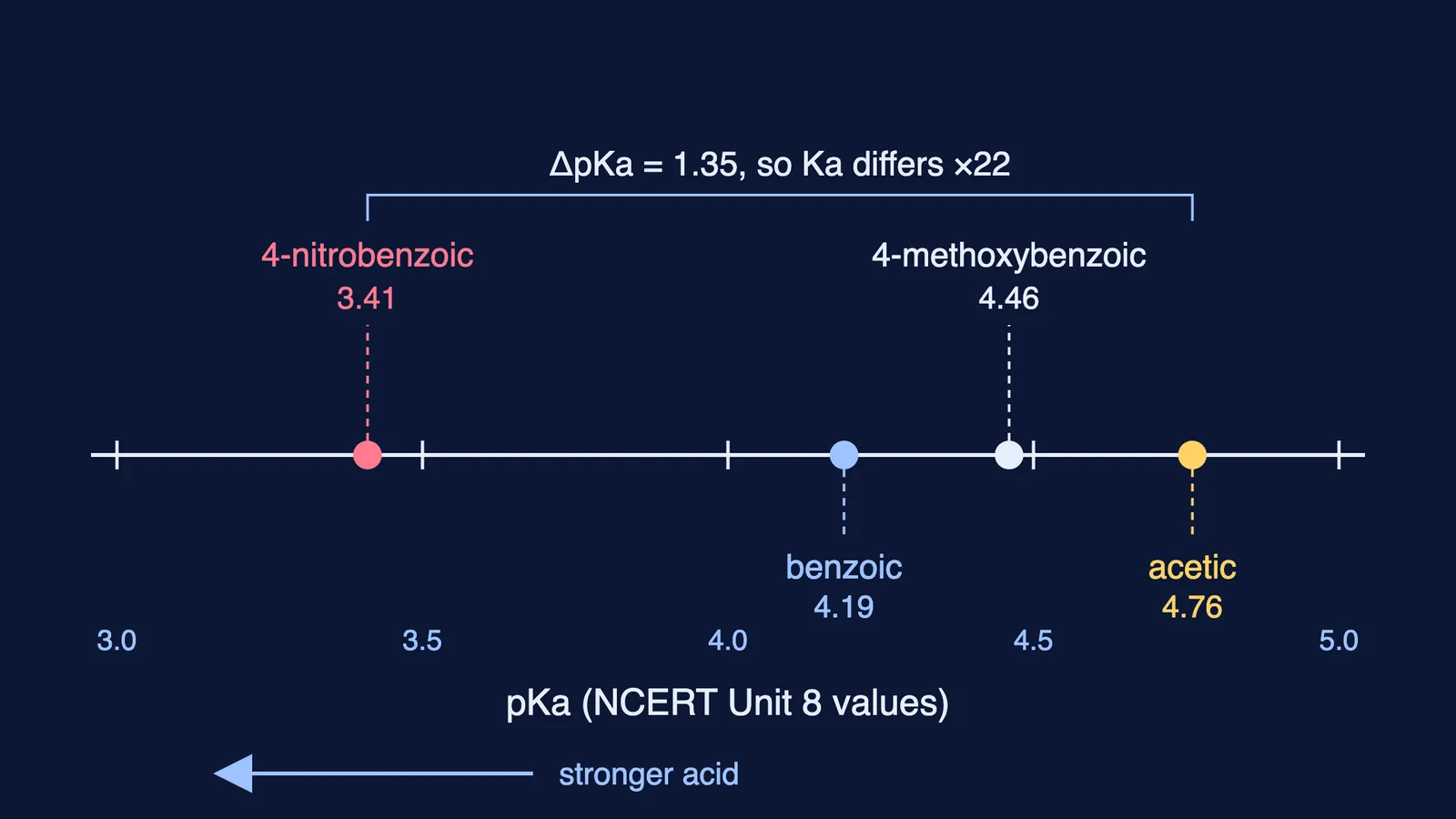
Q6 (medium). Arrange in decreasing acid strength: acetic acid, benzoic acid, 4-nitrobenzoic acid, 4-methoxybenzoic acid.
(A) 4-nitrobenzoic > benzoic > 4-methoxybenzoic > acetic
(B) 4-nitrobenzoic > 4-methoxybenzoic > benzoic > acetic
(C) acetic > 4-methoxybenzoic > benzoic > 4-nitrobenzoic
(D) 4-nitrobenzoic > benzoic > acetic > 4-methoxybenzoic
Answer: (A). NCERT Unit 8 gives pKa values of 3.41, 4.19, 4.46 and 4.76 for these four, and a lower pKa means a stronger acid. The nitro group withdraws electrons and stabilises the carboxylate; methoxy donates by resonance at the para position. A pKa gap of 1.35 means 4-nitrobenzoic acid has a Ka about 22 times that of acetic acid. Trap: (B), from treating methoxy as electron-withdrawing because oxygen is electronegative.
Hard: can you track two molecules, or five clues, at once?
Q7 (hard, numerical). Benzaldehyde and propanal are mixed with dilute NaOH. How many different β-hydroxy aldehydes can form before any dehydration, ignoring stereoisomers?
Answer: 2. Only propanal has α-hydrogens, so only propanal forms an enolate. It can add to another propanal (3-hydroxy-2-methylpentanal) or to benzaldehyde (3-hydroxy-2-methyl-3-phenylpropanal). Benzaldehyde can accept but never donate. Trap: 4, the count you get when both partners have α-hydrogens.
Q8 (hard). Compound X, C₅H₁₀O, gives a coloured precipitate with 2,4-DNP, does not reduce Tollens' reagent and gives iodoform. Wolff-Kishner reduction of X gives 2-methylbutane. X is:
(A) pentan-2-one
(B) 3-methylbutan-2-one
(C) 2-methylbutanal
(D) pentan-3-one
Answer: (B). The 2,4-DNP result says aldehyde or ketone; no silver mirror says ketone; iodoform says methyl ketone. Wolff-Kishner turns C=O into CH₂ without touching the skeleton, so X must have a branched four-carbon chain: CH₃COCH(CH₃)₂. Trap: (A). Pentan-2-one passes the first three tests but reduces to straight-chain pentane, not 2-methylbutane.
What should you do after checking your answers?
Sort each miss into one of three bins: reading reactivity and acidity (Q1, Q6), α-hydrogen logic (Q5, Q7), or tests and products (Q2, Q3, Q4, Q8). Spend this week on the fullest bin, and redo those questions in three days without the solutions.
When you can follow a solution but could not have started it yourself, the Fermi Problem Library has worked problems with a step-by-step solver that explains the reasoning rather than printing an answer.