On this page
Here are eight original JEE Main-style questions on haloalkanes and haloarenes, from easy to hard. Each answer has a worked solution and a trap line naming the most tempting wrong option. Q6 is numerical; the rest are single-correct.
How should you use this haloalkanes practice set?
The JEE (Main) 2027 syllabus lists this chapter as Unit 16, Organic Compounds Containing Halogens: preparation, properties and reactions, the nature of the C–X bond, and substitution mechanisms. Every question stays inside that unit and Unit 6 of the NCERT Class 12 Chemistry Part II textbook (Reprint 2026-27).
Give yourself 16 minutes, about two per question.
Before choosing, write one line naming the mechanism or rule that decides it.
Read every trap line, even where you were right.
New to the chapter? Start with our guide on how to prepare haloalkanes and haloarenes for JEE Main and come back.
Easy: do you know the C–X bond and its reagents?
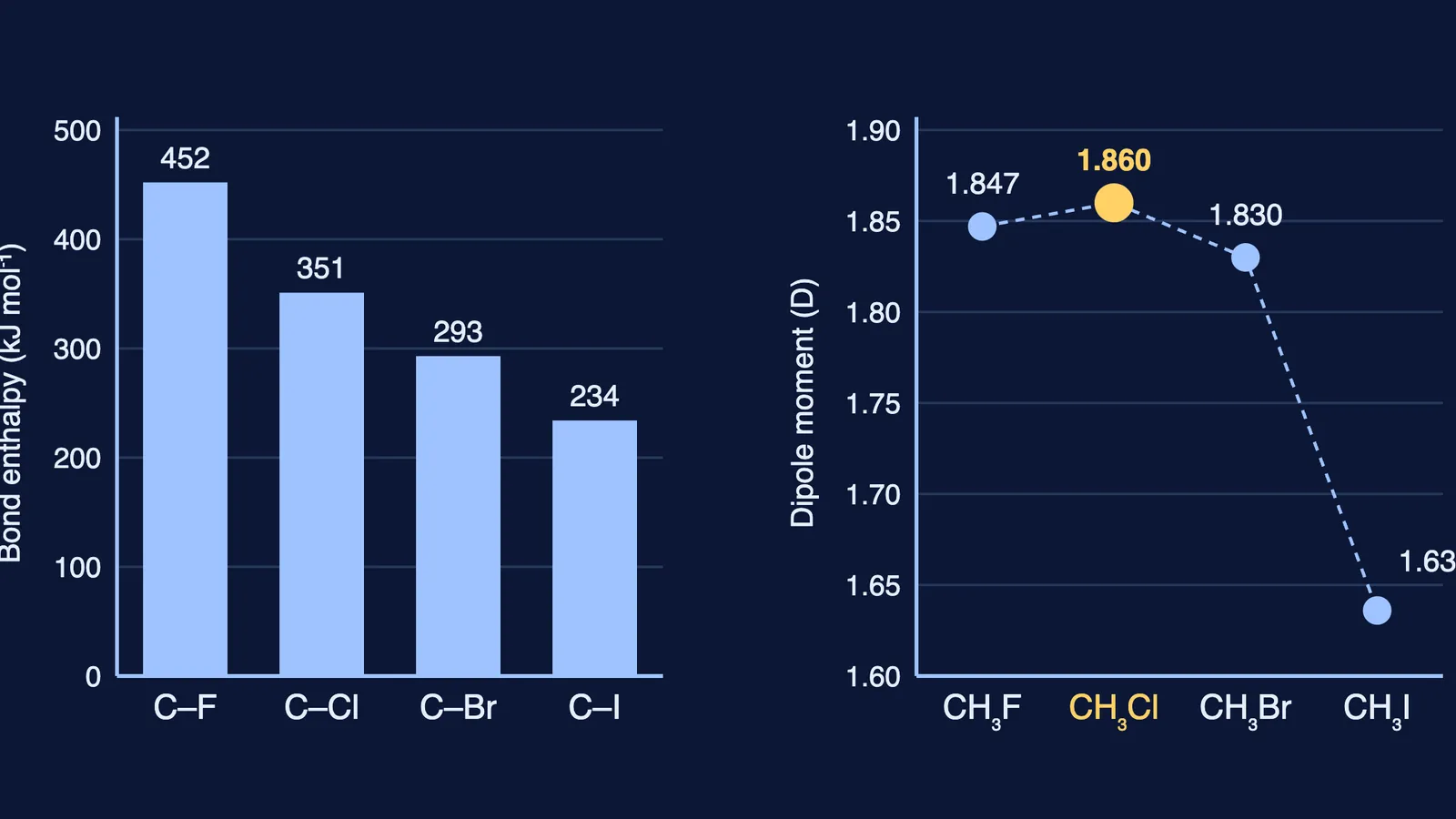
Q1 (easy). Use the CH₃X data in NCERT Table 6.2. Which statement is correct?
(A) Dipole moment falls steadily from CH₃F to CH₃I.
(B) CH₃Cl has the largest dipole moment, though C–F is the most polar bond.
(C) C–I, the longest bond, is the strongest.
(D) CH₃Br has a smaller dipole moment than CH₃I.
Answer: (B). NCERT gives 1.847 D for CH₃F, 1.860 D for CH₃Cl, 1.830 D for CH₃Br and 1.636 D for CH₃I. Fluorine pulls harder, but the C–F bond (139 pm) is much shorter than C–Cl (178 pm), and dipole moment depends on charge and distance, so chloride edges ahead. C–I is the weakest bond (234 kJ mol⁻¹). Trap: (A), from reading electronegativity alone.
Q2 (easy). 1-Bromopropane is warmed with silver nitrite in dry ether. The main organic product is:
(A) propyl nitrite, CH₃CH₂CH₂–O–N=O
(B) 1-nitropropane, CH₃CH₂CH₂–NO₂
(C) propan-1-ol
(D) propene
Answer: (B). AgNO₂ is largely covalent, so the nitrogen end of the nitrite group attacks carbon and a nitroalkane forms. Trap: (A), which is the KNO₂ product: ionic nitrite attacks through oxygen.
Q3 (easy). Which reagent converts 1-chlorobutane into 1-fluorobutane on heating?
(A) NaI in dry acetone
(B) NaF in dry acetone
(C) Hg₂F₂
(D) F₂ gas in the dark
Answer: (C). This is the Swarts reaction: an alkyl chloride or bromide heated with a metallic fluoride such as AgF, Hg₂F₂, CoF₂ or SbF₃. Trap: (B), borrowing from Finkelstein, which uses NaI and works because NaCl precipitates in dry acetone; it makes iodides, not fluorides.
Medium: can you predict the product and its configuration?
Q4 (medium). (S)-2-Bromobutane reacts with NaCN in DMSO by an SN2 path. The product is:
(A) (S)-2-methylbutanenitrile
(B) (R)-2-methylbutanenitrile
(C) racemic 2-methylbutanenitrile
(D) pentanenitrile
Answer: (B). SN2 attack from the back inverts the geometry. CN takes Br's place as top priority (CN > C₂H₅ > CH₃ > H), so the label flips from S to R. Trap: (C), the SN1 outcome via a flat carbocation.
Q5 (medium). 2-Bromo-3-methylbutane is heated with alcoholic KOH. The major product is:
(A) 3-methylbut-1-ene
(B) 2-methylbut-2-ene
(C) 3-methylbutan-2-ol
(D) 2-methylbut-1-ene
Answer: (B). β-Hydrogens sit on C1 and C3. Losing H from C3 gives (CH₃)₂C=CHCH₃, with three alkyl groups on the double bond; losing H from C1 gives CH₂=CH–CH(CH₃)₂, with one. Zaitsev's rule, as NCERT states it, favours the alkene with more alkyl groups on the doubly bonded carbons. Trap: (A), because C1 has more hydrogens; that count does not decide.
Q6 (medium, numerical). 10.9 g of bromoethane (M = 109 g mol⁻¹) is treated with sodium in dry ether. If the Wurtz reaction gives butane (M = 58 g mol⁻¹) in 80% yield, what mass of butane forms, in grams?
Answer: 2.32. Moles of C₂H₅Br = 10.9/109 = 0.100. Two molecules of halide make one butane, so the theoretical yield is 0.0500 mol, or 2.90 g; 80% of that is 2.32 g. Trap: 4.64, from forgetting the 2 : 1 ratio.
Hard: which compound reacts fastest, and why?
Q7 (hard). Arrange these in decreasing order of SN1 reactivity in aqueous ethanol: P = 4-CH₃O–C₆H₄CH₂Cl, Q = C₆H₅CH₂Cl, R = 4-O₂N–C₆H₄CH₂Cl, S = C₆H₅Cl.
(A) S > R > Q > P
(B) P > Q > R > S
(C) R > Q > P > S
(D) Q > P > R > S
Answer: (B). SN1 speed follows carbocation stability; P, Q and R all give benzylic cations. Para methoxy donates electrons by resonance and spreads the positive charge, so P is fastest; para nitro withdraws electrons, so R is slowest of the three. Chlorobenzene does not react by SN1: NCERT notes the phenyl cation is not resonance-stabilised. Trap: (C), assuming an electron-withdrawing group helps chloride leave; the slow step makes a cation, which nitro destabilises.
Q8 (hard). Which compound is converted to the corresponding phenol by aqueous NaOH under the mildest conditions?
(A) chlorobenzene
(B) 1-chloro-3,5-dinitrobenzene
(C) 1-chloro-4-nitrobenzene
(D) 1-chloro-2,4-dinitrobenzene
Answer: (D). NCERT notes that chlorobenzene needs 623 K and 300 atm. An ortho or para nitro group stabilises the negative charge formed when OH⁻ adds to the ring; (D) has two, (C) one. Trap: (B): both its nitro groups are meta to chlorine, and NCERT says a meta nitro group has no effect on this reactivity.
What should you revise if you missed some?
Q1 or Q3: reread the C–X bond table and the Finkelstein and Swarts reactions.
Q2 or Q4: list ambident nucleophiles (CN⁻, NO₂⁻) and draw one SN2 inversion with CIP labels.
Q5 or Q6: practise eliminations and Wurtz, writing the mole ratio first.
Q7 or Q8: compare carbocation stability with ring substituents, then the ortho, para and meta effect of nitro groups on haloarenes.
The next chapter builds on these reactions: see our guide to preparing alcohols, phenols and ethers for JEE Main. For the wider habit, read why organic chemistry rewards learning mechanisms, not lists.
When you want more problems of this kind, the Fermi Problem Library has worked problems with a step-by-step solver that explains the reasoning rather than printing an answer.