On this page
Eight questions on chemical thermodynamics for JEE Main, written for this post and graded easy to hard. Each has a worked solution and a trap: the wrong option a hurried student is most likely to pick.
Which chemical thermodynamics topics does this JEE Main set cover?
In the official Syllabus for JEE (Main) 2027 from NTA, Chemical Thermodynamics is Unit 4 of Physical Chemistry. It covers work, heat, internal energy and enthalpy, Hess's law, bond and other enthalpies, ΔS of the universe and ΔG of the system as tests of spontaneity, and ΔG° with the equilibrium constant. Every question below stays inside that list.
We follow Unit 5 of NCERT Class 11 Chemistry (Reprint 2026-27): ΔU = q + w, where w is work done on the system, R = 8.314 J K⁻¹ mol⁻¹, and bond enthalpies from its Table 5.3. Starting the chapter from scratch? Read our guide on how to prepare chemical thermodynamics for JEE Main first.
How should you use this practice set?
The JEE (Main) 2027 information bulletin gives Chemistry 20 multiple-choice questions and 5 numerical-value questions, with +4 for a correct answer and −1 for a wrong one in both sections. Numerical answers are rounded to the nearest integer.
Give yourself 16 minutes for all eight.
Before any arithmetic, write the sign you expect: is heat in or out, work on or by, ΔG up or down?
Mark your guesses, then read every trap.
Easy: work, ΔH versus ΔU, and entropy at a phase change
Q1 (easy). A gas expands against a constant external pressure of 1.5 bar, from 10.0 L to 22.0 L. What is the work w done on the gas? (1 bar L = 100 J)
(A) +1.8 kJ (B) −1.8 kJ (C) −18 kJ (D) −3.3 kJ
Answer: (B). w = −pₑₓΔV = −1.5 × (22.0 − 10.0) = −18 bar L = −1800 J. Trap: (D) multiplies the pressure by the final volume, not by the change in volume.
Q2 (easy). A bomb calorimeter gives ΔcU = −2870.0 kJ mol⁻¹ at 298 K for C₄H₁₀(g) + 13/2 O₂(g) → 4CO₂(g) + 5H₂O(l). What is ΔcH?
(A) −2861.3 kJ mol⁻¹ (B) −2866.3 kJ mol⁻¹ (C) −2870.0 kJ mol⁻¹ (D) −2878.7 kJ mol⁻¹
Answer: (D). Count gas moles only: Δn_g = 4 − (1 + 6.5) = −3.5. ΔH = ΔU + Δn_gRT = −2870.0 + (−3.5)(8.314 × 298 / 1000) = −2878.7 kJ mol⁻¹. Trap: (B) counts the liquid water as gas, giving Δn_g = +1.5.
Q3 (easy). Ethanol boils at 351 K under 1 bar, with ΔvapH = 38.6 kJ mol⁻¹. What is ΔvapS at its boiling point?
(A) 0 (B) 0.110 J K⁻¹ mol⁻¹ (C) 110 J K⁻¹ mol⁻¹ (D) 129.5 J K⁻¹ mol⁻¹
Answer: (C). At the boiling point the two phases are in equilibrium and the change is reversible, so ΔS = q_rev/T = 38 600 / 351 = 110 J K⁻¹ mol⁻¹. Trap: (A) mixes up ΔG = 0 at the boiling point with ΔS = 0.
Medium: Hess's law, bond enthalpies and the sign of ΔG
Q4 (medium). Given ΔfH°(CO₂, g) = −393.5 kJ mol⁻¹, ΔfH°(H₂O, l) = −285.8 kJ mol⁻¹ and ΔcH°(C₂H₂, g) = −1300.0 kJ mol⁻¹, what is ΔfH° of ethyne?
(A) −227.2 kJ mol⁻¹ (B) −58.6 kJ mol⁻¹ (C) +227.2 kJ mol⁻¹ (D) +620.7 kJ mol⁻¹
Answer: (C). C₂H₂ + 5/2 O₂ → 2CO₂ + H₂O, so ΔcH = 2(−393.5) + (−285.8) − ΔfH(C₂H₂). Then ΔfH = −1072.8 + 1300.0 = +227.2 kJ mol⁻¹. Trap: (A) takes reactants minus products and flips the sign.
Q5 (medium, numerical). Use mean bond enthalpies (kJ mol⁻¹): C=C 611, H–Br 368, C–C 347, C–H 414, C–Br 276. For the gas-phase reaction CH₂=CH₂ + HBr → CH₃–CH₂Br, ΔrH = −x kJ mol⁻¹. Find x.
Answer: 58. The four original C–H bonds are untouched, so ignore them. Bonds broken: 611 + 368 = 979. Bonds formed: 347 + 414 + 276 = 1037. ΔrH = 979 − 1037 = −58 kJ mol⁻¹. Trap: forgetting the new C–H bond gives 979 − 623 = +356, the wrong sign as well as the wrong size.
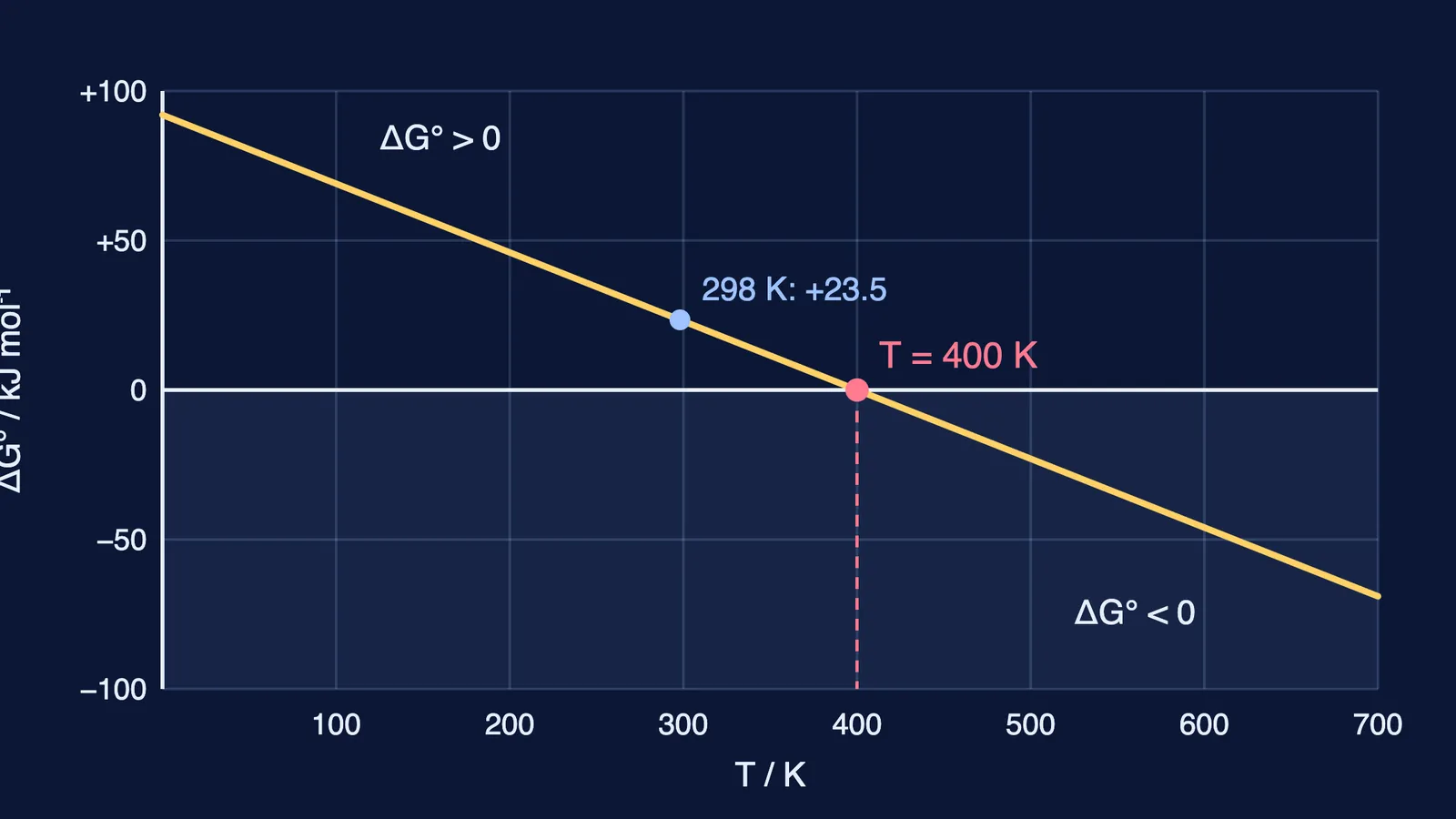
Q6 (medium). A reaction has ΔrH° = +92.0 kJ mol⁻¹ and ΔrS° = +230 J K⁻¹ mol⁻¹, both roughly constant with temperature. Which is correct?
(A) ΔrG°(298 K) = −23.5 kJ mol⁻¹; spontaneous at 298 K (B) ΔrG°(298 K) = +23.5 kJ mol⁻¹; spontaneous above 400 K (C) ΔrG°(298 K) = +23.5 kJ mol⁻¹; spontaneous below 400 K (D) ΔrG°(298 K) = −6.8 × 10⁴ kJ mol⁻¹; spontaneous at all temperatures
Answer: (B). ΔG° = 92.0 − 298 × 0.230 = +23.5 kJ mol⁻¹. It turns negative when T > ΔH/ΔS = 92.0/0.230 = 400 K. Trap: (D) subtracts 298 × 230 without turning J into kJ.
Hard: ΔG° with K, and entropy of the universe
Q7 (hard). At 500 K, a gas-phase reaction has ΔrH° = −52.0 kJ mol⁻¹ and ΔrS° = −85.0 J K⁻¹ mol⁻¹. Its equilibrium constant K at 500 K is closest to
(A) 0.10 (B) 2.3 (C) 9.8 (D) 1.9 × 10²
Answer: (C). ΔG° = −52 000 − 500(−85.0) = −9500 J mol⁻¹. ln K = 9500 / (8.314 × 500) = 2.285, so K = e^2.285 ≈ 9.8. Trap: (D) treats 2.285 as log K instead of ln K.
Q8 (hard). One mole of an ideal gas at 300 K expands isothermally into a vacuum, from 5.0 L to 20.0 L, inside an insulated box. Which pair (ΔS_system, ΔS_surroundings), in J K⁻¹, is correct?
(A) (0, 0) (B) (+11.5, −11.5) (C) (+11.5, 0) (D) (0, +11.5)
Answer: (C). Entropy is a state function, so find ΔS_system along a reversible isothermal path between the same states: ΔS = nR ln(V_f/V_i) = 8.314 × ln 4 = +11.5 J K⁻¹. No heat reaches the surroundings, so ΔS_surroundings = 0 and ΔS_total = +11.5 J K⁻¹ > 0. Trap: (A) reasons "q = 0, so ΔS = 0", but ΔS uses q_rev, not the actual q.
If Q6 or Q7 cost you marks, practise with our guides to the temperature at which a reaction becomes spontaneous and to calculating K from ΔG°. For more questions with every step shown, the Fermi Problem Library has worked problems with a step-by-step solver that explains the reasoning rather than printing an answer.