On this page
Eight original JEE Main-style questions, easy to hard: six single-correct MCQs and two numerical (Q3, Q8). Each answer has the working and a "Trap" line naming the wrong option most students pick.
Which topics does this magnetism question set cover?
Unit 13 of NTA's Syllabus for JEE (Main) - 2027 is "Magnetic Effects of Current and Magnetism". It covers the Biot-Savart and Ampere laws, forces on charges and currents, torque on a loop, the galvanometer, dipole fields and magnetic materials. Every question stays inside it and NCERT Class 12 Physics Chapter 4, Moving Charges and Magnetism and Chapter 5, Magnetism and Matter.
Take μ₀ = 4π × 10⁻⁷ T m A⁻¹ throughout.
Easy: can you pick the right formula first time?
Q1 (easy). A circular coil of 50 turns and radius 5.0 cm carries 2.0 A. The magnetic field at its centre is about:
(A) 0.40 mT
(B) 0.63 mT
(C) 1.26 mT
(D) 2.51 mT
Answer: (C). At the centre of a coil, B = μ₀NI/(2R) = 4π × 10⁻⁷ × 50 × 2.0/(2 × 0.050) = 1.26 × 10⁻³ T. Trap: (A) is μ₀NI/(2πR), the long straight wire formula.
Q2 (easy). In a non-uniform field, a small sample drifts from the strong-field region to the weak-field region. Its relative permeability is just below 1. The sample could be:
(A) aluminium
(B) copper
(C) nickel
(D) copper chloride
Answer: (B). That is diamagnetic behaviour, and NCERT Chapter 5 lists copper as diamagnetic. Trap: (D). The name contains copper, but NCERT lists copper chloride as paramagnetic.
Q3 (easy, numerical). Two long parallel wires 4.0 cm apart carry 10 A and 6.0 A in opposite directions. Find the force on each metre of either wire, in units of 10⁻⁵ N.
Answer: 30. F/L = μ₀I₁I₂/(2πd) = 2 × 10⁻⁷ × 60/0.040 = 3.0 × 10⁻⁴ N per metre, and opposite currents repel. Trap: 15, from using μ₀/4π in place of μ₀/2π.
Medium: do you know which part of the velocity does what?
Q4 (medium). A proton (m = 1.67 × 10⁻²⁷ kg, q = 1.6 × 10⁻¹⁹ C) enters a uniform 0.20 T field at 4.0 × 10⁵ m/s, its velocity making 60° with the field. The pitch of its helical path is closest to:
(A) 1.8 cm
(B) 6.6 cm
(C) 11.4 cm
(D) 13.1 cm
Answer: (B). The period T = 2πm/(qB) = 3.28 × 10⁻⁷ s. Along the field the proton moves at v cos 60° = 2.0 × 10⁵ m/s, so the pitch is 2.0 × 10⁵ × 3.28 × 10⁻⁷ = 6.6 cm. Trap: (C), which uses v sin 60°.
Q5 (medium). A galvanometer of resistance 60 Ω gives full-scale deflection at 4.0 mA. To use it as a voltmeter reading up to 12 V, you need:
(A) 2940 Ω in parallel
(B) 2940 Ω in series
(C) 3000 Ω in series
(D) 3060 Ω in series
Answer: (B). The total must be 12 V/4.0 mA = 3000 Ω; the coil supplies 60 Ω, so add 2940 Ω in series. Trap: (C), which forgets the galvanometer's own resistance.
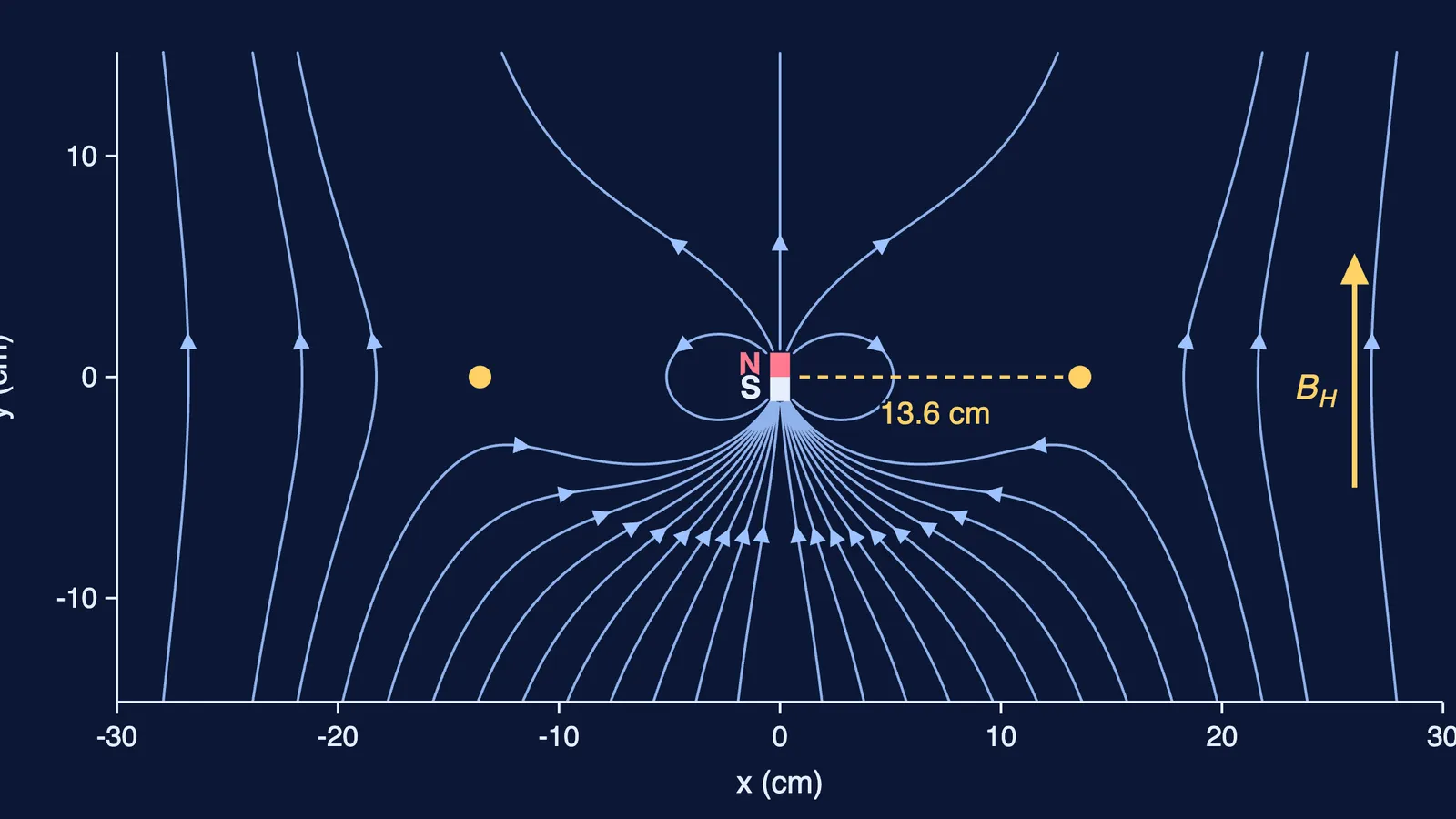
Q6 (medium). A short bar magnet of moment 0.80 A m² lies in the magnetic meridian with its north pole pointing geographic north. The horizontal component of Earth's field there is 3.2 × 10⁻⁵ T. The neutral points are:
(A) 13.6 cm from the centre, on the equatorial line
(B) 13.6 cm from the centre, on the axis
(C) 17.1 cm from the centre, on the axis
(D) 17.1 cm from the centre, on the equatorial line
Answer: (A). On the axis the magnet's field points north, along Earth's, so it cannot cancel. On the equatorial line it points south: (μ₀/4π)m/r³ = B_H gives r³ = 10⁻⁷ × 0.80/(3.2 × 10⁻⁵) = 2.5 × 10⁻³ m³, so r = 13.6 cm. Trap: (C), which uses the axial formula 2m/r³ without checking direction.
Hard: can you add field contributions and track energy?
Q7 (hard). A long wire is bent into a hairpin: two parallel straight parts, each running off to infinity, joined by a semicircle of radius 2.0 cm. It carries 4.0 A. The field at the centre of the semicircle is closest to:
(A) 2.3 × 10⁻⁵ T
(B) 6.3 × 10⁻⁵ T
(C) 1.03 × 10⁻⁴ T
(D) 1.43 × 10⁻⁴ T
Answer: (C). The semicircle gives μ₀I/(4R) = 6.28 × 10⁻⁵ T. Each straight part is semi-infinite and gives μ₀I/(4πR) = 2.0 × 10⁻⁵ T, in the same direction. Total: 6.28 + 4.0 = 10.3 × 10⁻⁵ T. Trap: (D), which treats each straight part as infinite.
Q8 (hard, numerical). A rectangular coil of 50 turns, 8.0 cm × 5.0 cm, carries 0.50 A in a uniform 0.40 T field. It is held with its plane at 30° to the field and then released. Find the kinetic energy it has on reaching its stable position, in mJ.
Answer: 20. The moment is m = NIA = 50 × 0.50 × 4.0 × 10⁻³ = 0.10 A m². The normal makes 90° − 30° = 60° with the field. With U = −mB cos θ, the energy released is mB(1 − cos 60°) = 0.10 × 0.40 × 0.5 = 0.020 J. Trap: 5, from putting the plane's 30° into the formula.
How should you use this set before JEE Main?
The JEE (Main) 2027 information bulletin gives +4 for a correct answer and −1 for a wrong one in both sections, and numerical answers are rounded to the nearest integer.
Do all eight in 24 minutes, no calculator.
Mark each one sure, unsure or guessed before you check.
For every miss, write which trap caught you: wrong formula, wrong angle, missed direction, or forgotten resistance.
Three days later, redo the misses with your own numbers.
If a trap keeps returning, read our guide on how to prepare moving charges and magnetism for JEE Main. For Q6, see the field of a bar magnet on its axis and equator; for Q8, work done to rotate a current loop in a field. For more practice, the Fermi Problem Library has worked problems with a step-by-step solver that explains the reasoning rather than printing an answer.