On this page
Here are eight new JEE Main questions on atoms and nuclei, easy to hard, each with a worked solution and the trap: the wrong option a hurried student picks.
Unit 18 of the NTA Syllabus for JEE (Main) - 2027 covers alpha-particle scattering, the Bohr model, energy levels, the hydrogen spectrum, nuclear size, mass defect, binding energy per nucleon, fission and fusion. Radioactive decay law is not listed, so no question uses it. New to the chapter? Start with our guide on how to prepare atoms and nuclei for JEE Main.
How should you use this practice set?
The JEE (Main) 2027 information bulletin gives +4 for a correct answer and −1 for a wrong one in both the multiple-choice and numerical-value sections, so a blind guess costs you.
Allow 16 minutes for all eight questions.
Cover each solution and choose first.
Q5 is numerical-value: type an integer, no options.
For every miss, write the trap in one line in your own words.
You need four NCERT Class 12 results. From Chapter 12, Atoms: the hydrogen energy levels are En = −13.6/n² eV, and the electron's angular momentum is L = nh/2π. From Chapter 13, Nuclei: nuclear radius is R = R0A^(1/3) with R0 = 1.2 fm, and 1 u = 931.5 MeV/c².
From NIST's CODATA values: hc ≈ 1240 eV nm, from the Planck constant in eV, and e²/4πε0 ≈ 1.44 MeV fm, from the fine-structure constant times ħc in MeV fm.
Easy: can you apply the core formulas?
Q1 (easy). A nucleus with mass number 64 has radius R. What is the radius of a nucleus with mass number 343?
(A) 5.36R (B) 2.32R (C) 1.75R (D) 3.06R
Answer: (C). R ∝ A^(1/3). The cube root of 64 is 4 and of 343 is 7, so the radius is 7R/4 = 1.75R. Trap: (A) scales the radius with A itself. Volume, not radius, grows with A.
Q2 (easy). A hydrogen atom is already in the n = 3 state. What is the minimum energy needed to ionise it?
(A) 12.09 eV (B) 1.51 eV (C) 13.6 eV (D) 4.53 eV
Answer: (B). E3 = −13.6/9 = −1.51 eV, and ionising means reaching E = 0, so 1.51 eV is enough. Trap: (A) is the energy to lift the atom from n = 1 to n = 3.
Q3 (easy). An alpha particle with kinetic energy 4.7 MeV heads straight at a silver nucleus (Z = 47). Taking e²/4πε0 = 1.44 MeV fm, what is the distance of closest approach?
(A) 14.4 fm (B) 28.8 fm (C) 57.6 fm (D) 7.2 fm
Answer: (B). At the turning point K = (2e)(Ze)/4πε0d, so d = 2 × 47 × 1.44/4.7 = 28.8 fm. Trap: (A) gives the alpha particle a charge of e instead of 2e.
Medium: which hydrogen transition is it?
Q4 (medium). An electron in a hydrogen atom drops from n = 5 to n = 3. The emitted photon has wavelength
(A) 684 nm, visible (B) 434 nm, visible (C) 1282 nm, ultraviolet (D) 1282 nm, infrared
Answer: (D). ΔE = 13.6(1/9 − 1/25) = 0.967 eV, so λ = 1240/0.967 ≈ 1282 nm, in the infrared. Trap: (A) uses 1/n in place of 1/n².
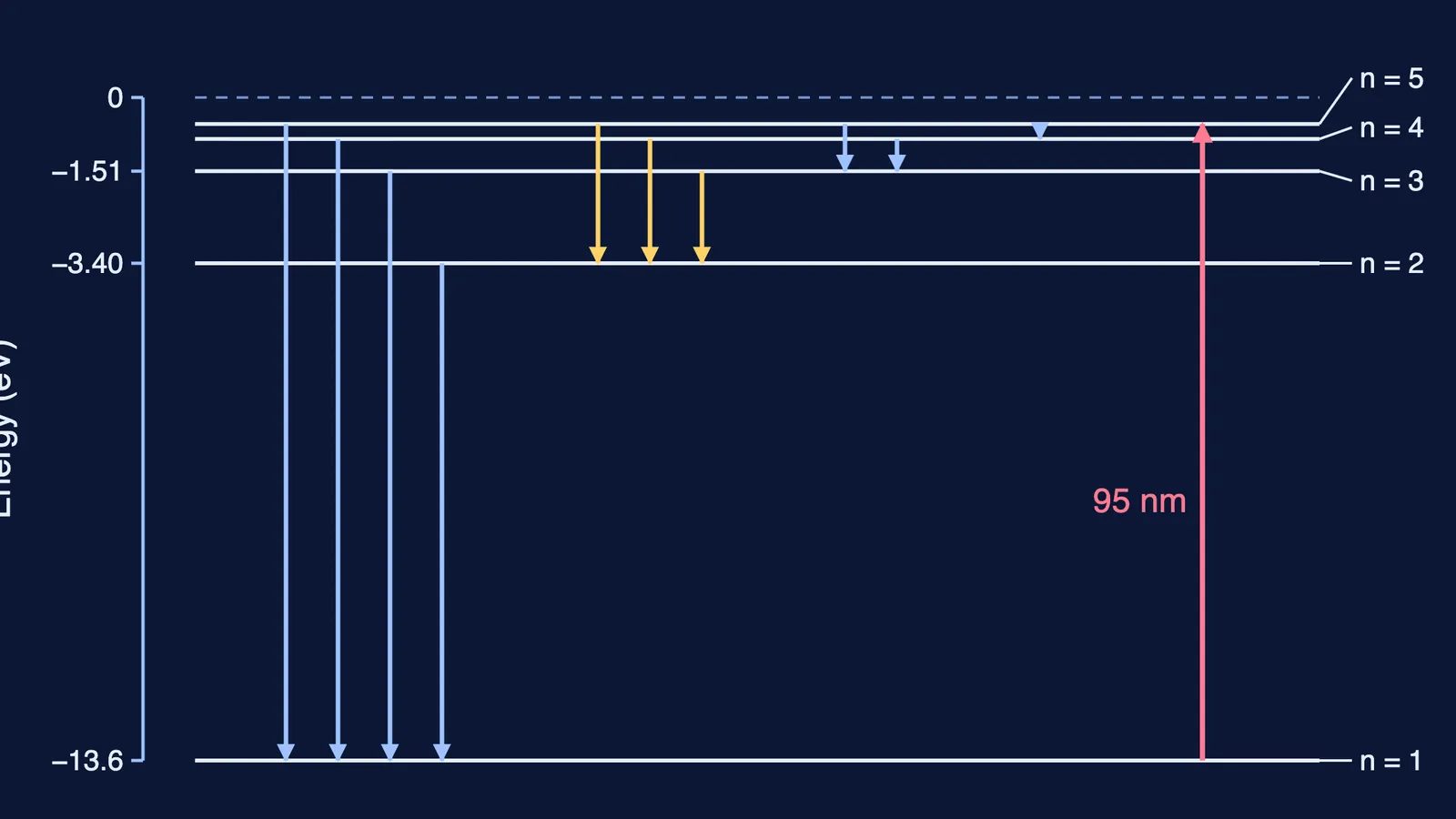
Q5 (medium, numerical). Ground-state hydrogen atoms absorb photons of wavelength about 95 nm, each rising to one excited level. Returning to the ground state by every possible route, how many different wavelengths can they emit?
Answer: 10. The photon energy is 1240/95 ≈ 13.05 eV, and E5 − E1 = 13.6(1 − 1/25) = 13.06 eV, so the atoms reach n = 5. Any pair of the five levels gives a line: 5 × 4/2 = 10. Trap: answering 4, which counts only direct jumps from n = 5.
Q6 (medium). Using m(¹H) = 1.007825 u, m(n) = 1.008665 u, m(¹²C) = 12.000000 u and 1 u = 931.5 MeV/c², the binding energy per nucleon of carbon-12 is
(A) 7.68 MeV (B) 7.42 MeV (C) 92.2 MeV (D) 15.36 MeV
Answer: (A). Mass defect = 6(1.007825) + 6(1.008665) − 12.000000 = 0.098940 u. Binding energy = 0.098940 × 931.5 = 92.16 MeV, and dividing by 12 nucleons gives 7.68 MeV. The AME2020 atomic mass evaluation lists 7.680 MeV for carbon-12. Trap: (B) uses the bare proton mass with an atomic mass for carbon, so six electron masses no longer cancel.
Hard: can you handle two steps at once?
Q7 (hard). In a hydrogen atom the electron's angular momentum is 3h/π. It drops to the orbit where its angular momentum is h/π. Taking hc = 1240 eV nm, the emitted wavelength is
(A) 103 nm (B) 274 nm (C) 410 nm (D) 656 nm
Answer: (C). L = nh/2π, so 3h/π = 6(h/2π) gives n = 6, and h/π gives n = 2. ΔE = 13.6(1/4 − 1/36) = 3.02 eV, and λ = 1240/3.02 ≈ 410 nm, a violet line. Trap: (A) reads 3h/π as n = 3 and h/π as n = 1, forgetting the 2π.
Q8 (hard). A nucleus with A = 236 and binding energy 7.59 MeV per nucleon splits into a fragment with A = 140 (8.38 MeV per nucleon), a fragment with A = 94 (8.59 MeV per nucleon) and two free neutrons. The energy released is about
(A) 211 MeV (B) 189 MeV (C) 1981 MeV (D) 1791 MeV
Answer: (B). Products: 140 × 8.38 + 94 × 8.59 = 1980.7 MeV; free neutrons have no binding energy. Parent: 236 × 7.59 = 1791.2 MeV. Energy released = 1980.7 − 1791.2 ≈ 189 MeV. Trap: (A) averages 8.38 and 8.59, subtracts 7.59 and multiplies by 236, as if all 236 nucleons ended up bound.
What should you do after this set?
Sort your misses, for example formula slips (Q2, Q4), factor slips (Q3, Q6) or two-step slips (Q7, Q8). Rework that kind for two days, then retry the set.
For Q4, Q5 and Q7, see the series limit in the hydrogen spectrum; for Q6 and Q8, read the binding energy per nucleon curve explained.
If you keep picking the right formula but the wrong method, the Fermi Problem Library has worked problems with a step-by-step solver that explains the reasoning rather than printing an answer.