On this page
Dual Nature is a short NEET Physics unit that rewards a clean energy balance. These eight original questions climb from an intensity check to the de Broglie wavelength of a photoelectron, and each answer names the trap behind the tempting wrong option.
What does NEET test in Dual Nature of Matter and Radiation?
The NEET (UG)-2026 syllabus from the National Medical Commission lists Dual Nature of Matter and Radiation as Unit 17 of Physics: the photoelectric effect, Hertz and Lenard's observations, Einstein's equation, the particle nature of light and the de Broglie relation. The matching NCERT text is Chapter 11 of Class 12 Physics Part II, marked Reprint 2026-27. Every question stays inside both.
For NEET (UG)-2026, the NTA information bulletin sets 45 Physics questions, each with four options and one correct or best answer, marked +4 for correct, −1 for wrong and 0 if left blank.
New to the chapter? Start with our guide on how to prepare Dual Nature of Matter and Radiation for NEET.
How should you attempt these questions?
Cover the answers. Allow a minute per easy question, two per hard one.
Write the relation first: E = hc/λ, K(max) = hν − φ = eV₀, or λ = h/p.
Stay in electronvolts; convert to joules only for momentum or current.
Read every trap and list the ones that caught you.
Take h = 6.63 × 10⁻³⁴ J s, e = 1.6 × 10⁻¹⁹ C, electron mass = 9.1 × 10⁻³¹ kg and hc = 1240 eV nm throughout.
Easy: photons, threshold and intensity
Q1 (easy). Light above threshold frequency falls on a metal plate. Its intensity is tripled at the same frequency. What happens?
(A) Saturation current triples; stopping potential unchanged (B) Both triple (C) Stopping potential triples; saturation current unchanged (D) Saturation current triples; stopping potential rises by √3
Answer: (A). More intensity means more photons per second, so more saturation current. Each photon still carries hν, so stopping potential is unchanged.
Trap: (B) and (C) assume brighter light gives faster electrons. Here is why it does not.
Q2 (easy). A metal has a work function of 2.48 eV. Which wavelength will NOT eject photoelectrons from it?
(A) 380 nm (B) 450 nm (C) 495 nm (D) 540 nm
Answer: (D). Threshold wavelength = 1240/2.48 = 500 nm. Only shorter wavelengths carry enough energy per photon.
Trap: (A) treats shorter wavelength as weaker light. Photon energy rises as wavelength falls.
Q3 (easy). What is the momentum of a single photon of wavelength 663 nm?
(A) 1.0 × 10⁻²⁷ kg m/s (B) 3.0 × 10⁻¹⁹ kg m/s (C) 3.3 × 10⁻³⁶ kg m/s (D) 4.4 × 10⁻⁴⁰ kg m/s
Answer: (A). p = h/λ = (6.63 × 10⁻³⁴)/(663 × 10⁻⁹) = 1.0 × 10⁻²⁷ kg m/s.
Trap: (B) is the photon's energy, hc/λ, in joules.
Medium: stopping potential, photocurrent and matter waves
Q4 (medium). Light of 248 nm gives a stopping potential of 1.5 V on a metal. The wavelength is halved to 124 nm. What is the new stopping potential?
(A) 0.75 V (B) 3.0 V (C) 6.5 V (D) 8.5 V
Answer: (C). At 248 nm the photon carries 5.0 eV, so φ = 5.0 − 1.5 = 3.5 eV. At 124 nm it carries 10.0 eV, so V₀ = 10.0 − 3.5 = 6.5 V.
Trap: (B) doubles the stopping potential. Only the photon energy doubles; the work function does not.
Q5 (medium). A 4.0 mW beam of 496 nm light falls on a metal of work function 2.0 eV. One photon in 400 ejects an electron. What is the saturation photocurrent?
(A) 1.6 mA (B) 4.0 µA (C) 20 µA (D) 4.0 mA
Answer: (B). Photon energy = 1240/496 = 2.5 eV = 4.0 × 10⁻¹⁹ J, so 10¹⁶ photons arrive per second, giving 2.5 × 10¹³ electrons per second. I = 2.5 × 10¹³ × 1.6 × 10⁻¹⁹ = 4.0 µA.
Trap: (C) divides the power by the electrons' 0.5 eV kinetic energy. Count photons with their full energy; the work function is a distractor.
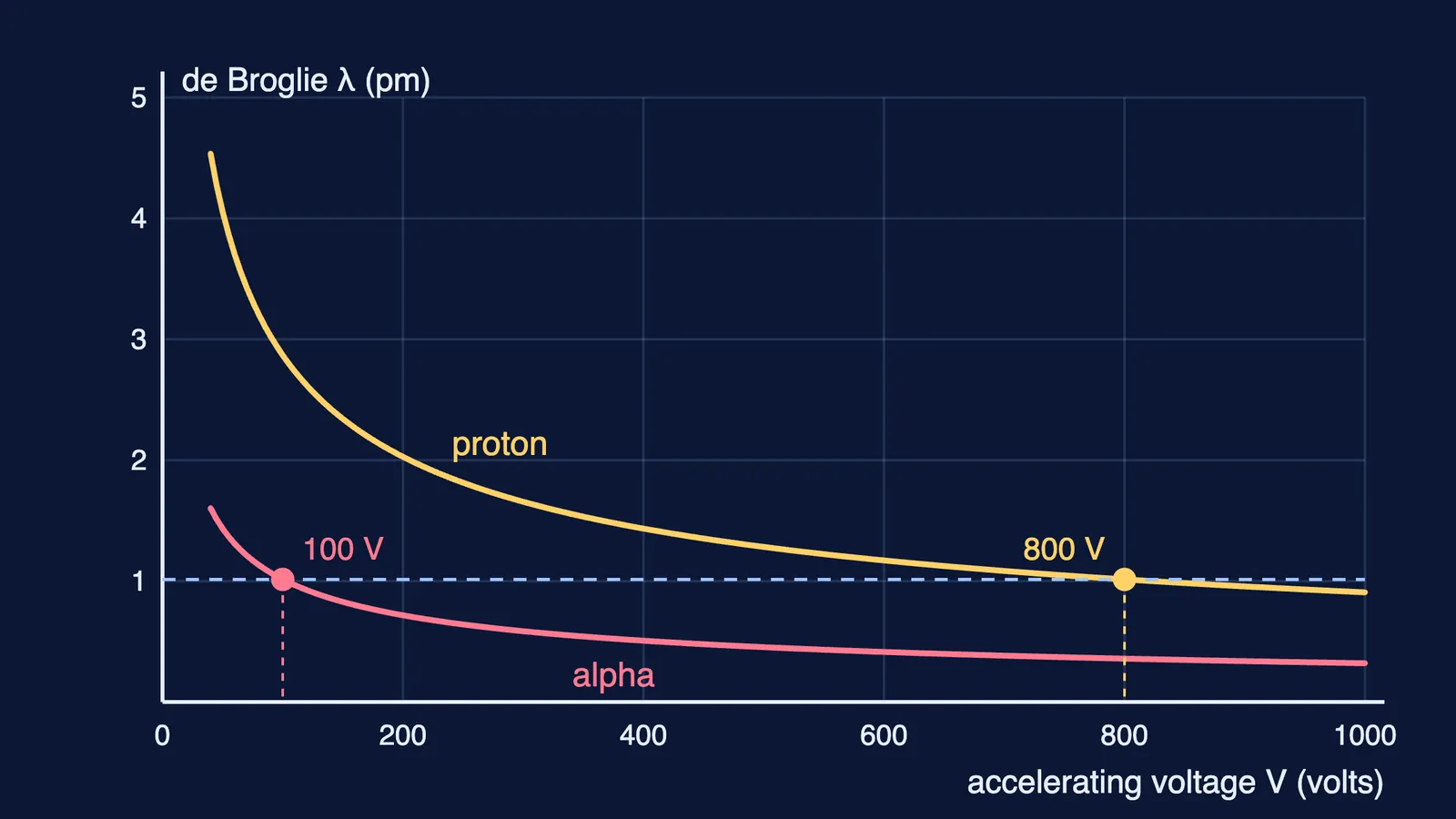
Q6 (medium). A proton accelerated from rest through 800 V has the same de Broglie wavelength as an alpha particle (four times the proton's mass, charge 2e) accelerated from rest through V. Find V.
(A) 100 V (B) 200 V (C) 400 V (D) 1600 V
Answer: (A). λ = h/√(2mqV). Equal wavelengths need equal mqV: m × e × 800 = 4m × 2e × V, so V = 100 V.
Trap: (B) forgets the alpha particle's double charge, which doubles the energy it gains per volt.
Hard: two metals and a photoelectron's wavelength
Q7 (hard). For metals P and Q, stopping potential against frequency gives straight lines cutting the frequency axis at 5.0 × 10¹⁴ Hz and 7.0 × 10¹⁴ Hz. Light of 1.0 × 10¹⁵ Hz falls on each. What is V₀(P) − V₀(Q)?
(A) zero (B) 0.83 V (C) 1.24 V (D) 2.07 V
Answer: (B). Both lines have slope h/e = 4.14 × 10⁻¹⁵ V s, so the gap is (h/e)(2.0 × 10¹⁴) = 0.83 V, with P higher.
Trap: (A) mistakes equal slopes for equal values. Parallel lines with different intercepts stay a fixed gap apart.
Q8 (hard). Ultraviolet light of 155 nm falls on a metal with work function 4.0 eV. What is the de Broglie wavelength of the fastest photoelectrons?
(A) 0.31 nm (B) 0.43 nm (C) 0.61 nm (D) 155 nm
Answer: (C). K(max) = 1240/155 − 4.0 = 4.0 eV = 6.4 × 10⁻¹⁹ J. p = √(2mK) ≈ 1.08 × 10⁻²⁴ kg m/s, so λ = h/p ≈ 0.61 nm.
Trap: (B) gives the electron the full 8.0 eV, skipping the work function.
What should you do after this set?
Score yourself at +4/−1 and group your mistakes by trap. If the energy balance tripped you, rework Q4 and Q8 cold, then try our photoelectric effect problems and their traps.
If a solution step still feels unclear, the Fermi Problem Library has worked problems with a step-by-step solver that explains the reasoning rather than printing an answer.