On this page
These eight NEET-UG Physics questions were written for this post, not taken from NCERT, the exemplar or past papers.
Which parts of rotational motion does NEET test?
The National Medical Commission's updated syllabus for NEET (UG)-2026 lists Rotational Motion as Physics Unit 5, from centre of mass and torque to angular momentum and moment of inertia. Rolling motion is not named there, so it is left out.
Chapter 6 of the NCERT Class 11 Physics textbook, Reprint 2026-27, does not include the parallel and perpendicular axes theorems, so each question gives the moment of inertia or builds it from point masses.
In NEET-UG 2026, the NTA information bulletin gave +4 for a correct answer and −1 for a wrong one.
How should you use this practice set?
Cover the solutions. Allow a minute per easy question, two per hard one.
Name the axis and the equation linking the quantities before calculating.
Read the trap line even when you got it right, and redo misses two days later.
New to the chapter? Start with our guide on how to prepare rotational motion for NEET. The linear and rotational analogues, side by side, help with Questions 3, 6 and 8.
When a solution's method is unclear, the Fermi Problem Library has worked problems with a step-by-step solver that explains the reasoning rather than printing an answer.
Easy: centre of mass, torque and angular kinematics
Q1 (easy). A 3 kg ball and a 1 kg ball are joined by a light rod 40 cm long. How far is the centre of mass from the 3 kg ball?
(A) 10 cm (B) 20 cm (C) 30 cm (D) 13.3 cm
Answer: (A). Put the 3 kg ball at x = 0: x_cm = (3 × 0 + 1 × 40)/(3 + 1) = 10 cm.
Trap: (C) is the distance from the 1 kg ball.
Q2 (easy). A force F = (2i + 3j) N acts at a point whose position vector is r = (4i − j) m. What is the torque about the origin?
(A) 14k N m (B) −14k N m (C) 10k N m (D) 5 N m
Answer: (A). τ = r × F, so τ_z = x·F_y − y·F_x = 4 × 3 − (−1) × 2 = 12 + 2 = 14, so τ = 14k N m.
Trap: (B) works out F × r, which has the opposite sign.
Q3 (easy). A potter's wheel starts from rest and, with uniform angular acceleration, reaches 12 rad/s in 3 s. Through what angle does it turn during the third second alone?
(A) 10 rad (B) 18 rad (C) 8 rad (D) 12 rad
Answer: (A). α = 12/3 = 4 rad/s². Angle in 3 s = ½ × 4 × 3² = 18 rad; in 2 s = ½ × 4 × 2² = 8 rad. The third second covers 18 − 8 = 10 rad.
Trap: (B) is the angle for all three seconds, not just the last one.
Medium: radius of gyration, balance and moment of inertia
Q4 (medium). A uniform disc of radius 0.3 m spins about a diameter, where I = MR²/4. What is its radius of gyration?
(A) 0.15 m (B) 0.21 m (C) 0.075 m (D) 0.19 m
Answer: (A). Mk² = MR²/4, so k = R/2 = 0.15 m.
Trap: (B) is R/√2, for the axis perpendicular to the disc.
Q5 (medium). A uniform 2.0 m beam of mass 8 kg is hinged to a wall at its left end and held horizontal by a vertical rope tied to its right end. A 6 kg box sits on the beam 0.5 m from the hinge. Take g = 10 m/s². What is the tension in the rope?
(A) 85 N (B) 15 N (C) 55 N (D) 70 N
Answer: (C). Take moments about the hinge, which removes the hinge force: T × 2.0 = 80 × 1.0 + 60 × 0.5 = 110, so T = 55 N.
Trap: (B) forgets the beam's own 80 N weight acting at its middle. (A) is the hinge force, 140 − 55 N.
Q6 (medium). Four 0.5 kg point masses sit at the corners of a light square frame of side 0.4 m. The frame turns about an axis through its centre, perpendicular to its plane. A constant torque of 0.32 N m acts from rest. What is its angular speed after 2 s?
(A) 2 rad/s (B) 4 rad/s (C) 8 rad/s (D) 1 rad/s
Answer: (B). Each mass is half a diagonal from the axis: r² = (0.4/√2)² = 0.08 m². So I = 4 × 0.5 × 0.08 = 0.16 kg m², α = 0.32/0.16 = 2 rad/s² and ω = 2 × 2 = 4 rad/s.
Trap: (A) takes the side, 0.4 m, as each mass's distance from the axis.
Hard: angular momentum and power
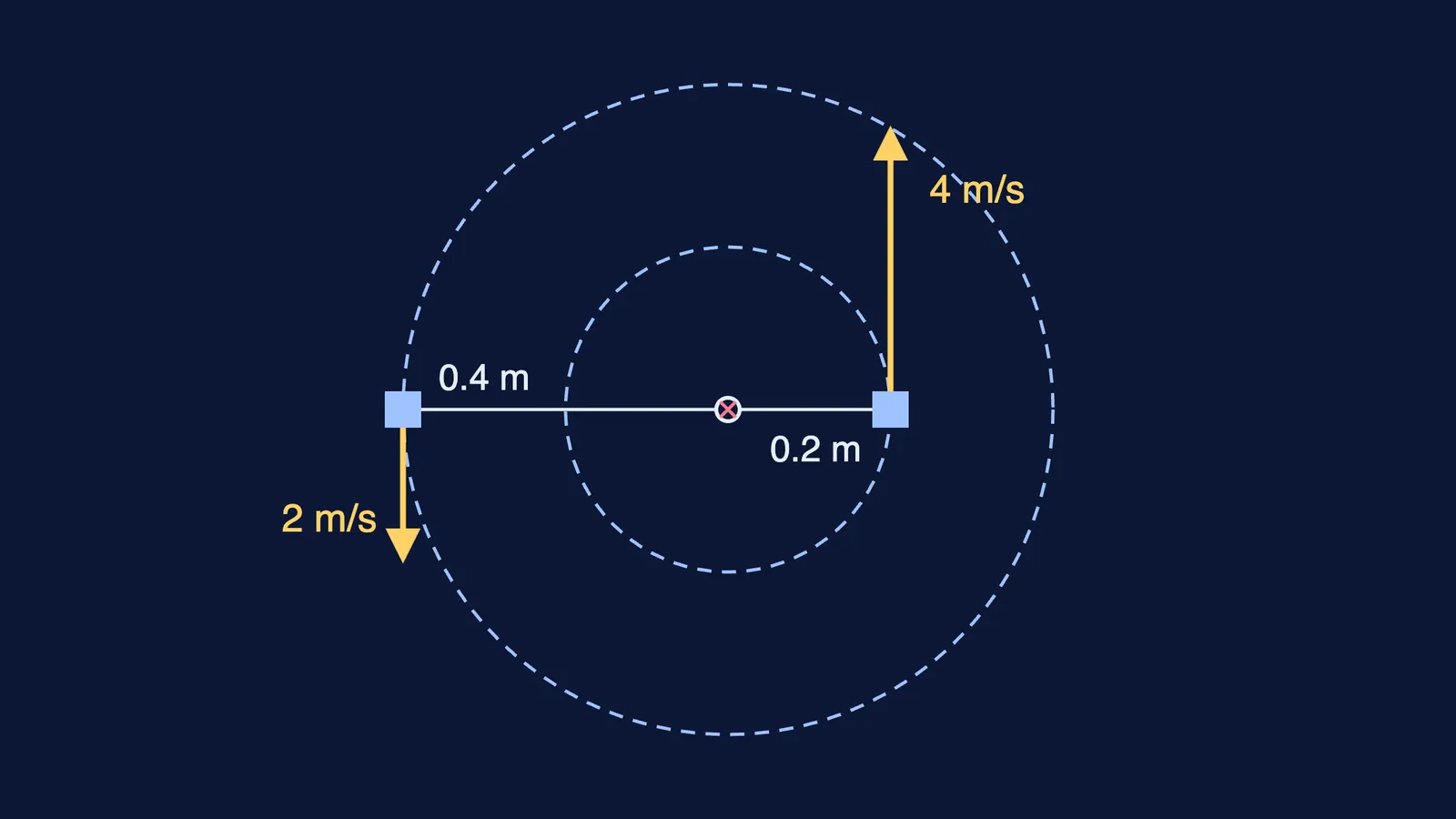
Q7 (hard). A 0.5 kg block moves in a circle of radius 0.4 m at 2 m/s on a frictionless horizontal table, held by a string through a small hole at the centre. The string is slowly pulled down until the radius is 0.2 m. How much work does the pull do?
(A) 0 J (B) 3 J (C) 4 J (D) 15 J
Answer: (B). The string pulls towards the hole, so it exerts no torque about it and mvr is conserved: v₂ = 2 × 0.4/0.2 = 4 m/s. Work = ½ × 0.5 × (4² − 2²) = 3 J.
Trap: (A) assumes kinetic energy is conserved too, but the pull does positive work.
Q8 (hard). A constant torque of 4 N m acts on a wheel of moment of inertia 2 kg m², starting from rest on a frictionless axle. What power does the torque deliver at t = 5 s?
(A) 20 W (B) 40 W (C) 100 W (D) 160 W
Answer: (B). α = 4/2 = 2 rad/s², so ω = 2 × 5 = 10 rad/s, and P = τω = 4 × 10 = 40 W.
Trap: (A) is the average power, 100 J/5 s; instantaneous power grows with ω.
What should you do after checking your answers?
Easy misses usually mean a formula or sign slip; hard misses usually mean mixing up energy and angular momentum. For Question 7, see why a skater spins faster when pulling her arms in.