On this page
Sit on a spinning chair, hold your arms out, and pull them in. You speed up, though nobody pushed you. A figure skater does the same on ice. Here is why, plus a small spinning-chair model to check the rule yourself: angular speed goes up while angular momentum stays the same.
Why does a skater spin faster when pulling their arms in?
For a body turning about a fixed axis, angular momentum is L = Iω, the moment of inertia times the angular speed (NCERT Class 11 Physics, Chapter 6, section 6.12).
The moment of inertia is I = Σmr², the sum of each bit of mass times the square of its distance from the axis (same NCERT chapter).
When the total external torque is zero, Iω stays constant; NCERT writes this as its Equation 6.44 and uses a swivel chair to show it.
Pulling your arms in moves mass closer to the axis, I falls, and ω has to rise to keep the product fixed. Because r is squared, bringing a hand to half its distance cuts that hand's share of I to a quarter. OpenStax University Physics, section 11.3 states the skater version as I′ω′ = Iω, where the primed values come after the arms are pulled in.
If angular momentum is fixed, where does the extra spin come from?
Angular momentum is conserved; kinetic energy is not. OpenStax explains that the work the skater does pulling the arms in raises the rotational kinetic energy, so the final energy is larger by the factor I/I′ (OpenStax, section 11.3). Your arm muscles pay for the faster spin. We go through that energy step in more detail in why kinetic energy increases when a skater pulls their arms in.
How do you check it with a spinning-chair simulation?
This model runs on a calculator, using L = Iω and I = Σmr² from the NCERT chapter. The numbers are round values chosen for the example, not measurements of a real person.
The person plus the chair's turning part: I₀ = 2.0 kg m², treated as fixed.
Two dumbbells of 2 kg each, one in each hand.
Start with the dumbbells 0.8 m from the axis, spinning at 1 revolution per second (ω = 2π ≈ 6.283 rad/s).
Now run it in three steps:
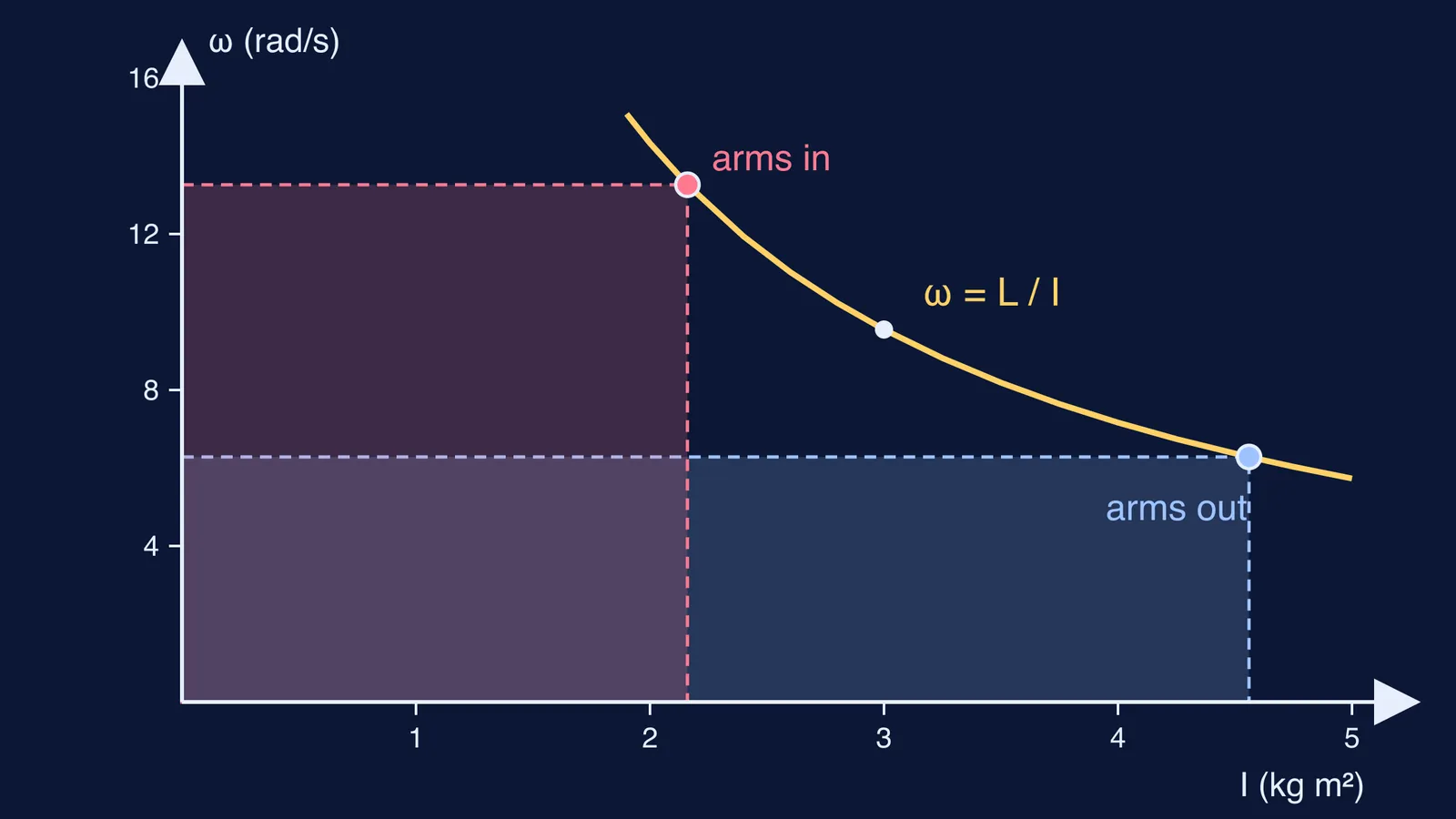
Arms out (r = 0.8 m): I = 2.0 + 2 × 2 × 0.8² = 4.56 kg m². So L = 4.56 × 6.283 ≈ 28.65 kg m²/s, and kinetic energy ½Iω² ≈ 90 J.
Arms halfway (r = 0.5 m): I = 2.0 + 4 × 0.25 = 3.00 kg m². Keep L at 28.65, so ω = 28.65 ÷ 3.00 ≈ 9.55 rad/s, about 1.52 revolutions per second. Kinetic energy ≈ 137 J.
Arms in (r = 0.2 m): I = 2.0 + 4 × 0.04 = 2.16 kg m². Now ω = 28.65 ÷ 2.16 ≈ 13.26 rad/s, about 2.11 revolutions per second. Kinetic energy ≈ 190 J.
Then run three checks on your results:
Multiply I by ω at every step. You should get about 28.65 each time, give or take rounding. That is the conservation law.
Divide the final ω by the starting ω. You get 2.11, the same as 4.56 ÷ 2.16. Speed rises by exactly the factor that I falls.
Divide the final kinetic energy by the starting one. You again get 2.11, the I/I′ factor OpenStax gives. Energy went up; momentum did not.
If you would rather drag a slider than repeat the arithmetic, the Fermi Simulation Lab has interactive simulations for ideas that are easier to see than to read. Change one thing at a time and predict the result before you watch it, the same habit as in our post on three predictions to test in a rotational motion simulation.
Can you try the spinning chair at home?
Yes. NCERT describes it: sit on a swivel chair with your arms folded and feet off the ground, ask a friend to spin the chair fast, then stretch your arms out and your speed drops; fold them again and it rises (NCERT, section 6.12.1). The chapter adds that this works when friction in the chair's pivot is small enough to ignore.
Scientific American's spinning-chair activity suggests holding dumbbells or heavy books to make the change bigger, setting up in the middle of the room with space for outstretched arms, and using a carpeted floor so the chair's wheels stay put. Keep the spins short and stop if you feel dizzy.
What mistakes do students make in exam answers?
Saying angular momentum increases when the skater speeds up. It stays the same; ω goes up because I goes down.
Saying kinetic energy is conserved too. It increases, paid for by the work done pulling the arms in.
Leaving the body out of I. The NCERT definition of moment of inertia sums every bit of turning mass, torso and chair included, so ω here rises 2.11 times, not the 16 times the dumbbells alone would suggest.
Mixing units. Ratios work in rev/s, but energy needs rad/s. Our guide to the SI units of moment of inertia, torque and angular momentum lists each one.
When a textbook problem combines this idea with a disc, a bullet or a falling mass, the Fermi Problem Library has worked problems with a step-by-step solver that explains the reasoning rather than printing an answer.
Next time you spin on a chair, pull your arms in slowly and say it out loud: I down, ω up, Iω the same.