On this page
A hot air balloon is Class 11 physics you can watch. The burner does not push the balloon up. It thins out the air inside, and the denser air outside does the lifting. Below we turn that into numbers with PV = nRT.
Why does hot air make a balloon rise?
The buoyant force on an object equals the weight of the fluid it displaces (OpenStax University Physics, Archimedes' principle). For a balloon, the fluid is the surrounding air and the displaced volume is the envelope.
The envelope is open at the bottom, so the pressure inside stays close to the pressure outside. Heated air expands and some spills out through the mouth, so the same volume holds fewer molecules and weighs less. Lift is the displaced air's weight minus the hot air's weight. The first balloonists flew on this principle; see the Montgolfier brothers and the physics of the first balloons.
How do you find air density from PV = nRT?
The ideal gas law is pV = nRT, with R = 8.31 J/(mol·K) (OpenStax University Physics, the ideal gas law). Write the number of moles as mass over molar mass, n = m/M, and divide both sides by V. Density, m/V, becomes:
ρ = PM / RT
Air is about 78% nitrogen, 21% oxygen and 1% argon, which gives a molar mass of 29.0 g/mol, the value OpenStax uses in its own hot air balloon example (OpenStax, Example 2.3). At fixed pressure, density falls as absolute temperature rises: heat air from 288 K to 373 K and its density drops by the ratio 288/373, about 23%.
As a check, NASA's atmosphere model gives sea-level air at about 15 °C a density of about 1.225 kg/m³ (NASA Glenn Research Center, Earth atmosphere model).
Worked example: how much can a 2000 m³ balloon lift?
Take a 2000 m³ envelope at sea level, P = 101 325 Pa, outside air at 15 °C and inside air heated to 100 °C. Use M = 0.029 kg/mol and R = 8.31 J/(mol·K) from the OpenStax ideal gas chapter.
Convert to kelvin: T_out = 288.15 K, T_in = 373.15 K.
Outside density: ρ_out = (101 325 × 0.029) / (8.31 × 288.15) = 2938.4 / 2394.5 ≈ 1.2271 kg/m³.
Inside density: ρ_in = 2938.4 / (8.31 × 373.15) = 2938.4 / 3100.9 ≈ 0.9476 kg/m³.
Difference: Δρ = 1.2271 − 0.9476 = 0.2795 kg/m³.
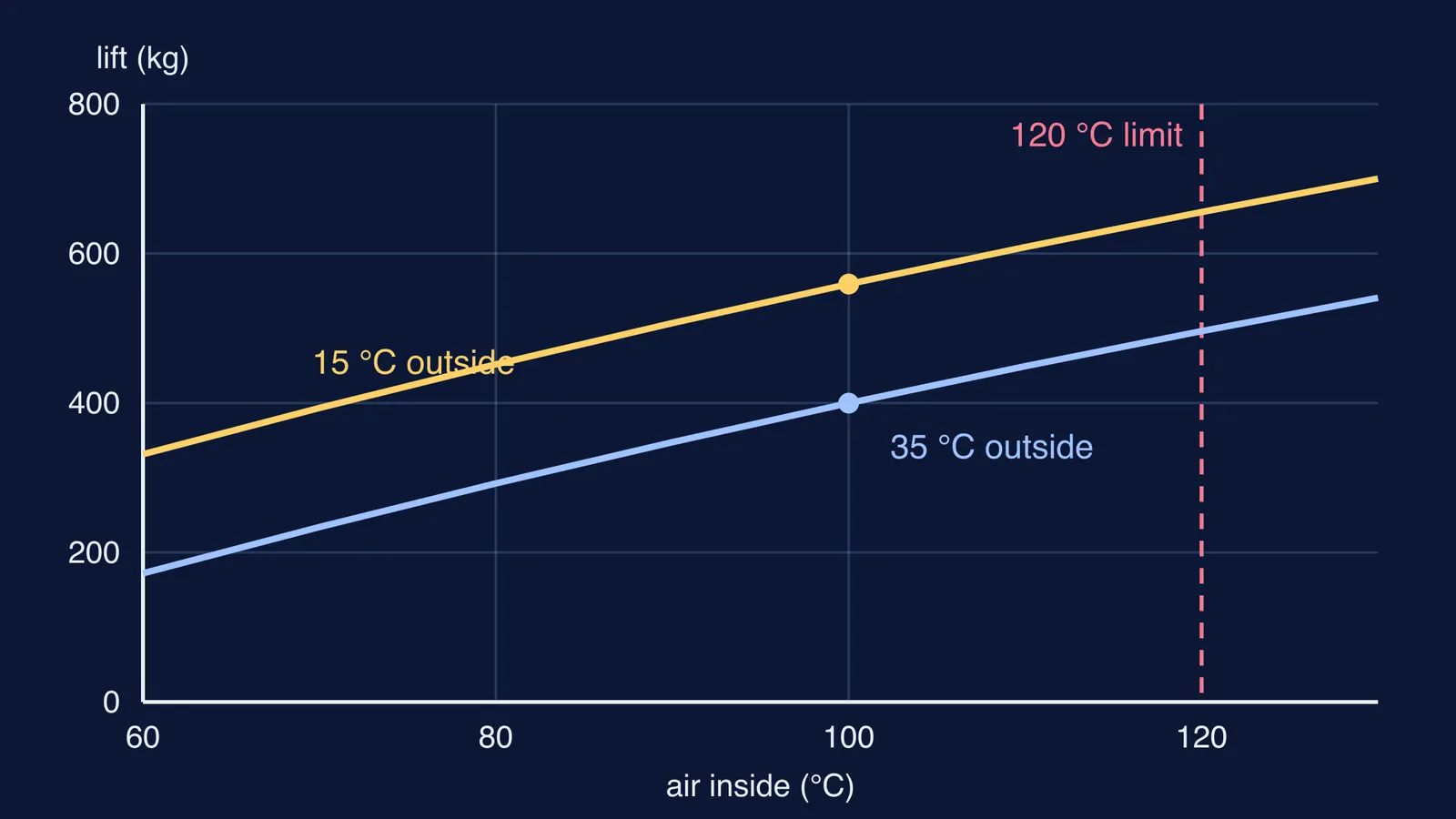
Gross lift: m = V × Δρ = 2000 × 0.2795 ≈ 559 kg.
Payload: subtract the envelope, basket, burners and fuel; the rest carries people.
Push the inside air to 120 °C (393.15 K) and the same steps give ρ_in ≈ 0.8994 kg/m³ and a gross lift of about 656 kg. OpenStax's version, with 0 °C outside air and 2200 m³ at 120 °C, arrives at about 867 kg (OpenStax, Example 2.3).
Why does a balloon lift less on a hot day?
Repeat the calculation with 35 °C outside air (308.15 K), using the OpenStax values for R and M. Outside density falls to about 1.1475 kg/m³, the gap at 100 °C inside shrinks to 0.1999 kg/m³, and gross lift drops to about 400 kg. Lighter outside air costs the same balloon roughly 160 kg.
Why not just heat the air more? The envelope fabric sets a ceiling. The European Union Aviation Safety Agency's type-certificate data sheet for Lindstrand and Sky balloons gives most Lindstrand envelopes a maximum continuous temperature of 125 °C, and says Sky envelopes and Lindstrand special shapes must not exceed 120 °C (250 °F) (EASA type-certificate data sheet BA.021). Even at 120 °C on a 35 °C day, our 2000 m³ envelope gives about 496 kg, less than the 559 kg it managed at 100 °C on a 15 °C morning.
Our post on how hot the air must be to lift a hot air balloon runs the problem the other way, starting from the load.
Which mistakes cost marks in balloon problems?
Putting °C into PV = nRT. The law needs absolute temperature (OpenStax, the ideal gas law), and 100/15 is not 373/288; always add 273.15.
Using M = 29 instead of 0.029 kg/mol with R in J/(mol·K), which makes every density a thousand times too large.
Calling ρ_in × V the lift. The balloon is lifted by the difference in densities, not by the hot air.
Forgetting the balloon's own mass, which gross lift must carry first.
More gas-law traps are collected in ideal gas problems: gas laws, Dalton's law and the units trap.
If your steps look right but the number still comes out wrong, the Fermi Problem Library has worked problems with a step-by-step solver that explains the reasoning rather than printing an answer, so you can find where your method went off. To see density and buoyancy change together, the Fermi Simulation Lab has interactive simulations for ideas that are easier to see than to read.
Try one yourself: a 3000 m³ envelope, 25 °C outside, 100 °C inside. Does it clear 700 kg of gross lift? (It should come to about 715 kg.)