

On this page
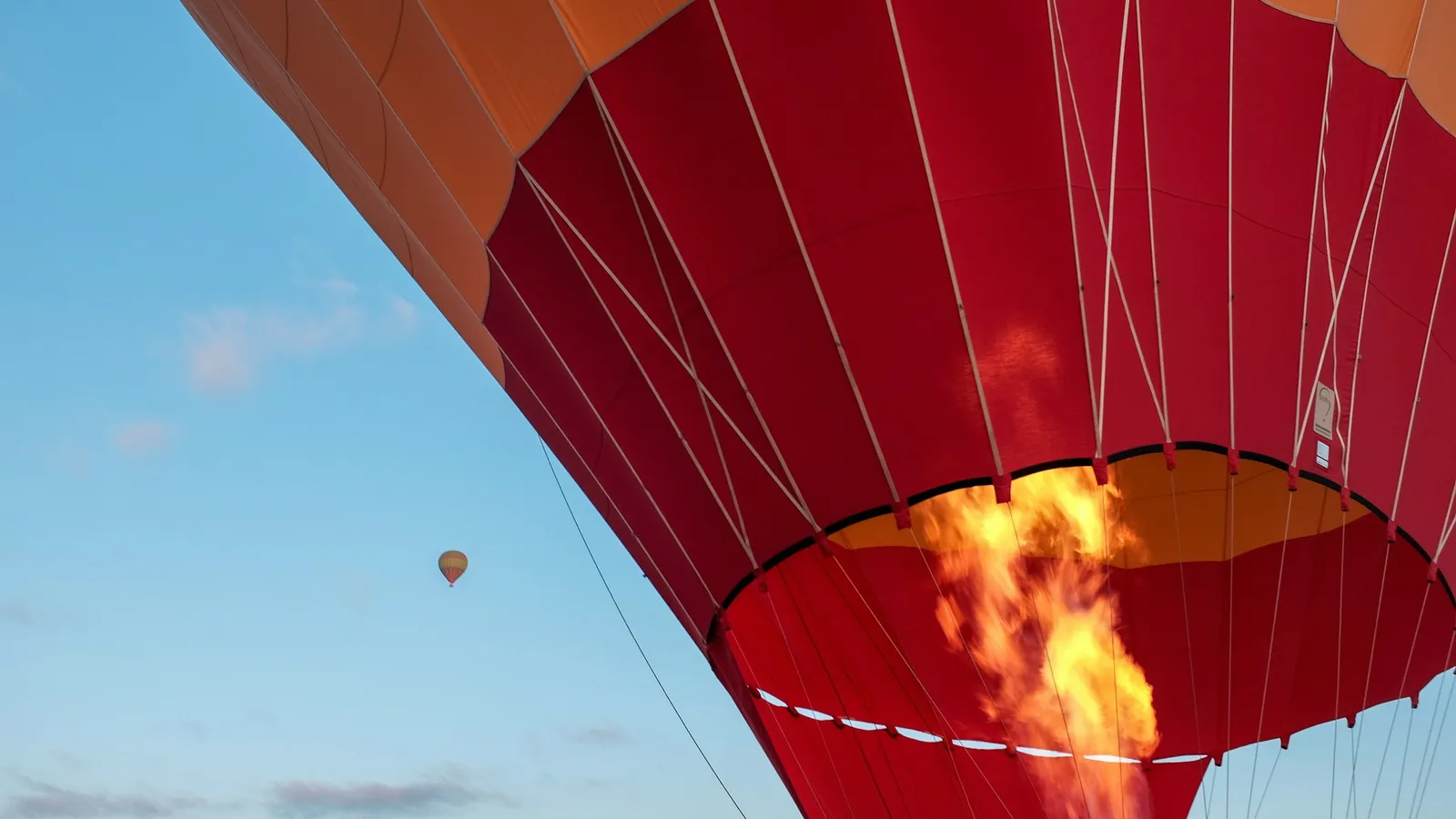
Every hot-air balloon you have seen is an exercise in Archimedes' principle and the gas laws. The first ones were built in 1783 by two brothers who ran a paper mill and who, at first, had the physics wrong. This post tells their story with dates from reliable sources, explains why hot air rises, and works through a lift calculation you can do with Class 11 physics.
For the hydrogen balloon flown the same year by Jacques Charles, see our post on Charles and his gas law. This one is about hot air.
Who were the Montgolfier brothers?
Britannica gives their dates. Joseph-Michel was born in Annonay, France, on 26 August 1740 and died at Balaruc-les-Bains on 26 June 1810. Jacques-Étienne was born in Annonay on 6 January 1745 and died on 2 August 1799, on the road from Lyon to Annonay. They were two of the 16 children of Pierre Montgolfier, whose paper factories at Vidalon, near Annonay, paid for their experiments.
What did they think made the balloon rise?
According to the US Centennial of Flight Commission's history of early balloon flight, the brothers saw that smoke rises and that paper bags held over a fire swell and float up. They believed they had found a new gas, which they called "Montgolfier gas". In fact it was ordinary air, made lighter per cubic metre by heating.
Britannica dates the key discovery to 1782: heated air collected in a large, light paper or fabric bag made the bag rise. The commission's history says they tested balloons from about 1.1 to 18.4 cubic metres, which rose 27 to 183 metres.
What happened in 1783?
4 June, Annonay. The first public demonstration, in the town marketplace. They filled the balloon by burning straw and wool under its open neck. Britannica says it rose about 1,000 metres, stayed up some 10 minutes and landed more than a mile and a half away. The commission's history describes it as about 10 metres across and gives a height of about 2,000 metres, so sources differ on the height.
19 September, Versailles. A larger balloon carried a sheep, a rooster and a duck. It flew for about 8 minutes and landed safely about 3.2 km away, in front of King Louis XVI and the court.
21 November, Paris. Jean-François Pilâtre de Rozier and the marquis d'Arlandes made the first crewed untethered flight, travelling about 9 km in about 25 minutes.
The Académie des Sciences honoured both brothers. Britannica adds that Joseph later invented a calorimeter and the hydraulic ram, and Étienne developed a process for making vellum.
Why does hot air lift a balloon?
A balloon floats when the air it pushes aside weighs more than the balloon and everything in it. That is buoyancy, covered in our post on Archimedes and buoyancy.
The ideal gas law from NCERT's Class 11 chapter on kinetic theory tells you how density depends on temperature. Rearranged, density is ρ = PM ÷ (RT). The neck of a hot-air balloon is open, so the pressure inside equals the pressure outside. With P and M fixed, ρ is proportional to 1/T, where T is in kelvin.
Worked example: lift of a 10 m balloon
Use sample conditions: a spherical envelope 10 m across, outside air at 15 °C (288 K), inside air at 100 °C (373 K), pressure 101,325 Pa, molar mass of air 0.029 kg/mol.
Volume: V = (4/3)π × 5³ = 524 m³.
Outside density: ρ = 101,325 × 0.029 ÷ (8.314 × 288) = 1.227 kg/m³.
Inside density: ρ = 1.227 × 288 ÷ 373 = 0.947 kg/m³.
Difference: 0.280 kg/m³.
Gross lift: 0.280 × 524 ≈ 147 kg, a force of about 147 × 9.81 ≈ 1,440 N.
That 147 kg has to carry the envelope, ropes, fuel and passengers. Notice how weak hot air is as a lifting gas: each cubic metre lifts less than 0.3 kg. That is why crewed balloons had to be so large.
Common slips:
Forgetting the hot air's own weight. Lift is the weight of displaced cold air minus the weight of the hot air inside, not the full 1.227 kg/m³.
Using Celsius in the ratio. Always convert to kelvin.
Thinking hot air "pulls" the balloon up. The upward push comes from pressure differences in the surrounding air.
Try changing one number at a time. If the inside air is 120 °C (393 K), the inside density falls to 0.899 kg/m³ and lift rises to about 172 kg. For more practice, see our ideal gas problems guide.
What can a student take from the Montgolfiers' way of working?
Start small and scale up. They tested bags of a cubic metre or so before building anything large.
Demonstrate in public. A flight watched by a whole town, or a royal court, is hard to dismiss.
A wrong explanation can still give a working device, but it limits you. "Montgolfier gas" could not tell you how hot to make the air or how big to build. The gas law can.
If buoyancy and gas density are hard to picture together, the Fermi Simulation Lab has interactive simulations for ideas that are easier to see than read.
Next step: find the inside temperature a 524 m³ balloon needs to lift 200 kg in total, using the same outside conditions.


