

On this page
Charles's law is one line in your textbook: at fixed pressure, the volume of a gas is proportional to its absolute temperature. The man it is named after never published it. He was also a pioneering balloonist. This post tells how the law got his name, then works through the numbers so you can use it without the usual slip.
Who was Jacques Charles?
Jacques Charles (1746 to 1823) was a French natural philosopher and balloonist, as the editor's note to the Classic Chemistry edition of Gay-Lussac's 1802 paper describes him. He used hydrogen, rather than hot air, to lift his balloon.
A print in the Smithsonian Libraries image collection, from Gaston Tissandier's history of ballooning, shows "Ascension éxecutée par Charles dans La Prairie de Nesles, le 1 Decémbre 1783". The Smithsonian's note describes it as the first crewed hydrogen balloon taking off on 1 December 1783. The caption places that ascent in the meadow at Nesles, in France.
How did a balloonist end up with a gas law?
The answer is in a paper by Joseph Gay-Lussac read in Paris in early 1802, The Expansion of Gases by Heat. Gay-Lussac found that oxygen, nitrogen, hydrogen, carbon dioxide and air "all expand identically from 0° to 80°". Then he added that "citizen Charles had noticed the same property in these gases 15 years ago; however, since he never published his results, it is only by great luck that I knew it."
So the measurement that fixed the law was Gay-Lussac's, and the name honours Charles because Gay-Lussac was fair about who saw it first. The Science History Institute tells the story the same way. You can read about Gay-Lussac's other law in our post on the law of combining volumes.
What number did Gay-Lussac find?
He reported that between melting ice and boiling water, each permanent gas grows by 100/266.66 of its volume on the centigrade scale. That is 0.375, or 37.5 per cent. The modern value is 100/273.15 = 0.366. His number implies that a gas would shrink to zero volume near −267 °C, close to the modern absolute zero of −273.15 °C.
Worked example: heating a sample of air
A syringe holds 2.00 L of air at 27 °C. It is heated to 87 °C at constant pressure. What is the new volume?
Convert to kelvin. 27 + 273.15 = 300.15 K. 87 + 273.15 = 360.15 K.
Set up the ratio. V2 / V1 = T2 / T1, so V2 = 2.00 × 360.15 / 300.15.
Calculate. V2 = 2.40 L.
The common mistake: using Celsius gives 2.00 × 87 / 27 = 6.44 L. The gas would have more than tripled in volume for a 60 degree rise, which a quick sense check rules out.
The NCERT Class 11 Physics chapter Kinetic Theory derives Charles's law, V ∝ T at fixed pressure, from the perfect gas equation and compares it with measured curves for carbon dioxide at three pressures. The JEE (Main) 2026 syllabus lists the "equation of state of a perfect gas" under kinetic theory. Check the syllabus for your exam year.
Why does a hydrogen balloon rise?
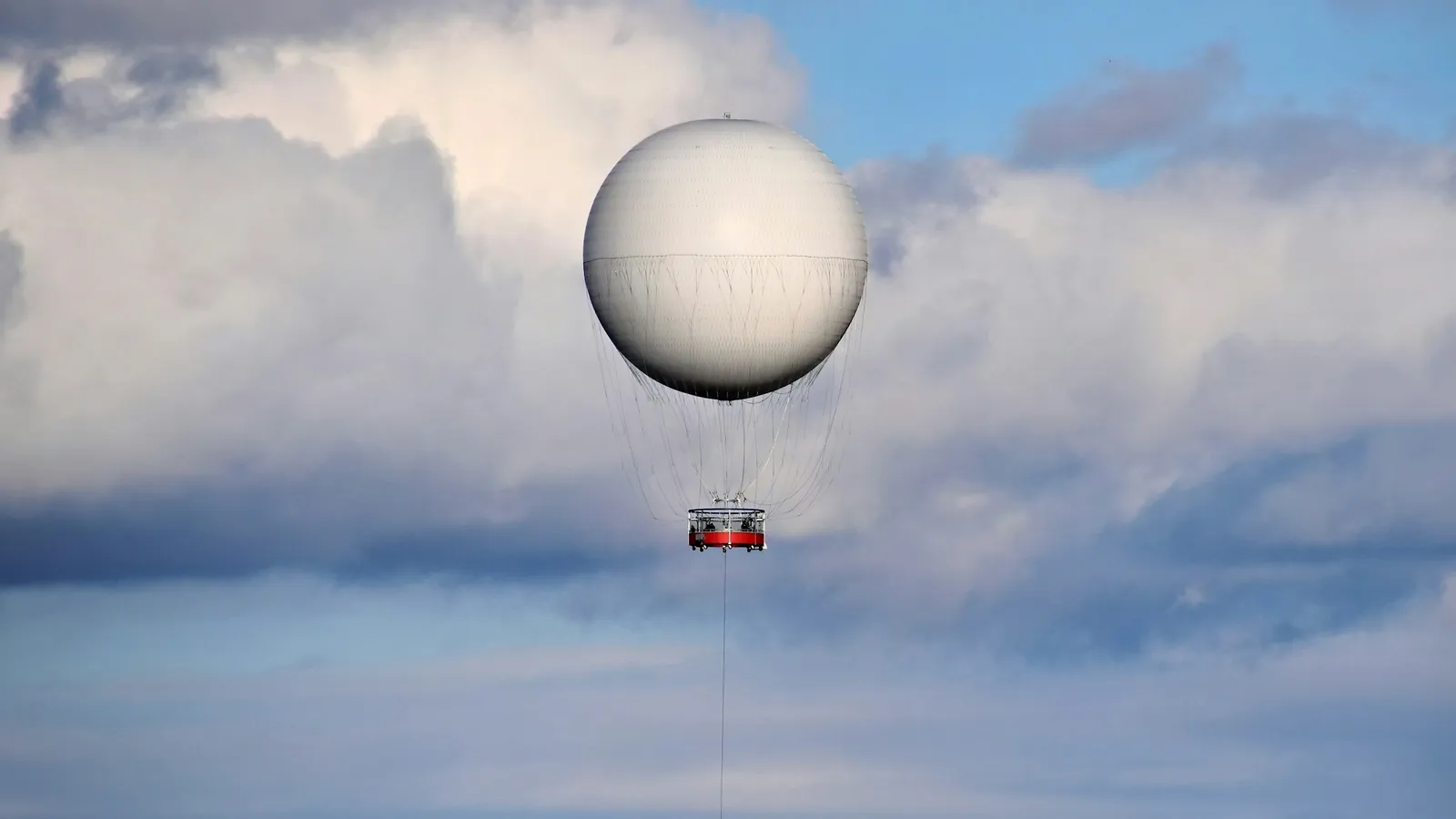
The balloon floats for the same reason a cork does: it weighs less than the air it pushes aside. Hydrogen is much lighter than air at the same temperature and pressure, so a bag of it feels a net upward force. Hot air works the same way, as Charles's law explains. Heating air makes it expand, so a fixed volume of warm air holds less mass than the same volume of cool air.
Which mistakes does this help you avoid?
Celsius in a ratio. Always kelvin, as above.
Changing pressure too. If pressure also changes, use the combined form PV/T = constant. Our post on Robert Boyle and the gas law covers the pressure side.
Expecting it to hold near liquefaction. Real gases depart from the law when cold or compressed.
What can a student take from Charles's way of working?
Match the material to the job. A gas much lighter than air was the key to his balloon.
Write it down and publish. Charles noticed the law first, yet the measurement in print was Gay-Lussac's.
Give credit. Gay-Lussac named another scientist's earlier work in his own paper, and the law carries Charles's name because of it.
If the link between temperature and molecular motion is hard to picture, the Fermi Simulation Lab has interactive simulations for ideas that are easier to see than read.
Try it now: a balloon holds 3.0 L at 15 °C. Find its volume at 45 °C, keeping the pressure fixed.


