

On this page
When you watch a hot air balloon rise, you are seeing the same physics that lifted the first balloons built by the Montgolfier brothers. A balloon floats not because hot air inherently wants to go up, but because it is less dense than cold air. The surrounding cold air pushes up on the balloon harder than gravity pulls it down.
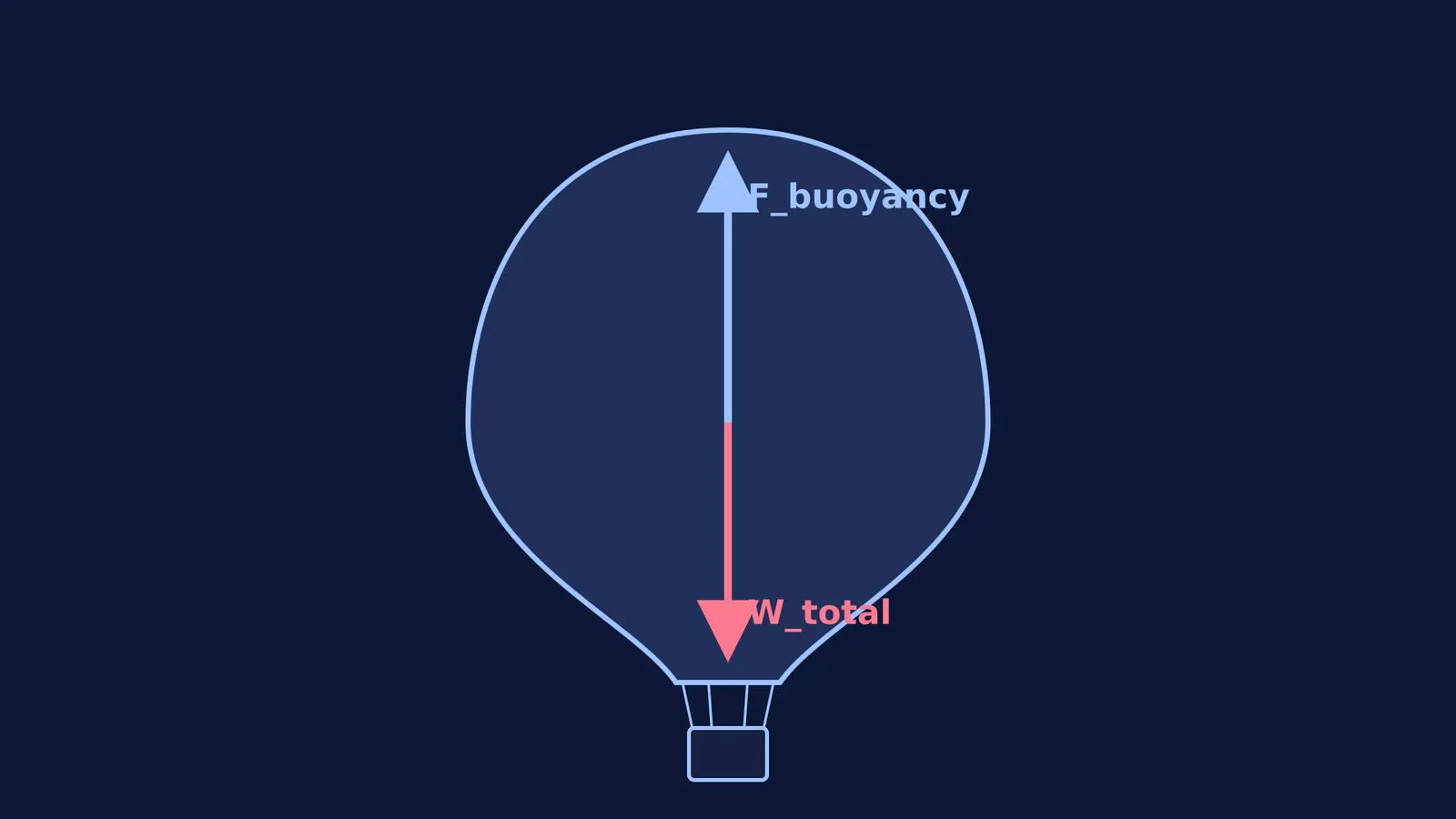
But how hot is hot enough? To find out, you need to balance the upward buoyant force against the total downward weight.
How hot must air be to lift a hot air balloon?
For a balloon to lift off, the buoyant force (the weight of the cold air displaced by the balloon) must be greater than the total weight of the balloon. That total weight includes the basket, the envelope, the passengers, and the hot air itself.
By combining the ideal gas law with the buoyancy equation, we get a direct formula for the required internal temperature (T_hot):
T_hot = T_ambient / [ 1 - (m / (ρ_ambient × V)) ]
Here is what the variables mean, using a typical passenger balloon as an example:
V (Volume): A standard envelope holds 2,800 m³ of air (Wikipedia).
m (Mass): The basket, envelope, fuel, and passengers weigh about 725 kg.
T_ambient (Outside temperature): Let's say it is a mild 20 °C morning, which is 293 Kelvin.
ρ_ambient (Outside air density): At 20 °C near sea level, air density is 1.204 kg/m³ (Engineering ToolBox).
First, find the mass of the cold air the balloon displaces: 1.204 kg/m³ × 2,800 m³ = 3,371.2 kg
Now, put the numbers into the formula: T_hot = 293 / [ 1 - (725 / 3371.2) ] T_hot = 293 / (1 - 0.215) T_hot = 293 / 0.785 = 373 K
Convert 373 K back to Celsius by subtracting 273.15, and you get 100 °C. To get off the ground on a 20 °C day, the pilot must heat the air inside to 100 °C. The difference in density works precisely because the average molar mass of the gas mixture remains the same inside and out.
How does the outside temperature affect a hot air balloon?
If you have ever been to a balloon festival, you know flights almost always happen at dawn. The air is calmest then, but it is also coldest.
Cold air is denser. When the outside air is denser, it provides a stronger buoyant force, which means you do not have to heat the inside air as much to create a weight difference.
Let's run the same balloon on a chilly 10 °C (283 K) morning.
At 10 °C, the outside air density (ρ_ambient) rises to 1.246 kg/m³ (Engineering ToolBox).
The displaced air now weighs 1.246 × 2,800 = 3,488.8 kg.
Using the formula again: T_hot = 283 / [ 1 - (725 / 3488.8) ] T_hot = 283 / (1 - 0.208) T_hot = 283 / 0.792 = 357 K
That is 84 °C.
By launching in 10 °C weather instead of 20 °C, the pilot only needs to heat the balloon to 84 °C. This saves a massive amount of propane and puts less heat stress on the nylon envelope.
How does altitude affect a hot air balloon?
If you are launching from a high altitude, such as a mountain plateau, the ambient air is thinner. Because the starting air density (ρ_ambient) is much lower, the balloon displaces less mass.
To compensate for the thinner air, the pilot has two choices: they must either carry a much lighter payload (reducing m) or heat the inside air to a significantly higher temperature to create the necessary density difference. This is why high-altitude flights push the limits of the nylon fabric, which can begin to weaken if the internal temperature stays above 120 °C (Wikipedia). The same balloon that easily lifts off in a cold valley might not generate enough lift to fly safely on a warm mountain.
Test volume, load and temperature
Calculating these values by hand is good practice for exams, but changing one variable often changes the others. If you want to see how density, temperature, and volume interact in real time, testing them in the Fermi Simulation Lab lets you adjust the payload, shrink the balloon, or drop the outside temperature to freezing. You can watch the forces balance out without having to do the division yourself.


