

On this page
If you have ever written "torque = 12 J" and lost the mark, you are in good company. Torque and energy share base units, so the slip feels logical. The rules say otherwise, and the reason teaches you something about rotation.
What are the SI units of moment of inertia, torque and angular momentum?
Each unit falls out of its definition, so there is nothing extra to memorise. The units below match the classical mechanics table in the IUPAC Green Book, Quantities, Units and Symbols in Physical Chemistry, which follows the ISO and IUPAP recommendations.
Moment of inertia, I = Σ m r²: mass times distance squared, so the SI unit is kg m². Dimensions: M L².
Torque, τ = r × F: distance times force, so the SI unit is the newton metre, N m, which is kg m² s⁻² in base units. Dimensions: M L² T⁻².
Angular momentum, L = r × p = Iω: kg m² times s⁻¹, so the SI unit is kg m² s⁻¹. The Green Book lists it as J s, and N m s is the same thing.
Where did the radian go? The Green Book notes that the radian has dimension one and may be omitted from derived units where clarity is not lost, so Iω gives kg m² s⁻¹.
To see these beside their straight-line cousins (mass, force, momentum), our post on linear and rotational motion analogues lines them up.
Why is torque not written in joules?
The answer comes from the BIPM, which maintains the SI. Its SI Brochure (9th edition) gives torque the unit newton metre, symbol N m, and then says plainly: "Even though torque has the same dimension as energy (SI unit joule), the joule is never used for expressing torque."
Because several quantities can share one SI unit, the brochure says certain unit names are preferred "to facilitate the distinction between different quantities having the same dimension." The US National Institute of Standards and Technology says the same in its guide to SI units: the unit of moment of force is the newton metre rather than the joule.
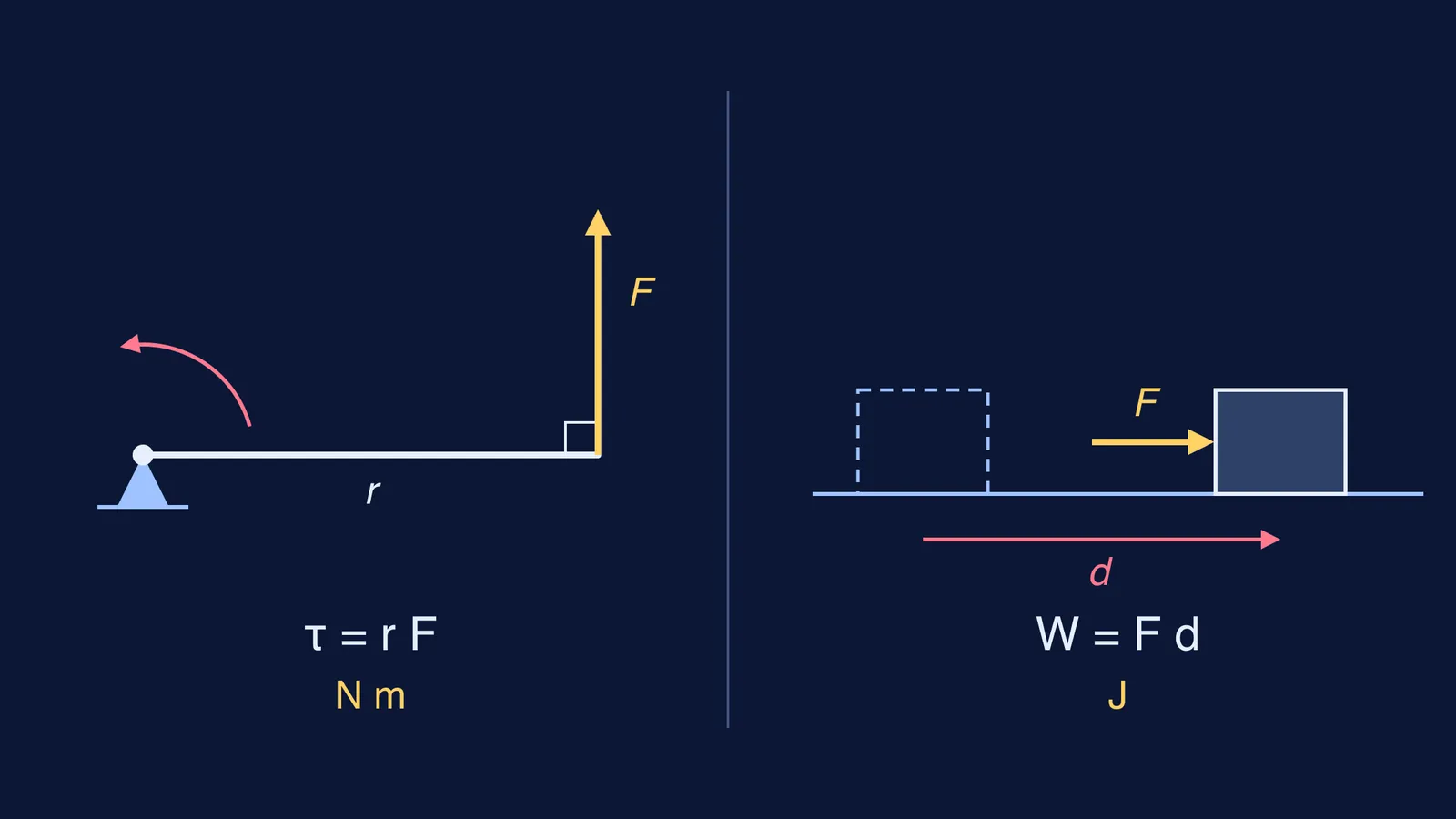
The physics behind the rule is about direction:
Work is a dot product, W = F · d. Only the force along the displacement counts, and the answer is a scalar.
Torque is a cross product, τ = r × F. Only the force perpendicular to the lever arm counts, and the answer is a vector along the axis.
The two meet in one place: when a constant torque turns a body through an angle θ in radians, the work done is W = τθ. Because the radian has dimension one, N m × rad gives J. Our post on work and power by torque works through W = τθ and P = τω, and why torque and energy have the same dimensions covers the dimensional formula.
Worked example: one wheel, three units
A solid disc (2 kg, radius 0.3 m) starts from rest. A constant torque of 0.45 N m acts for 4 s.
Moment of inertia: I = ½MR² = ½ × 2 kg × (0.3 m)² = 0.09 kg m².
Angular acceleration: α = τ/I = 0.45 N m ÷ 0.09 kg m² = 5 rad s⁻². In base units, kg m² s⁻² ÷ kg m² leaves s⁻².
Angular velocity after 4 s: ω = αt = 5 × 4 = 20 rad s⁻¹.
Angular momentum: L = Iω = 0.09 × 20 = 1.8 kg m² s⁻¹. Check with angular impulse: τt = 0.45 N m × 4 s = 1.8 N m s. Same number, same unit.
Angle turned: θ = ½αt² = ½ × 5 × 16 = 40 rad.
Work done by the torque: W = τθ = 0.45 N m × 40 rad = 18 J. Check with kinetic energy: ½Iω² = ½ × 0.09 × 400 = 18 J.
The joule appears only in step 6, once the torque has acted through an angle. The torque itself stays in N m.
How do you check rotational units in an exam?
Run this check before you box an answer:
Moment of inertia has a squared length: kg m², never kg m.
Torque is N m. If you wrote J, ask whether the question wanted work.
Angular momentum is kg m² s⁻¹ (or J s, or N m s). If you wrote kg m² s⁻², that is torque.
Radians go with ω and α, and drop out in energy and angular momentum.
Angular impulse τΔt has the unit of angular momentum: a free cross-check.
If a rotation problem keeps going wrong, the Fermi Problem Library has worked problems with a step-by-step solver that explains the reasoning rather than printing an answer. If the cross product itself feels shaky, the Fermi Concept Library gives each concept its own lesson.
Your next step: take the last three rotation problems you solved and derive each answer's unit from the formula, not from memory.


