

On this page
Every JEE Main, JEE Advanced and Class 11 student meets this puzzle in the units and dimensions chapter. You work out the dimensional formula of torque, then of energy, and get the same answer twice: [M L² T⁻²]. Does that make them the same thing? No. And the reason tells you something useful about what dimensional analysis can and cannot do.
What is the dimensional formula of torque and energy?
Start with energy. Work is force times displacement, and a newton times a metre is called a joule, as OpenStax University Physics, section 7.1 sets out. Force is [M L T⁻²] and displacement is [L], so work and every other form of energy is [M L² T⁻²].
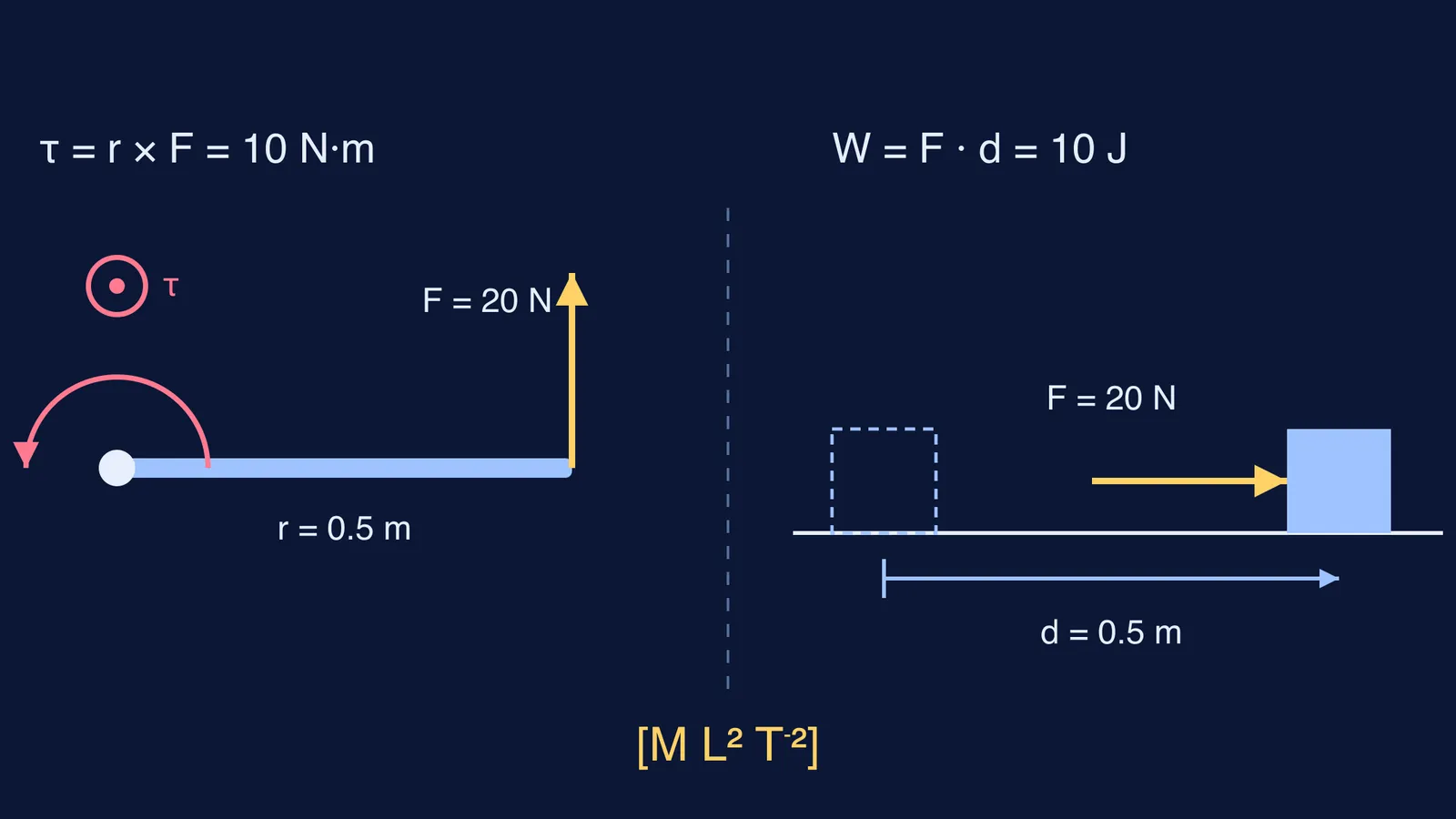
Now torque. Torque about a point O is the position vector of the point where the force acts, crossed with the force: τ = r × F, according to OpenStax University Physics, section 10.6. Its magnitude is rF sin θ. Position is [L] and force is [M L T⁻²], so torque is also [M L² T⁻²].
Dimensions only track which base quantities appear and to what power. They never record how the vectors were multiplied.
Why is torque a vector but energy a scalar?
The difference sits in the product, not in the dimensions.
Work uses the dot product. OpenStax section 7.1 defines dW = F · dr = |F||dr| cos θ, which gives a single number with no direction. Work is a scalar.
Torque uses the cross product. τ = r × F gives a vector perpendicular to the plane containing r and F, per OpenStax section 10.6. For a body turning about a fixed axis, it points along that axis.
In work, the length is the distance moved along the force. In torque, the length is the lever arm, at right angles to the force, and nothing has to move at all. A spanner jammed on a rusted bolt can carry a large torque while doing zero work.
Why is torque not measured in joules?
Because the unit would hide the difference. The NIST Guide to the SI, chapter 4 states that the SI unit of moment of force is specified as the newton metre (N·m) rather than the joule (J). The same guide gives a second example: the joule per kelvin is the SI unit of both heat capacity and entropy, so the name of the unit is not enough to define the quantity measured.
This is the general rule. A physical quantity fixes its dimensions, but a set of dimensions does not fix the quantity. If you want more pairs like this for exam revision, our list of physical quantities that have the same dimensions collects them.
A worked example: where the radian hides
The link between torque and energy becomes clear when something actually rotates. For a constant torque, the work done is W = τθ, with θ in radians, per OpenStax University Physics, section 10.8.
You push on a spanner 0.5 m from the bolt with 20 N, at right angles to the handle.
Torque: τ = rF sin 90° = 0.5 × 20 = 10 N·m, pointing along the bolt's axis.
The bolt turns a quarter turn, θ = π/2 ≈ 1.571 rad.
Work: W = τθ = 10 × 1.571 ≈ 15.7 J. This is a scalar, with no direction attached.
If the bolt is stuck, θ = 0, so the torque is still 10 N·m but the work is 0 J.
The same OpenStax section notes that the radian is dimensionless because it is the ratio of two lengths. That is why τθ comes out with the same dimensions as τ. A useful way to read it: torque is the energy delivered per radian of turning.
How do you use this in JEE Main and board answers?
Dimensional checks catch many errors, as our guide on using dimensions to check your physics answers shows. They cannot catch an answer that has the right dimensions but the wrong quantity. When a dimensional check passes, run this short checklist too:
Scalar or vector? If the question asks for a torque, your answer needs a direction (an axis and a sense, clockwise or anticlockwise). If it asks for work or energy, it must not have one.
Which length? Lever arm, perpendicular to the force, means torque. Distance moved along the force means work.
Which unit? Write N·m for torque and J for energy.
Is there a hidden dimensionless factor? Angles in radians, efficiencies and constants like 1/2 never show up in dimensions, which is also why dimensional analysis cannot find dimensionless constants.
If the cross product itself is the shaky part, the Fermi Concept Library gives every concept its own lesson and its place in the map, so you can see what vector products and rotational work depend on. To practise, the Fermi Problem Library has worked problems with a step-by-step solver that explains the reasoning rather than printing an answer.
Next time two quantities share a dimensional formula, ask how they were built. That question, not the formula, tells them apart.


