

On this page
Why can dimensional analysis find √(l/g) but not 2π?
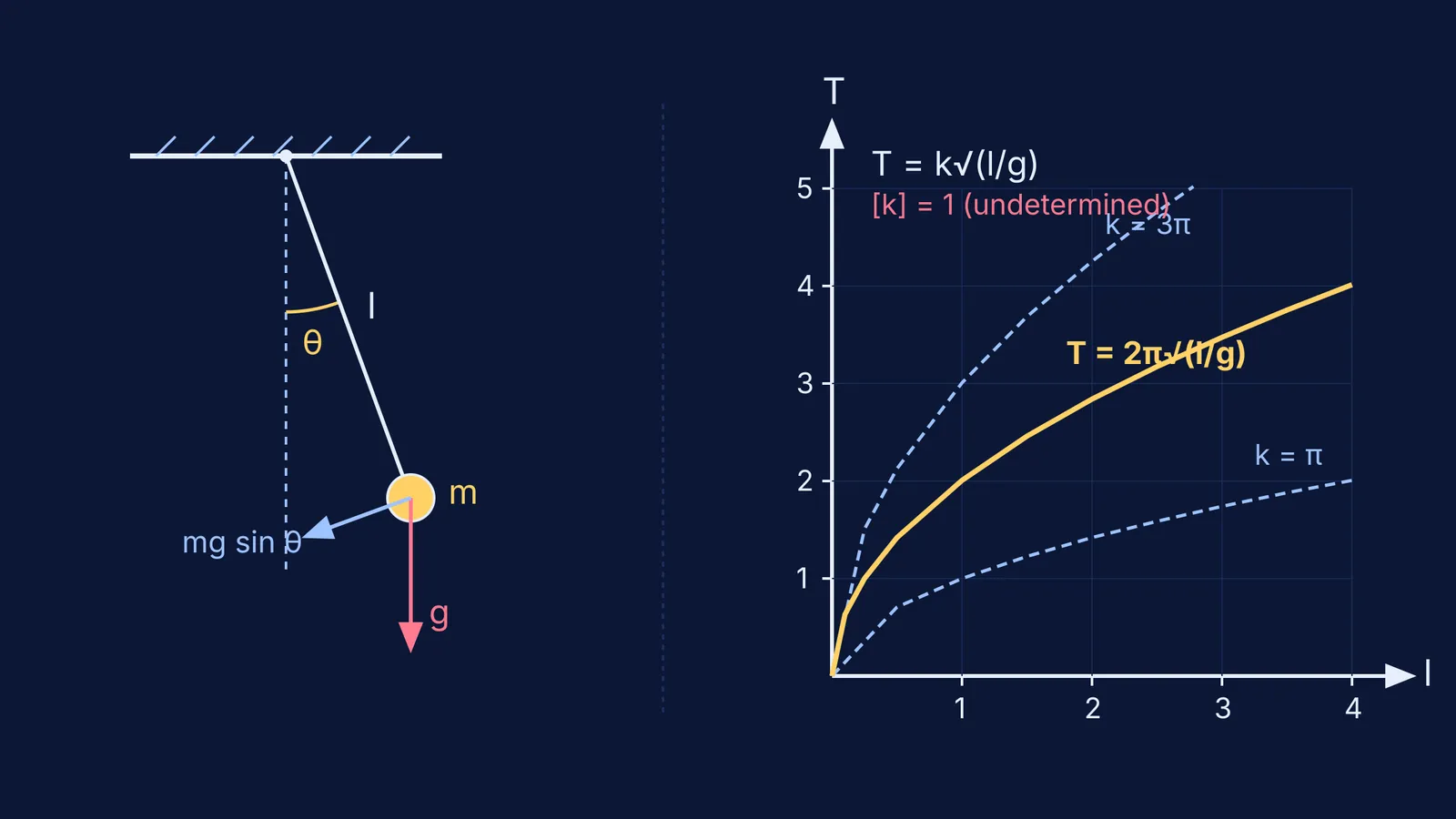
In Class 11 physics, dimensional analysis is often introduced with the simple pendulum. Assuming the period T depends on bob mass m, string length l, and gravity g, you write T = k · mᵃ · lᵇ · gᶜ. Equating powers of Mass [M], Length [L], and Time [T] yields the classic result: T ∝ √(l/g).
Yet every textbook notes the caveat: dimensional analysis cannot determine that the constant of proportionality k equals 2π. The reason lies in how physical dimensions operate.
In his 1822 foundation work, Théorie Analytique de la Chaleur, French mathematician Joseph Fourier established the principle of dimensional homogeneity: every valid physical equation must balance base dimensions on both sides. In 1914, physicist Edgar Buckingham formalized this logic in Physical Review through the Buckingham Pi theorem. The theorem proves that a physical relation with n variables and k independent dimensions reduces to a relation among n − k dimensionless groups.
For the pendulum, [T] = [k] · [M]ᵃ · [L]ᵇ · [L T⁻²]ᶜ. Because k is a pure number, its dimension is [M⁰ L⁰ T⁰] = 1. Matching powers gives a = 0, b = 1/2, and c = −1/2. Whether k is 1, 2, or 2π, the dimensional balance is identical.
As oceanographer James F. Price noted in the American Journal of Physics, dimensional analysis isolates the scaling group √(l/g), but the numeric prefactor requires solving the equation of motion. For small oscillations where sin θ ≈ θ, Newton's second law gives d²θ/dt² + (g/l)θ = 0. Solving this simple harmonic motion gives angular frequency ω = √(g/l). Because one complete cycle spans 2π radians, the period is T = 2π/ω = 2π√(l/g). The factor 2π originates in calculus and geometry, not units of measurement. You can see how this period responds in practical instruments in our guide on how a pendulum's period responds to length and gravity.
Why does dimensional analysis fail for sums and polynomials?
In Lord Rayleigh's method of dimensions, published in Nature in 1915, you assume variables relate as a single monomial product: y = k · x₁ᵃ · x₂ᵇ. But many fundamental laws are sums of distinct terms.
Consider the kinematic relation for displacement: s = ut + (1/2)at²
Both terms on the right share the dimension of length: [ut] = [L] and [(1/2)at²] = [L]. Because they are dimensionally homogeneous, they can be added. But dimensional analysis cannot derive this sum from scratch. Guessing s = k · uᵃ · aᵇ · tᶜ leaves three exponents with only two dimensions ([L] and [T]), creating an underdetermined system. A power product cannot produce addition signs or determine coefficients like 1 and 1/2.
Why can dimensional analysis not handle trigonometric and exponential terms?
Equations with oscillations or decay—such as x(t) = A sin(ωt) or N(t) = N₀ e^(−λt)—cannot be derived through dimensions. The barrier is the Taylor series: e^z = 1 + z + z²/2! + ... sin z = z − z³/3! + ...
Under Fourier's principle of dimensional homogeneity, you can only add terms with identical dimensions. In the expansion for e^z, the leading term 1 is dimensionless. If z carried physical dimensions—such as seconds [T]—the second term would be seconds and the third seconds squared [T²]. Adding seconds to seconds squared is physically impossible.
Consequently, the argument z of any trigonometric, exponential, or logarithmic function must be strictly dimensionless ([z] = 1). In ωt, the dimension of angular frequency [T⁻¹] cancels with time [T] to leave a pure number. Furthermore, the function output is also dimensionless. Because dimensional analysis sees only [1], it cannot determine whether a quantity belongs inside a trigonometric or exponential function.
When should you use dimensional analysis in physics problems?
Recognizing where dimensional analysis fails clarifies where it excels. Here is a practical framework for physics exams like JEE Main and school tests:
Rapid sanity check: After completing a derivation, check the dimensions of your final expression. If the units do not match the target quantity, you made an algebraic error. Learn this routine in our guide to a dimensional sanity check for physics answers.
Option elimination: In multiple-choice questions, check the dimensions of all four choices. Eliminating options with inconsistent dimensions saves valuable minutes.
Scaling and ratio questions: If a problem asks how a pendulum's period changes when its length changes, you do not need 2π: the square-root proportionality T ∝ √l gives the exact ratio directly.
Unit conversion across systems: Use dimensional formulas to convert numerical constants between SI and CGS units, as explained in our article on converting units across measurement systems.
When connecting dimensional shortcuts to complete physical principles, the Fermi Concept Library covers every concept in physics, chemistry, biology, mathematics and computing, each with its own lesson and its place in the map. And for practicing derivations where dimensional analysis falls short, the Fermi Problem Library provides worked problems with a step-by-step solver that explains the reasoning rather than printing an answer.


