

On this page
When studying physics, you will often find that different concepts share the exact same dimensional formula. This happens because dimensions describe the fundamental nature of a quantity—how it is built from mass [M], length [L] and time [T]—but they do not tell you the whole story of how that quantity behaves in space.
Understanding which quantities share dimensions is a powerful tool. Dimensional analysis lets you check the consistency of equations and even convert a quantity between unit systems using dimensions. However, it also presents a trap: just because different quantities have the same dimensions does not mean they are the same thing.
What are the dimensions of a physical quantity?
The dimensions of a physical quantity are the powers to which the base quantities are raised to represent that quantity. For instance, velocity is distance divided by time, so its dimension is length divided by time, written as [L T⁻¹].
The basic mechanics dimensions are Mass [M], Length [L] and Time [T]. Any mechanical quantity can be broken down into these base dimensions. If an equation is physically meaningful, the dimensions on the left side must perfectly match the dimensions on the right side. If they do not, the equation is physically impossible.
Which physical quantities have the same dimensions?
If you are looking for a physical quantities having the same dimensions list, here are the most frequent pairs you will encounter in physics:
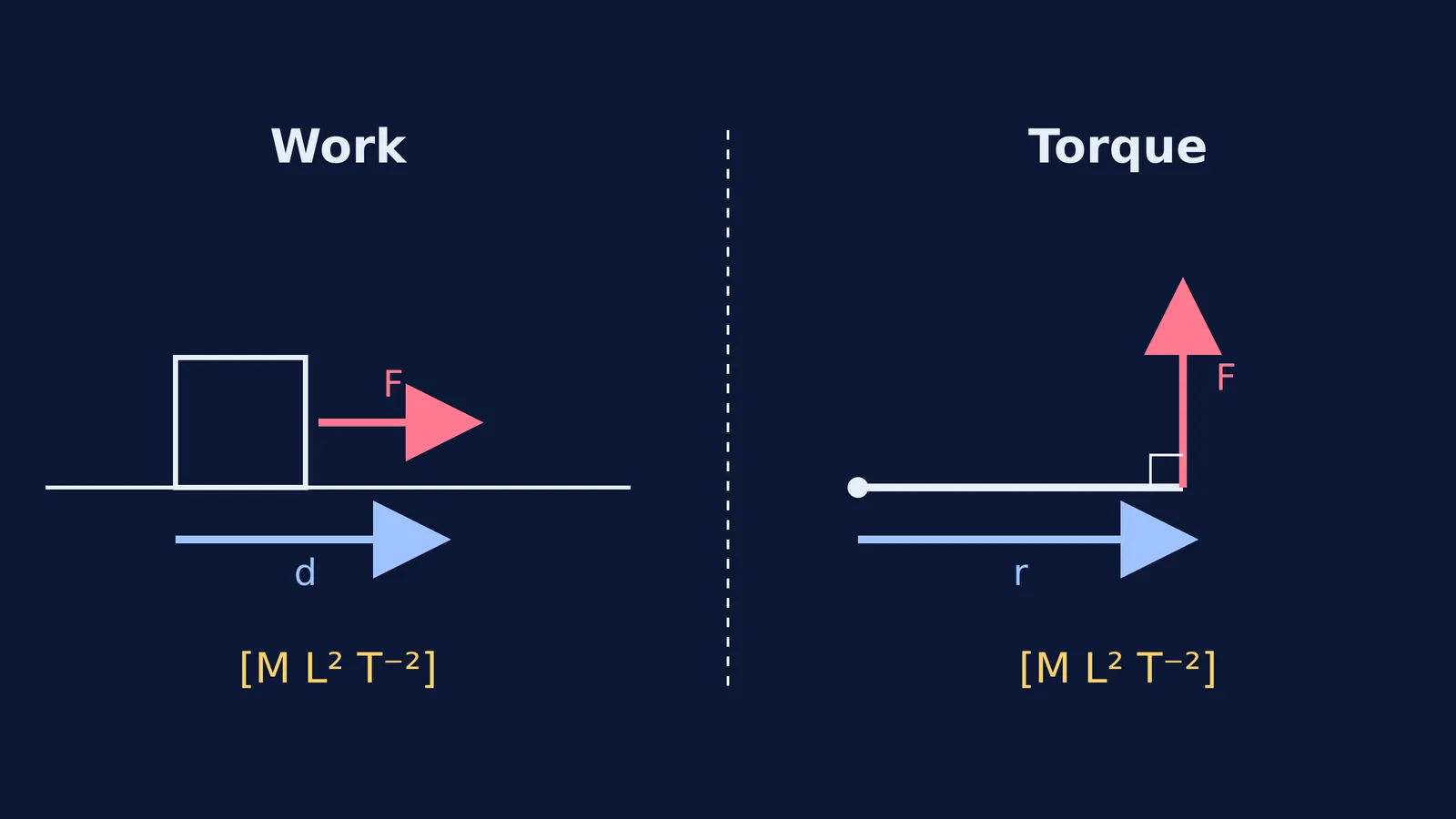
Work, Energy and Torque: All share the dimensional formula [M L² T⁻²]. Work is force multiplied by displacement, and energy is the capacity to do work. Torque is force multiplied by perpendicular distance.
Impulse and Momentum: Both share the dimension [M L T⁻¹]. Impulse is force applied over a time interval, which directly equals a change in momentum.
Pressure, Stress and Modulus of Elasticity: These share the dimension [M L⁻¹ T⁻²]. They are all defined fundamentally as a force applied per unit area.
Angular Momentum and Planck's Constant: Both have the dimensional formula [M L² T⁻¹]. Angular momentum is the rotational equivalent of linear momentum, and Planck's constant relates a photon's energy to its frequency.
Frequency, Angular Velocity and Velocity Gradient: These share the dimension [T⁻¹], because they all describe a rate of change with respect to time or distance, where the other units cancel out.
Surface Tension and Force Constant: Both share [M T⁻²]. Surface tension is force per unit length, and a spring's force constant is also force per unit extension.
If you are unsure whether a formula is dimensionally consistent, the Fermi Problem Library has worked problems with a step-by-step solver that explains the reasoning rather than printing an answer, letting you trace exactly how units cancel out line by line.
How to check dimensions: a worked example
If you want to prove that work and torque share the same dimensions, you can follow this simple framework:
Write the formula: Start with the basic equation for the quantity. For work, the formula is Work = Force × Displacement.
Break down the components: Force is Mass × Acceleration. Displacement is Length.
Insert the base dimensions: Acceleration is [L T⁻²]. Therefore, Force is [M L T⁻²].
Multiply it out: Multiply the force dimension [M L T⁻²] by the displacement dimension [L] to get [M L² T⁻²].
Repeat for the second quantity: Torque is Force × Perpendicular Distance. Since distance is also [L], the final dimension is again [M L T⁻²] × [L] = [M L² T⁻²].
This process proves that both quantities share the identical structural formula.
Why do work and torque have the same dimensions?
Work and torque are the classic example of quantities with matching dimensions. Both are calculated by multiplying a force by a distance.
For work, you multiply the force by the displacement in the direction of the force (a dot product). For torque, you multiply the force by the perpendicular distance from the pivot point (this defines torque as r × F).
Because both calculations boil down to [M L T⁻²] (force) multiplied by [L] (distance), they both result in the final dimensional formula of [M L² T⁻²].
Do same dimensions mean the same physical quantity?
No, having the same dimensions does not mean different quantities are interchangeable. Work and torque illustrate this perfectly.
Work is a scalar quantity; it has a magnitude but no direction. It measures the transfer of energy. Because of this, it is measured in Joules (J), whether you are lifting a box or calculating work in irreversible expansion.
Torque is a vector quantity; it has a magnitude and a specific direction of rotation. It measures the turning effectiveness of a force. To prevent confusion with energy, torque is never measured in Joules; its unit is kept strictly as Newton-meters (N·m).
You can add amounts of work together to get total energy, but you cannot add work to torque. This teaches an important lesson in dimensional analysis: matching dimensions are necessary for an equation to be valid, but they are not enough on their own to tell you exactly what physical process is happening.


