On this page
We wrote these eight Oscillations and Waves questions for NEET-UG Physics for this set, rather than copying them from NCERT or past papers. Each has a short solution and the trap behind the most tempting wrong option.
What does NEET cover in Oscillations and Waves?
The National Medical Commission's updated syllabus for NEET (UG)-2026 lists Oscillations and Waves as Physics Unit 10. It covers SHM, springs, energy in SHM, the simple pendulum, travelling waves, superposition, standing waves in strings and organ pipes, and beats. In the 2026-27 NCERT Class 11 Physics reprint, the unit is Chapter 13, Oscillations and Chapter 14, Waves.
For NEET-UG 2026, the NTA information bulletin gave four marks for a correct answer and took one mark off for a wrong one.
How should you use this practice set?
Cover the answers; allow a minute per easy question and two per hard one.
Write the formula before the numbers, and note what scales with what.
For strings and pipes, sketch the nodes first.
Read every trap, even for questions you got right.
New to the chapter? Read our guide on how to prepare Oscillations and Waves for NEET first. For more practice after this set, the Fermi Problem Library has worked problems with a step-by-step solver that explains the reasoning rather than printing an answer.
Easy: spring, pendulum and the wave equation
Q1 (easy). A block on a spring oscillates with a period of 0.5 s. Adding 1.5 kg to it raises the period to 1.0 s. What was the original mass?
(A) 0.375 kg (B) 0.50 kg (C) 1.5 kg (D) 3.6 kg
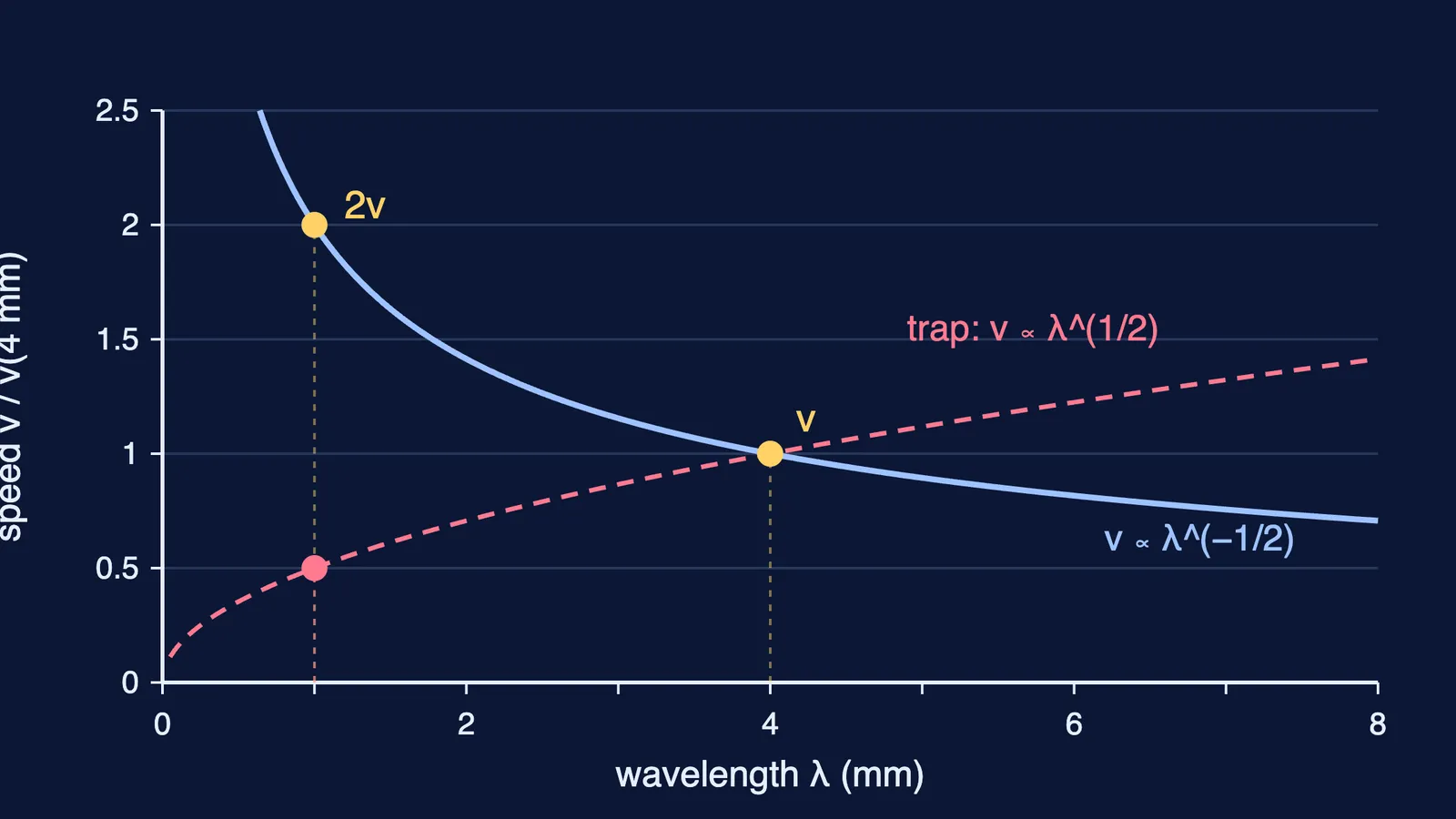
Answer: (B). T = 2π√(m/k), so (m + 1.5)/m = 2² = 4, giving m = 0.50 kg.
Trap: (C) assumes T grows in step with m, so doubling T would mean doubling the mass.
Q2 (easy). A simple pendulum takes 36 s for 20 oscillations. Its length is cut to 64% of the original. How long does it now take for 20 oscillations?
(A) 45.0 s (B) 29.5 s (C) 28.8 s (D) 23.0 s
Answer: (C). T ∝ √L, and √0.64 = 0.8, so the time becomes 36 × 0.8 = 28.8 s.
Trap: (B) halves the 36% change in length. That shortcut only works for small changes.
Q3 (easy). A wave on a string is y = 0.02 sin(4.0x − 600t), in SI units. What are its speed and direction?
(A) 150 m/s along +x (B) 150 m/s along −x (C) 600 m/s along +x (D) 2400 m/s along −x
Answer: (A). For y = a sin(kx − ωt), v = ω/k = 600/4.0 = 150 m/s.
Trap: (B) reads the minus sign as the direction. Opposite signs on kx and ωt mean motion along +x.
Medium: energy, strings and organ pipes
Q4 (medium). A particle moves in SHM with amplitude A. At what distance from the mean position is its kinetic energy eight times its potential energy?
(A) A/9 (B) A/(2√2) (C) 2√2A/3 (D) A/3
Answer: (D). If KE = 8 PE, the total energy is 9 PE, so ½kx² = (1/9)(½kA²). Then x² = A²/9 and x = A/3.
Trap: (B) sets PE to one eighth of the total, forgetting that the total is KE + PE = 9 parts.
Q5 (medium). A string 0.80 m long with a mass of 4.0 g is fixed at both ends under a tension of 72 N. What is the frequency of its third harmonic?
(A) 7.1 Hz (B) 112.5 Hz (C) 225 Hz (D) 300 Hz
Answer: (C). μ = 0.004/0.80 = 0.005 kg/m, so v = √(72/0.005) = 120 m/s. The fundamental is v/2L = 75 Hz, and the third harmonic is 3 × 75 = 225 Hz.
Trap: (A) leaves the mass in grams, which makes μ a thousand times too large.
Q6 (medium). A pipe 0.43 m long is closed at one end. Sound travels at 344 m/s. Which of these is not one of its natural frequencies?
(A) 200 Hz (B) 400 Hz (C) 600 Hz (D) 1000 Hz
Answer: (B). A closed pipe has only odd harmonics, f = nv/4L with n = 1, 3, 5. The fundamental is 344/1.72 = 200 Hz, giving 200, 600, 1000 Hz; 400 Hz would be an even harmonic.
Trap: (A) comes from using v/2L, the open-pipe formula, which puts the fundamental at 400 Hz and makes 200 Hz look too low.
Hard: phase in SHM and beats from pipes
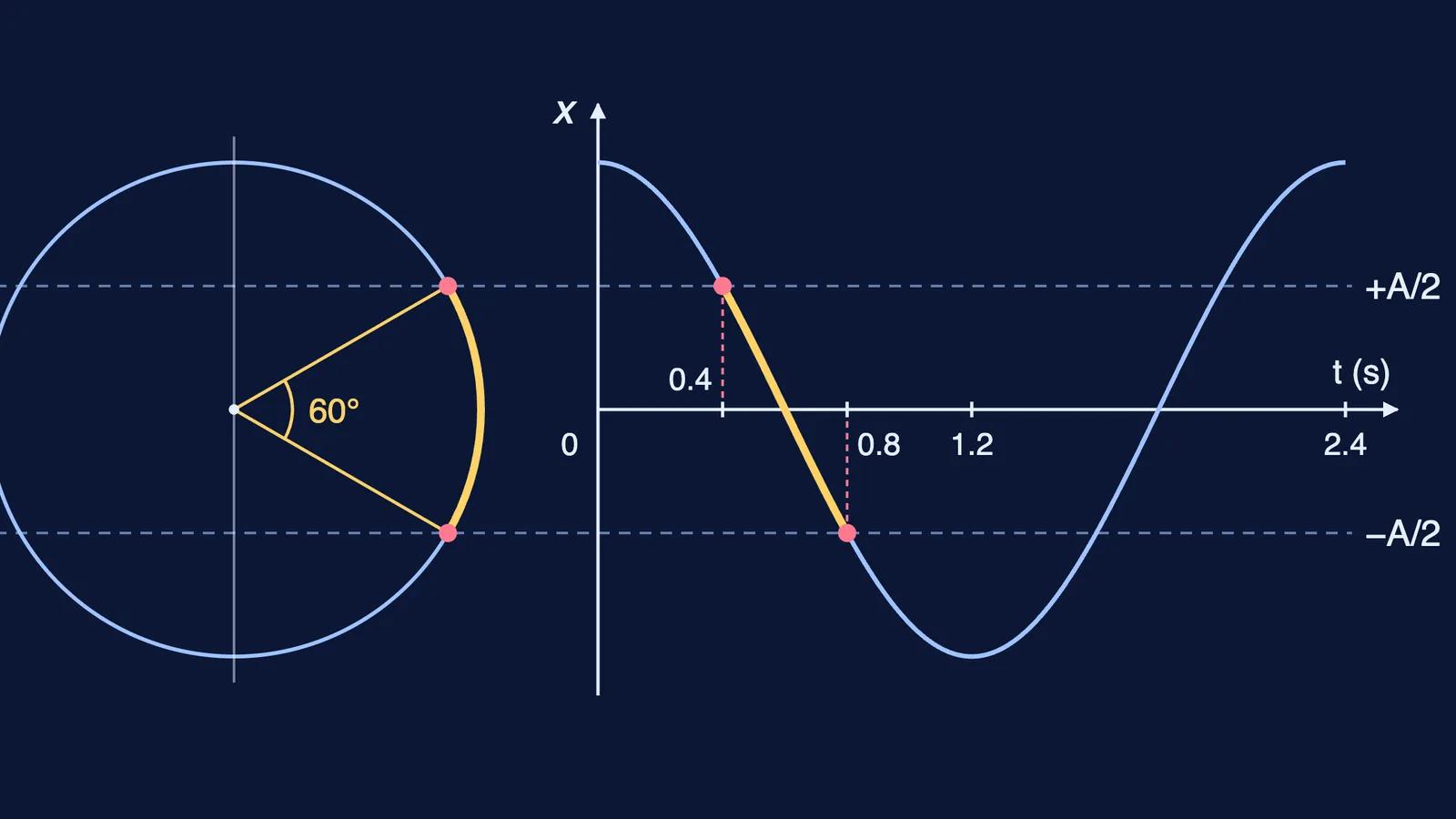
Q7 (hard). A particle in SHM has a period of 2.4 s and amplitude A. What is the shortest time it takes to go from x = +A/2 to x = −A/2?
(A) 0.4 s (B) 0.2 s (C) 0.6 s (D) 1.2 s
Answer: (A). Write x = A cos ωt. x = +A/2 when the phase is 60° and x = −A/2 when it is 120°, a change of 60°, which is one sixth of a cycle: 2.4/6 = 0.4 s. The diagram at the top shows this 60° arc on the reference circle.
Trap: (C) assumes uniform speed: distance A is a quarter of 4A, so T/4. The particle is fastest near the middle, so it takes less.
Q8 (hard). A pipe 25 cm long, closed at one end, and an open pipe sound their fundamentals together and give 5 beats per second. When the open pipe is shortened slightly, the beat frequency increases. Take the speed of sound as 340 m/s. How long was the open pipe?
(A) 24.6 cm (B) 50.7 cm (C) 98.6 cm (D) 49.3 cm
Answer: (D). The closed pipe's fundamental is 340/(4 × 0.25) = 340 Hz, so the open pipe sounds 335 Hz or 345 Hz. Shortening it raises its frequency, and the beats increase only if it moves away from 340 Hz, so it was 345 Hz. Then L = v/2f = 340/690 ≈ 0.493 m = 49.3 cm.
Trap: (B) picks 335 Hz. Shortening a 335 Hz pipe would bring it closer to 340 Hz and reduce the beats.
Next, try our assertion-reason traps on waves and oscillations, or revise the derivations in Oscillations for Class 11 Physics.