On this page
Here are eight new JEE Main-style questions on inverse trigonometric functions, from principal values to a telescoping sum. Seven are single-correct; Q7 asks for a number. We checked every answer in Python with SymPy, and each solution names the wrong option that pulls hardest.
Is inverse trigonometry in the JEE Main syllabus?
Yes. The NTA's Syllabus for JEE (Main) 2027 lists inverse trigonometrical functions and their properties in Unit 14, Trigonometry, and their differentiation in Unit 7. If the principal value branches still feel shaky, start with our guide to preparing inverse trigonometric functions for JEE Main.
How should you work through these questions?
Cover the answers. Give yourself about 2 minutes for each easy question and 4 for each hard one.
Before you choose, write the principal range of every function in the question in the margin.
Mark each miss with the trap that caught you, then redo it from a blank page two days later.
Easy: principal values and domains
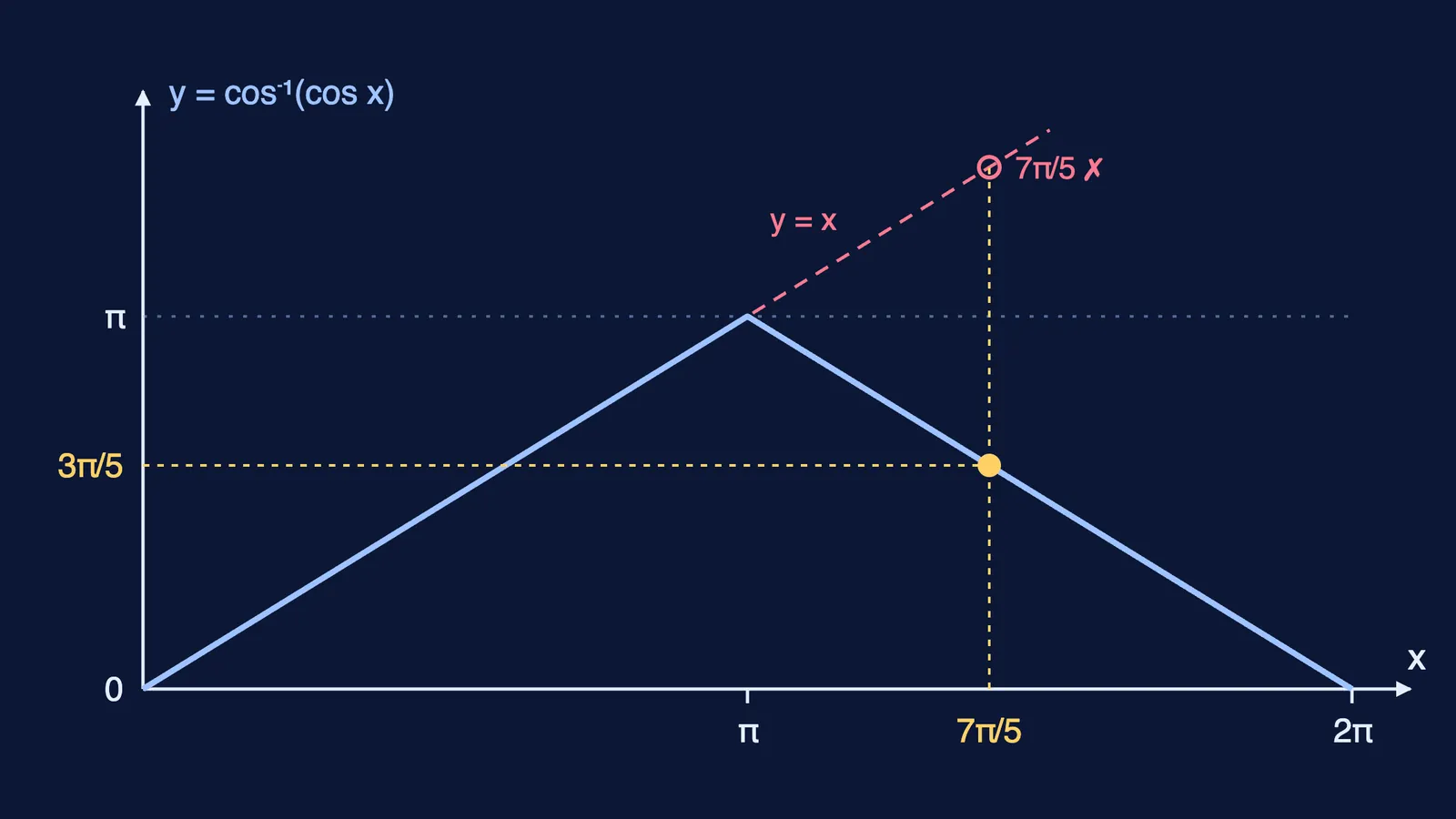
Q1 (easy). The value of cos⁻¹(cos(7π/5)) is
(A) 7π/5
(B) 3π/5
(C) −3π/5
(D) 2π/5
Answer: (B). The range of cos⁻¹ is [0, π], and 7π/5 is outside it. Since cos(7π/5) = cos(2π − 7π/5) = cos(3π/5) and 3π/5 lies in [0, π], the value is 3π/5. Trap: (A) cancels cos⁻¹ and cos without checking the range. The diagram at the top shows why.
Q2 (easy). The value of 2 sin⁻¹(−√3/2) + cos⁻¹(−√3/2) − tan⁻¹(−1/√3) is
(A) −2π/3
(B) π/3
(C) 2π/3
(D) 0
Answer: (B). sin⁻¹(−√3/2) = −π/3, cos⁻¹(−√3/2) = π − π/6 = 5π/6 and tan⁻¹(−1/√3) = −π/6, so the value is −2π/3 + 5π/6 + π/6 = π/3. Trap: (A) treats cos⁻¹ as odd and writes cos⁻¹(−√3/2) = −π/6; only sin⁻¹ and tan⁻¹ are odd.
Q3 (easy). The domain of f(x) = sin⁻¹((2x − 3)/5) + cos⁻¹(x − 2) is
(A) [−1, 4]
(B) [1, 3]
(C) [−1, 3]
(D) [−4, 1]
Answer: (B). The first term needs −5 ≤ 2x − 3 ≤ 5, so x is in [−1, 4]. The second needs −1 ≤ x − 2 ≤ 1, so x is in [1, 3]. Both must hold, and the intersection is [1, 3]. Trap: (A) finds the first domain and stops.
Medium: sums, compositions and range
Q4 (medium). tan⁻¹ 4 + tan⁻¹(5/3) equals
(A) −π/4
(B) 3π/4
(C) π/4
(D) 5π/4
Answer: (B). (4 + 5/3)/(1 − 20/3) = −1, but the product 4 × 5/3 is greater than 1 and both angles are positive, so the sum lies between π/2 and π. Add π: −π/4 + π = 3π/4. Trap: (A) uses tan⁻¹((a + b)/(1 − ab)) without the ab > 1 correction; two positive angles cannot add to a negative one.
Q5 (medium). sin(2 tan⁻¹(1/2)) + cos(tan⁻¹ √15) equals
(A) 21/20
(B) 19/12
(C) (16 + 5√15)/20
(D) 17/20
Answer: (A). sin 2θ = 2 tan θ/(1 + tan²θ) = 1/(5/4) = 4/5. For tan φ = √15, draw a right triangle with sides 1 and √15: the hypotenuse is 4, so cos φ = 1/4. The sum is 4/5 + 1/4 = 21/20. Trap: (B) uses 1 − tan²θ in the denominator, which belongs to tan 2θ.
Q6 (medium). The range of f(x) = sin⁻¹ x + cos⁻¹ x + 2 tan⁻¹ x is
(A) (−π/2, 3π/2)
(B) [0, π]
(C) [π/4, 3π/4]
(D) [−π/2, π/2]
Answer: (B). sin⁻¹ x + cos⁻¹ x = π/2 for every x in [−1, 1], so f(x) = π/2 + 2 tan⁻¹ x. That is increasing, and on [−1, 1] the term 2 tan⁻¹ x runs from −π/2 to π/2, giving [0, π]. Trap: (A) lets x range over all reals, forgetting that sin⁻¹ x restricts the domain to [−1, 1].
Hard: equations and an infinite sum
Q7 (hard, numerical value). If tan⁻¹(3x) + tan⁻¹(10x) = π/4, the value of 1/x is ____.
Answer: 15. Take tan of both sides: 13x/(1 − 30x²) = 1, so 30x² + 13x − 1 = 0, giving x = 1/15 or x = −1/2. At x = −1/2 both angles are negative, so their sum cannot be π/4; it is −3π/4. At x = 1/15, 30x² = 2/15 < 1 and the sum is exactly π/4, so 1/x = 15. Trap: entering −2 from the rejected root. Taking tan of both sides can add solutions, so check every root in the original equation.
Q8 (hard). The sum of the series tan⁻¹(1/7) + tan⁻¹(1/13) + tan⁻¹(1/21) + … , whose kth term is tan⁻¹(1/(k² + 3k + 3)), is
(A) π/4
(B) tan⁻¹(1/2)
(C) tan⁻¹ 2
(D) π/2
Answer: (B). Write 1/(k² + 3k + 3) = ((k + 2) − (k + 1))/(1 + (k + 1)(k + 2)), so each term is tan⁻¹(k + 2) − tan⁻¹(k + 1). The first n terms telescope to tan⁻¹(n + 2) − tan⁻¹ 2, which tends to π/2 − tan⁻¹ 2 = cot⁻¹ 2 = tan⁻¹(1/2). Trap: (A) is the answer for terms tan⁻¹(1/(k² + k + 1)), which telescope from tan⁻¹ 1; check where your sum actually starts.
What should you do after this set?
Group your misses. Range slips (Q1, Q2, Q6) mean the principal value branches need another pass; the Class 12 board guide to inverse trigonometric functions lists them with the usual traps. Formula slips (Q4, Q7, Q8) come from using tan⁻¹ addition without checking signs and products. Next, the same functions turn up in calculus: practise the derivatives of all six inverse trig functions and their signs.
For more practice, the Fermi Problem Library has worked problems with a step-by-step solver that explains the reasoning rather than printing an answer.