On this page
This is a set of eight new NEET-UG Biology questions on Morphology of Flowering Plants, written for this post rather than taken from NCERT, exemplar or past papers.
What does this morphology set test?
The NEET (UG)-2026 syllabus released by the National Medical Commission lists morphology of root, stem, leaf, inflorescence (cymose and racemose), flower, fruit and seed in Biology Unit 2. Every fact in the questions below comes from Chapter 5 of the NCERT Class 11 Biology book, Reprint 2026-27.
If the chapter is still new to you, read our guide on how to prepare Morphology of Flowering Plants for NEET first. The Class 11 morphology walkthrough explains the floral formula.
How should you use these practice questions?
Cover the answers and allow about a minute for each question.
Before you pick an option, say which NCERT example the question is pointing at.
Read the trap line even when you got the question right.
Keep a list of the traps that caught you and look at it before your next mock test.
Easy: leaves, inflorescences and aestivation
Q1 (easy). A neem leaf you pick up has nine leaflets on its rachis. How many axillary buds belong to this one leaf?
(A) 0 (B) 1 (C) 9 (D) 10
Answer: (B). NCERT says a bud sits in the axil of the petiole in both simple and compound leaves, but never in the axil of a leaflet. One leaf, one bud. Trap: (C) treats every leaflet as a leaf; the missing buds are how you tell a leaflet from a leaf.
Q2 (easy). On a flowering shoot, the main axis ends in a flower, and the flowers get younger as you move down the axis. Which description fits?
(A) Racemose, acropetal (B) Cymose, basipetal (C) Racemose, basipetal (D) Cymose, acropetal
Answer: (B). When the axis ends in a flower, its growth is limited, which is cymose; the flowers then form in basipetal order, oldest at the top. Trap: (D) gets the type right but uses acropetal, the order of racemose, where the main axis keeps growing.
Q3 (easy). In a bud, a flower's five petals are arranged so that the largest petal covers the two side petals, and those cover the two smallest front petals. This flower is most likely from:
(A) Cassia (B) bean (C) cotton (D) Calotropis
Answer: (B). This is vexillary (papilionaceous) aestivation: standard over wings over keel, which NCERT gives for pea and bean. Trap: (A) Cassia also has overlapping petals, but they overlap in no fixed direction, which is imbricate.
Medium: ovary position, placentation and seeds
Q4 (medium). Which set contains only flowers with an inferior ovary?
(A) Guava, cucumber, ray floret of sunflower (B) Mustard, china rose, brinjal (C) Plum, rose, peach (D) Guava, plum, cucumber
Answer: (A). In epigynous flowers, the thalamus rim grows up, fuses with the ovary and the other parts arise above it, so the ovary is inferior: guava, cucumber and sunflower's ray florets. Trap: (D) slips in plum, which is perigynous with a half-inferior ovary.
Q5 (medium). A transverse cut through an ovary shows one chamber divided into two by a false septum, with ovules growing on the inner wall. Which placentation and example match it?
(A) Axile, lemon (B) Parietal, mustard (C) Parietal, tomato (D) Basal, marigold
Answer: (B). Ovules on the wall of a one-chambered ovary that a false septum splits in two is parietal placentation, as in mustard. Trap: (A) is tempting because the ovary shows two chambers, but axile needs a truly multilocular ovary with ovules on a central axis.
Q6 (medium). How many of these statements about a maize grain are correct?
I. The scutellum is its single, shield-shaped cotyledon.
II. The coleoptile sheathes the radicle.
III. The endosperm is bulky and stores food.
IV. The seed coat is membranous and fused with the fruit wall.
(A) 1 (B) 2 (C) 3 (D) 4
Answer: (C). I, III and IV are NCERT's description of the maize seed. II is wrong: the coleoptile sheathes the plumule, and the coleorhiza sheathes the radicle. Trap: (D) comes from swapping the two sheaths.
Hard: can you count and correct a family description?
Q7 (hard). NCERT gives mustard's floral formula as K2+2 C4 A2+4 G(2), with a bicarpellary, syncarpous gynoecium. Assuming each anther is the usual bilobed kind, how many floral members does one flower have, and how many pollen sacs are there across all its anthers?
(A) 16 members, 24 pollen sacs (B) 16 members, 12 pollen sacs (C) 14 members, 24 pollen sacs (D) 15 members, 24 pollen sacs
Answer: (A). Members: 4 sepals + 4 petals + 6 stamens + 2 carpels = 16. NCERT says each anther is usually bilobed with two pollen sacs per lobe, so 4 per anther, and 6 × 4 = 24. Trap: (B) counts one pollen sac per lobe; (D) reads the bracket in G(2) as one carpel, when the bracket only shows the two carpels are fused.
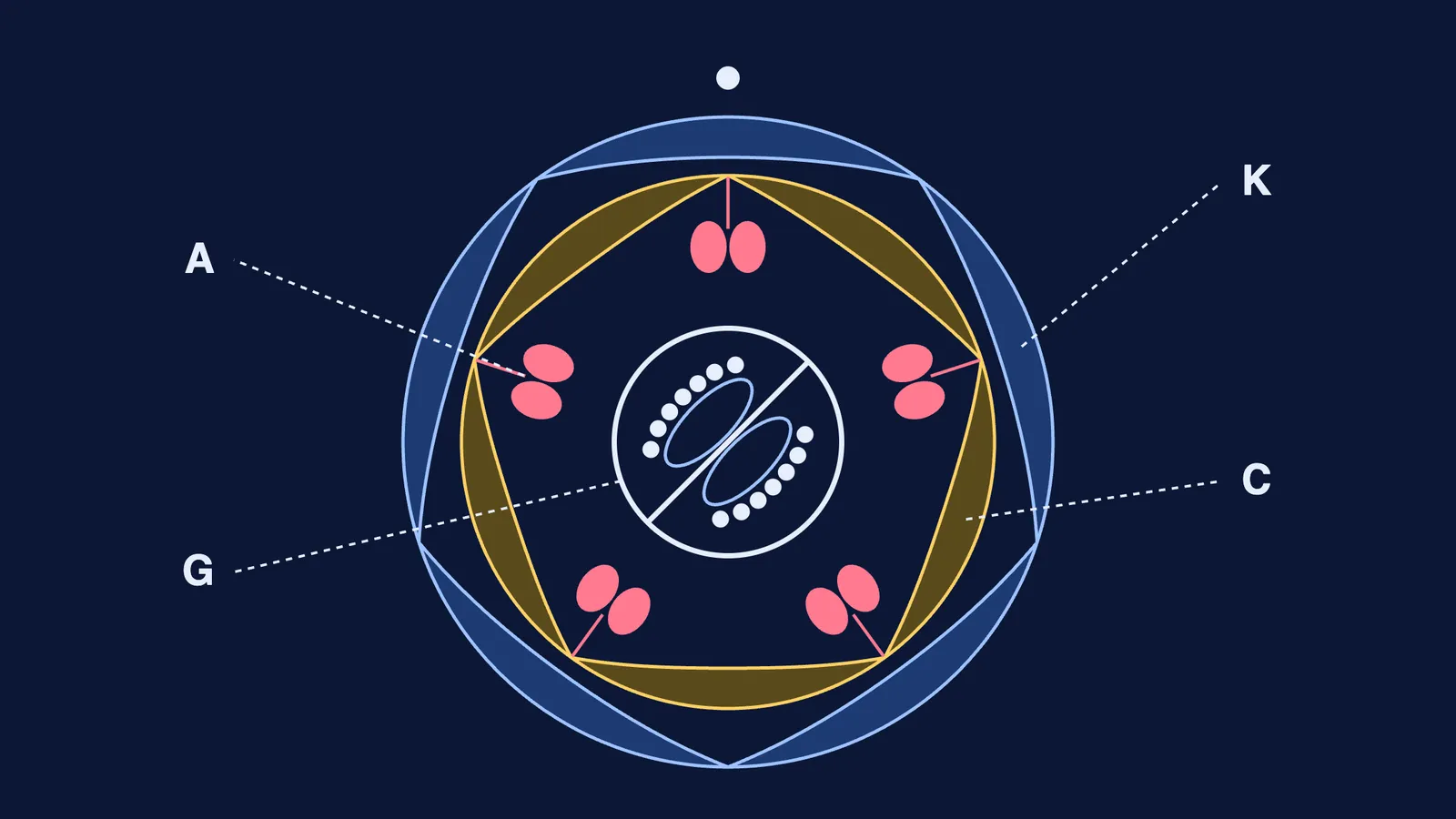
Q8 (hard). A student describes a flower of Solanum nigrum (makoi), family Solanaceae. Which line is wrong?
(A) Calyx: five sepals, united, persistent, valvate (B) Androecium: five stamens, epipetalous (C) Gynoecium: bicarpellary, syncarpous, ovary inferior, axile placentation (D) Corolla: five petals, united, valvate
Answer: (C). NCERT's Solanaceae description gives a superior, bilocular ovary with a swollen axile placenta, so "inferior" is the error. The image at the top is its floral diagram. Trap: (D) looks wrong to students who remember twisted aestivation from china rose, but the Solanaceae corolla is valvate.
What should you do after this set?
Mark each miss by type: a wrong example, a swapped term (coleoptile and coleorhiza, acropetal and basipetal), or a counting slip. Fix wrong examples from the NCERT lists, swapped terms with a one-line rule per pair, and counting slips by writing out the formula first.
To see how these flower and seed terms connect with internal structure, the next chapter's guide on how to prepare Anatomy of Flowering Plants for NEET is a good follow-on. If one term keeps tripping you up, the Fermi Concept Library gives every concept in biology its own lesson, so you can relearn it before you try the set again.