On this page
These eight questions cover application of derivatives at JEE Main level, graded from easy to hard. Each has a short worked solution and the trap: the wrong option a hurried student is most likely to choose. Every question was written for this set.
The NTA syllabus for JEE (Main) 2027 lists three applications of derivatives: rate of change of quantities, increasing and decreasing functions, and maxima and minima of functions of one variable. This set stays inside those three. If you have not finished the chapter, read our guide on how to prepare application of derivatives for JEE Main first.
How should you use this practice set?
As in JEE (Main) 2027, according to the NTA information bulletin, a correct answer earns +4 and a wrong one costs −1 in both the multiple-choice and the numerical-value sections. Treat a blind guess as a real cost.
Set a timer for 16 minutes, about two minutes a question.
Cover each solution and commit to an answer before reading it.
When you miss one, write the trap in one line. That is your revision note.
Question 4 is numerical-value: the answer is an integer and there are no options.
Easy: can you read the sign of the derivative?
Q1 (easy). A cube of ice melts so that its edge shrinks at 0.2 cm/min. How fast is its surface area decreasing when the edge is 5 cm?
(A) 6 cm²/min (B) 12 cm²/min (C) 30 cm²/min (D) 60 cm²/min
Answer: (B). S = 6a², so dS/dt = 12a · da/dt = 12 × 5 × 0.2 = 12 cm²/min. Trap: (D) is 12a alone, the derivative with respect to a, with the rate of the edge forgotten.
Q2 (easy). f(x) = x² − 8 ln x is decreasing on
(A) (0, 2) (B) (−2, 2) (C) (2, ∞) (D) (0, 4)
Answer: (A). f′(x) = 2x − 8/x = 2(x² − 4)/x. With x > 0 the sign is that of x − 2, so f′ < 0 on (0, 2). Trap: (B) solves x² < 4 and forgets that ln x needs x > 0.
Q3 (easy). For x > 0, the minimum value of f(x) = x + 9/x is
(A) 3 (B) 6 (C) 9 (D) 10
Answer: (B). f′(x) = 1 − 9/x² = 0 gives x = 3, and f″(3) = 18/27 > 0, so it is a minimum. f(3) = 3 + 3 = 6. Trap: (A) is where the minimum occurs, not its value.
Medium: what happens when a rate or a parameter enters?
Q4 (medium, numerical). Water is pumped at 72π cm³/s into a tank shaped like an inverted cone, so the radius of the water surface is always twice the water depth. At what rate, in cm/s, is the depth rising when the depth is 3 cm?
Answer: 2. With r = 2h, V = (1/3)π(2h)²h = 4πh³/3, so dV/dt = 4πh² · dh/dt. Then 72π = 4π × 9 × dh/dt, which gives dh/dt = 2. Trap: writing r = h/2 instead of r = 2h leads to 32.
Q5 (medium). f(x) = x³ + kx² + 12x − 7 is increasing on all of ℝ exactly when k lies in
(A) (−6, 6) (B) [−6, 6] (C) [−12, 12] (D) [0, 6]
Answer: (B). f′(x) = 3x² + 2kx + 12 must never be negative, so its discriminant must satisfy 4k² − 144 ≤ 0, that is |k| ≤ 6. At k = 6, f′(x) = 3(x + 2)², which is zero only at x = −2, so f is still increasing. Trap: (A) drops the endpoints. A derivative that touches zero at isolated points does not stop a function from increasing.
Q6 (medium). The maximum value of f(x) = x e^(−x/2) for x ≥ 0 is
(A) 2/e (B) 1/√e (C) 2 (D) 4/e²
Answer: (A). f′(x) = e^(−x/2)(1 − x/2), which is zero at x = 2, positive before it and negative after it. f(2) = 2e^(−1) = 2/e. Trap: (B) comes from dropping the chain-rule factor 1/2, which gives f′ = e^(−x/2)(1 − x) and the wrong point x = 1.
Hard: where do the extreme values hide?
Q7 (hard). The shortest distance from the point (4, 0) to the curve y = √x is
(A) 4 (B) √15/2 (C) 15/4 (D) 2
Answer: (B). A point on the curve is (x, √x) with x ≥ 0, so the squared distance is D² = (x − 4)² + x = x² − 7x + 16. Its derivative 2x − 7 is zero at x = 7/2, a minimum since the second derivative is 2 > 0. Then D² = 15/4, so D = √15/2 ≈ 1.94. Trap: (D) is the distance to (4, 2), straight above, and (A) to the origin; neither point is nearest. (C) forgets the square root.
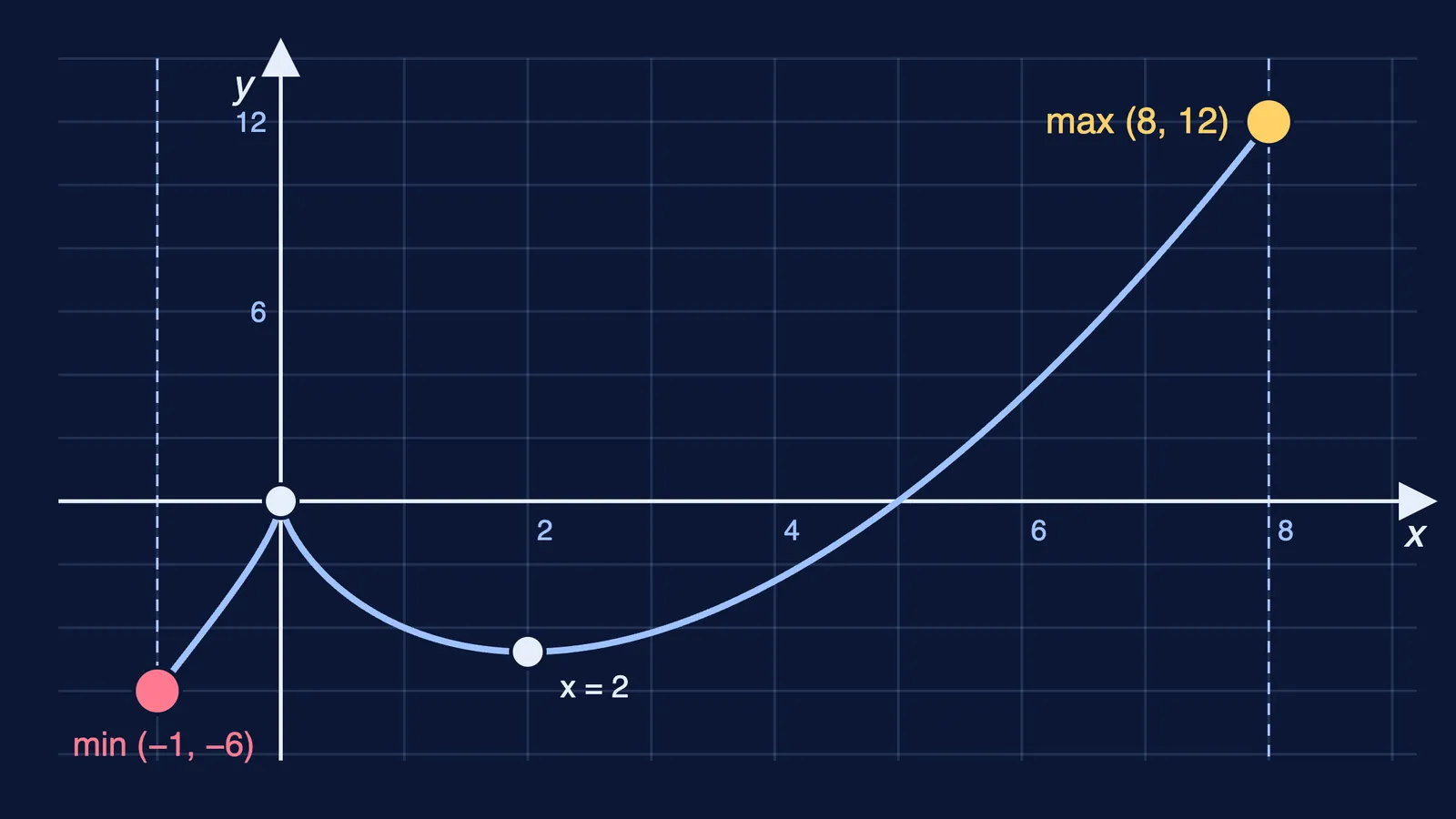
Q8 (hard). On the interval [−1, 8], the absolute minimum value of f(x) = x^(2/3)(x − 5) is
(A) −3∛4 (B) −6 (C) 0 (D) −5
Answer: (B). f′(x) = 5(x − 2)/(3x^(1/3)), so the critical points are x = 2 (f′ = 0) and x = 0 (f′ does not exist). Compare all candidates: f(−1) = −6, f(0) = 0, f(2) = −3∛4 ≈ −4.76 and f(8) = 12. The smallest is −6, at the endpoint. Trap: (A) is the only interior minimum, and checking it alone misses the lower value at x = −1.
What should you do after this set?
Count your misses by type. For set-up mistakes, like Q4, practise turning sentences into equations. If they came from domains or endpoints, like Q2 and Q8, add one line to every solution: "domain is…, endpoints are…".
The corner at x = 0 in Q8 is a differentiability question as much as a maxima one; our explainer on differentiability for JEE, with corners and modulus functions covers it. For the board-exam version of the chapter, see application of derivatives for Class 12 boards.
For more practice with each step explained, the Fermi Problem Library has worked problems with a step-by-step solver that explains the reasoning rather than printing an answer.