On this page
How many marks is Application of Derivatives worth in the 2026-27 board exam?
CBSE prints no separate weight for this chapter. In the official CBSE Mathematics curriculum 2026-27, Unit III, Calculus, carries 35 of the 80 theory marks, shared by five chapters: Continuity and Differentiability, Applications of Derivatives, Integrals, Application of the Integrals and Differential Equations.
The NCERT chapter (Reprint 2026-27) runs from section 6.1 to 6.4: rate of change, increasing and decreasing functions, maxima and minima. Its introduction mentions tangents, normals and approximations, but no section covers them.
In the CBSE 2026-27 sample paper the chapter appears as two 1-mark MCQs (Q9, Q10), a 3-mark rate question (Q27) and a 4-mark case study (Q37). The marking scheme splits Q27 as ½ + 1½ + 1: givens, chain-rule link, answer.
Which results must you know by heart?
From the NCERT chapter linked above:
Rate of change. dy/dx is the rate of change of y with respect to x.
Increasing or decreasing. If f is continuous on [a, b] and f′(x) > 0 on (a, b), f is increasing on [a, b]; f′(x) < 0 gives decreasing.
Critical point. A point c where f′(c) = 0 or f is not differentiable.
First derivative test. f′ changes from positive to negative through c: local maximum. Negative to positive: local minimum. No change: neither, a point of inflexion.
Second derivative test. f′(c) = 0 and f″(c) < 0: local maximum; f″(c) > 0: local minimum; f″(c) = 0: the test fails, so go back to the first test.
Absolute extrema on [a, b]. List the critical points and both end points, evaluate f at each, and pick the largest and smallest values.
How do you set out a 5-mark optimisation answer?
Step marks reward a visible chain: variable with units, constraint, a one-variable function with its domain, derivative, critical point, max/min justification, answer in words.
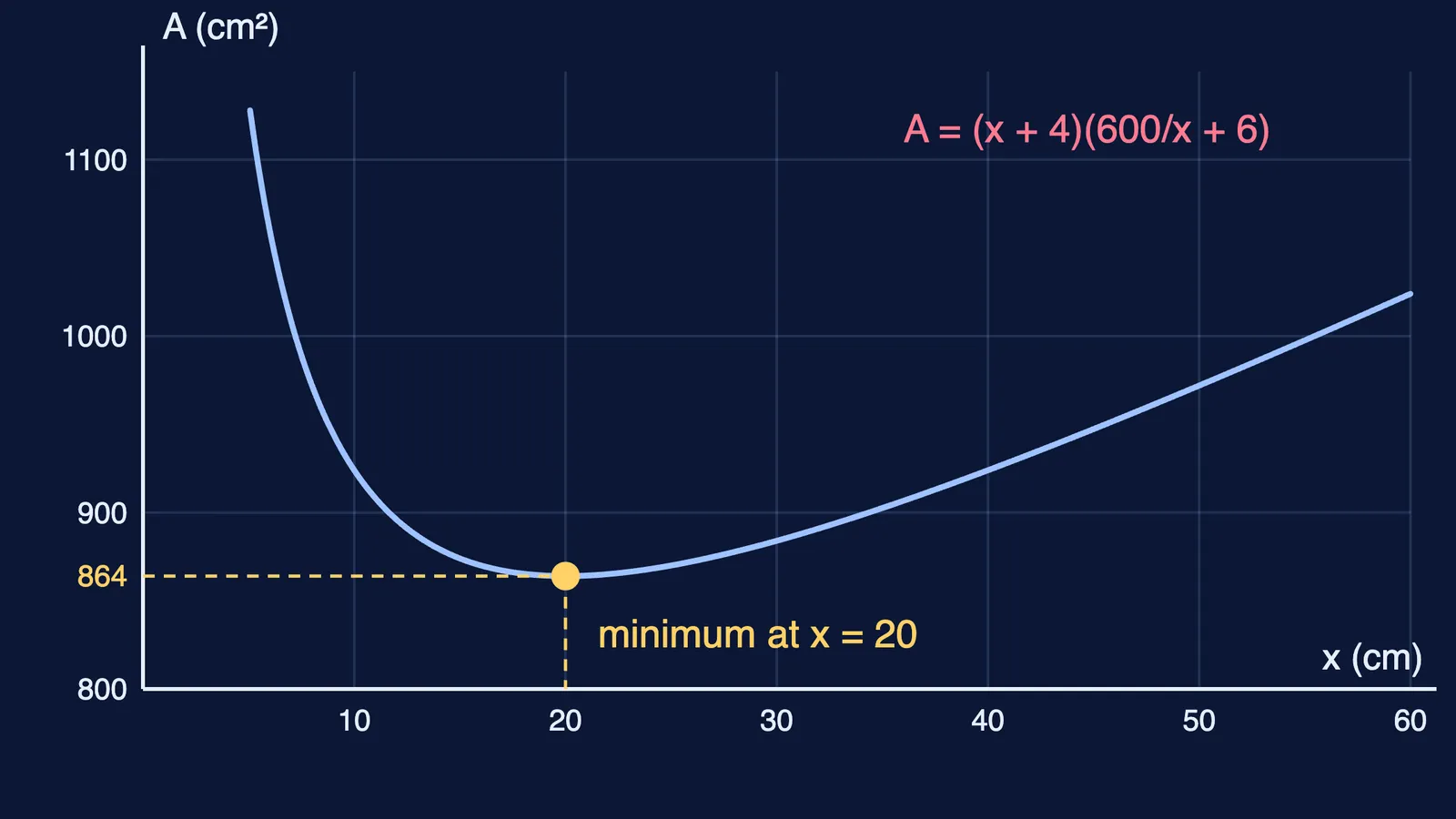
Example (our own). A school poster must have 600 cm² of printed area, with 3 cm margins at top and bottom and 2 cm margins at each side. What sheet size uses the least paper?
Method 1: second derivative test. Let the printed width be x cm, so its height is 600/x cm. Sheet area A(x) = (x + 4)(600/x + 6) = 624 + 6x + 2400/x, for x > 0. A′(x) = 6 − 2400/x² = 0 gives x = 20. A″(x) = 4800/x³, so A″(20) = 0.6 > 0: a minimum. Print 20 cm by 30 cm on a sheet 24 cm wide and 36 cm tall, using 864 cm².
Method 2: first derivative test, other variable. Let the printed height be y cm. Then A(y) = (600/y + 4)(y + 6) = 624 + 4y + 3600/y, and A′(y) = 4 − 3600/y² is negative for 0 < y < 30 and positive after. So y = 30 gives the least area: the same sheet.
Independent check. A(x) − 864 = 6(x − 20)²/x, never negative for x > 0 and zero only at x = 20, so 864 cm² is the least possible, with no calculus.
Which assertion-reason and case-study traps cost marks?
The sample paper's assertion-reason questions (Q19, Q20) test other chapters, but the four options are the same. NCERT's remark on x³ gives the classic trap here:
Assertion: x³ has neither a local maximum nor a local minimum at x = 0. Reason: the derivative of x³ is zero at x = 0. Both are true, but the reason does not explain the assertion: option (B). A zero derivative only makes a point a candidate.
Traps from the sample paper and marking scheme:
Q9: solving for x/a and forgetting to multiply back by a. The answer is (2πa/3, πa]; (2π/3, π] is the distractor.
Q10: strict inequality. 4x³ > x⁴ gives 0 < x < 4, not 0 < x ≤ 4.
Q37 (case study): part (ii) says "using the second derivative test", and ½ mark goes to showing W″(x) = −0.04 < 0. Part (iii) reuses x = 40 from part (i), so one slip spreads.
Short of time on the day? Use our triage plan for running out of time in a board paper.
A two-week revision plan
Days 1-2: rate of change (Exercise 6.1), with units.
Days 3-5: increasing and decreasing intervals with a sign chart; watch the brackets.
Days 6-8: both derivative tests on the same functions, including one where f″(c) = 0.
Days 9-11: optimisation in the layout above, then absolute extrema.
Days 12-14: sample paper Q9, Q10, Q27 and Q37, timed, marked against the scheme.
Shaky on differentiation itself? Start with our Continuity and differentiability board guide. Also sitting JEE Main? See Application of Derivatives for JEE Main.
When your working goes wrong and you cannot see where, the Fermi Problem Library has worked problems with a step-by-step solver that explains the reasoning rather than printing an answer.