On this page
Application of Derivatives turns differentiation into answers: how fast, where a graph rises, where it peaks. Below: the official scope, one worked example per question type, and a two-week plan.
What does the JEE Main 2027 syllabus include in Application of Derivatives?
The official Syllabus for JEE (Main) - 2027 from NTA lists applications of derivatives inside Unit 7 (Limit, Continuity and Differentiability) as three items: rate of change of quantities, monotonic (increasing and decreasing) functions, and maxima and minima of functions of one variable.
The NCERT Class 12 Mathematics Part I chapter on Application of Derivatives (Reprint 2026-27) has the same three sections, with absolute maxima and minima on a closed interval. Its introduction still mentions tangents, normals and approximations, but the reprint has no section on them and the NTA list does not name them.
If you are unsure why a function can be continuous but not differentiable, read why |x| is continuous but not differentiable at 0 first; it matters for the last trap below.
How do you solve rate of change problems?
Name the variables, write one equation linking them, differentiate with respect to time, then substitute. Substituting before differentiating freezes a quantity that is changing.
Example. A lamp is 6 m above the ground. A student 1.5 m tall walks away from its base at 1.2 m/s. How fast does the shadow lengthen?
Let x be the student's distance from the lamp and s the shadow's length. Similar triangles give 6/(x + s) = 1.5/s, so 4.5s = 1.5x and s = x/3. Differentiating, ds/dt = (1/3)(dx/dt) = 0.4 m/s. The tip of the shadow moves at dx/dt + ds/dt = 1.6 m/s. The answer does not depend on where the student stands.
How do you find where a function increases or decreases?
Factorise f′(x), mark its zeros on a number line and test the sign in each gap: f′ > 0 means increasing, f′ < 0 decreasing.
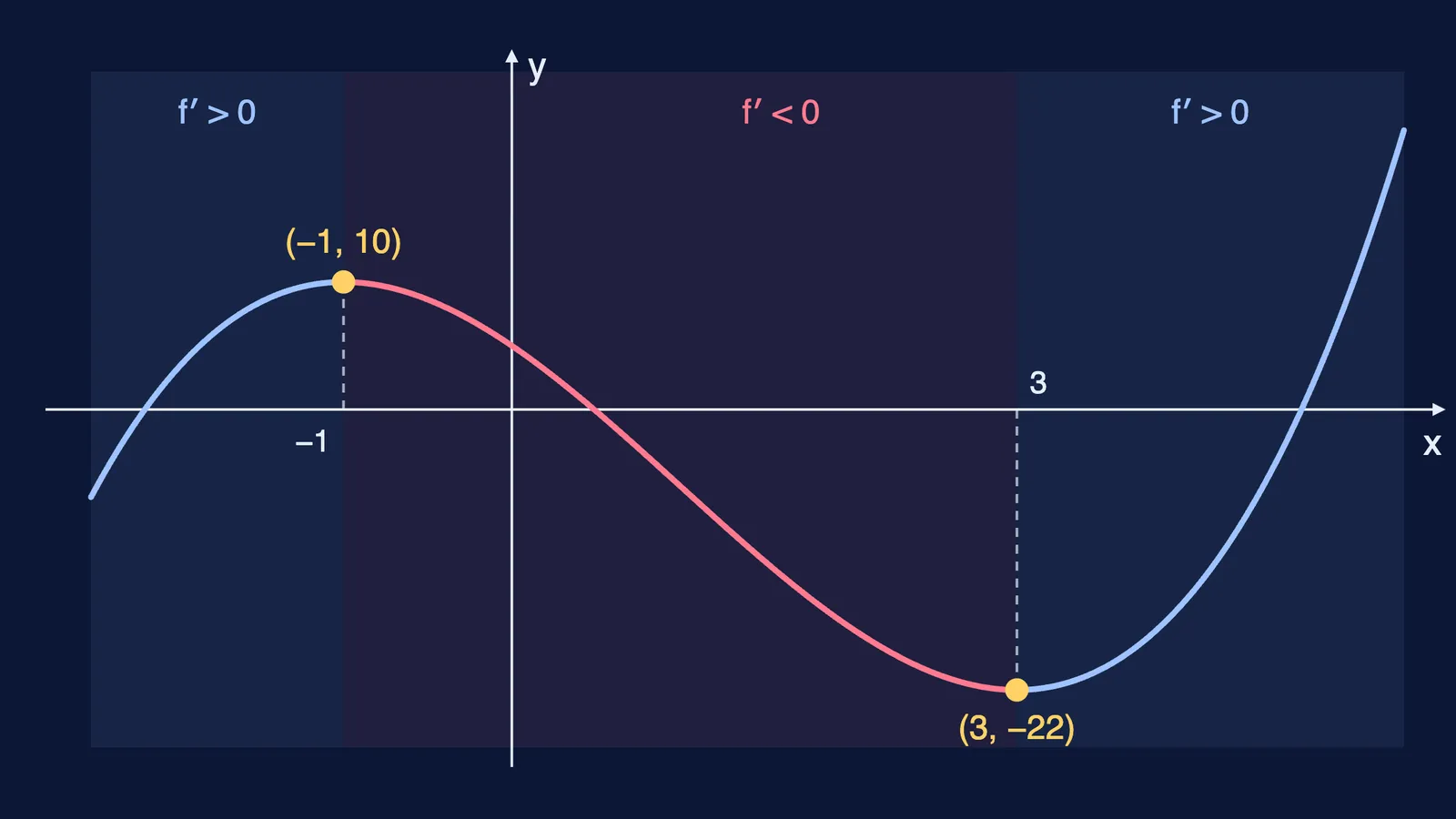
Example. For f(x) = x³ − 3x² − 9x + 5, f′(x) = 3x² − 6x − 9 = 3(x + 1)(x − 3). The sign runs plus, minus, plus, so f increases on (−∞, −1] and [3, ∞) and decreases on [−1, 3]. For more practice with sign charts, see how to find where a function is increasing or decreasing.
How do the first and second derivative tests work?
A critical point is where f′(x) = 0 or f is not differentiable. First derivative test: f′ changing from plus to minus gives a local maximum, minus to plus a local minimum, no change neither. Second derivative test, where f′ = 0: f″ < 0 means maximum, f″ > 0 minimum.
For the cubic above, f″(x) = 6x − 6. At x = −1, f″ = −12, so f(−1) = 10 is a local maximum. At x = 3, f″ = 12, so f(3) = −22 is a local minimum.
How do you solve optimisation and absolute extrema questions?
Example. 120 m of fencing encloses a rectangular plot beside a straight river, with no fence along the river. What is the largest area?
Let the two sides perpendicular to the river be x and the parallel side y. The constraint is 2x + y = 120, so y = 120 − 2x and the area is A(x) = x(120 − 2x) with 0 < x < 60. A′(x) = 120 − 4x = 0 gives x = 30, and A″ = −4 < 0 confirms a maximum. The plot is 30 m by 60 m with area 1800 m². Always write the constraint and the domain before differentiating. For a harder geometric version, try the largest cylinder inside a cone.
Two traps in absolute extrema on a closed interval:
The endpoint wins. On [−2, 6], the cubic gives f(−2) = 3, f(−1) = 10, f(3) = −22 and f(6) = 59. The absolute maximum is 59 at the endpoint x = 6, not 10; the minimum is −22.
The derivative never vanishes. For g(x) = |x − 2| + 3 on [0, 5], g′ is −1 or +1, never 0. The minimum sits at x = 2, where g is not differentiable: g(2) = 3. With g(0) = 5 and g(5) = 6, the absolute maximum is 6 at x = 5.
A two-week practice plan
Days 1-3: rate of change; draw every figure and write units.
Days 4-6: sign charts for polynomial, trigonometric and log functions.
Days 7-9: both derivative tests on the same functions.
Days 10-12: optimisation, constraint and domain first.
Days 13-14: timed closed-interval questions, then redo every miss.
When you cannot see where a solution went wrong, the Fermi Problem Library has worked problems with a step-by-step solver that explains the reasoning rather than printing an answer.