

On this page
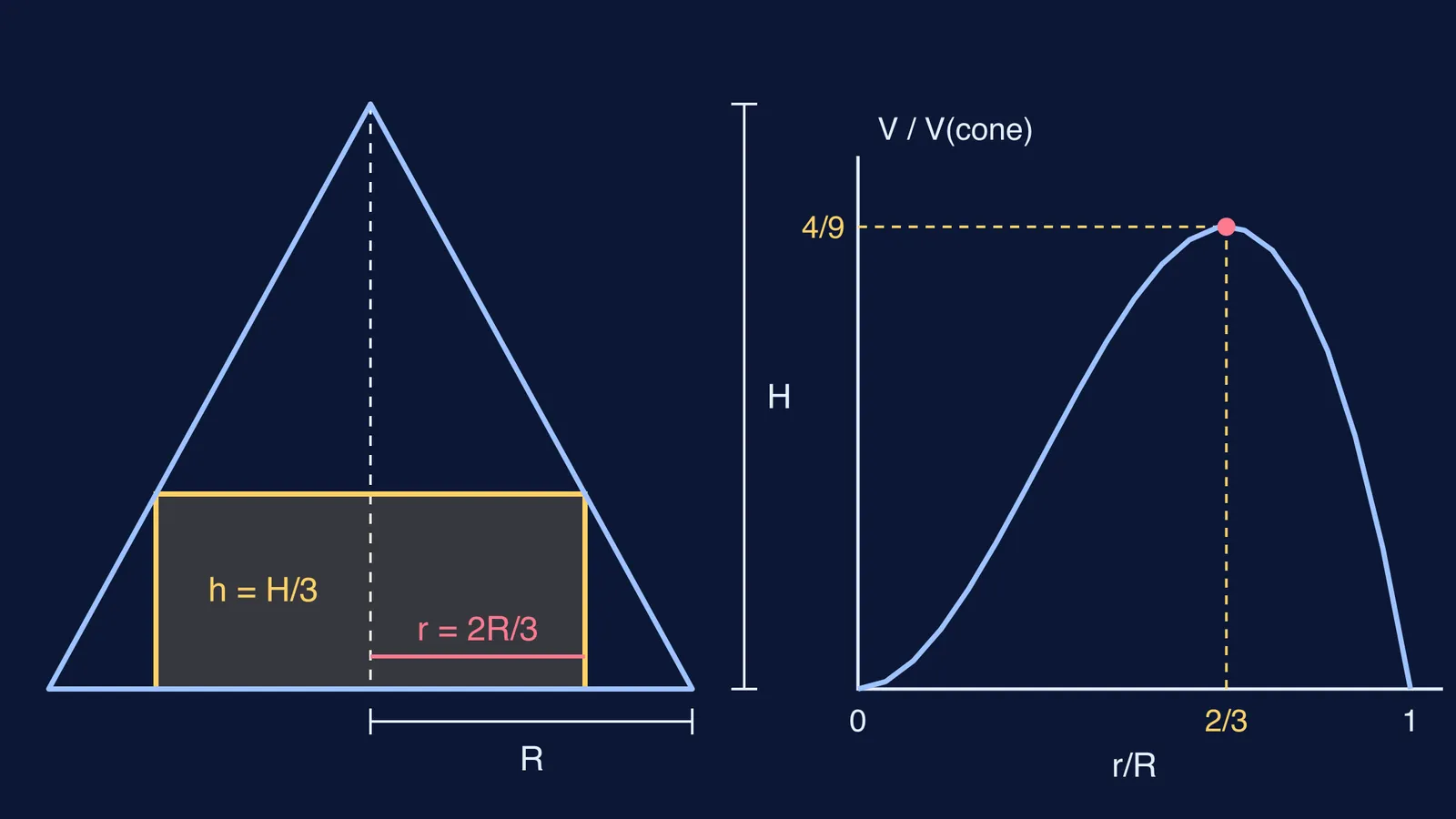
Picture a cone standing on its circular base, with a cylinder on the same base pushed up until its top rim touches the slanted wall all the way round. Make the cylinder wider and it must get shorter; make it taller and it must get thinner. Somewhere in between is the cylinder with the most volume, and the answer is neat: its height is always one-third of the cone's.
Where does this problem come from?
It is a standard Class 12 calculus question. In the NCERT Class 12 Mathematics chapter Application of Derivatives (reprint 2026-27), question 15 of the Miscellaneous Exercise asks you to show that the cylinder of greatest volume inscribed in a right circular cone of height h and semi-vertical angle α is one-third the cone's height, with greatest volume (4/27)πh³tan²α.
Below, the cone has height H and base radius R, and the cylinder has r and h. NCERT's angle form is the same answer, because R = H tan α. The method has two moves: similar triangles, then one derivative.
How do similar triangles link the radius and height?
Slice straight down through the axis. The cone becomes a triangle of height H and half-width R; the cylinder becomes a rectangle of half-width r and height h standing on the base.
Now look at the small triangle above the rectangle. Its tip is the cone's apex, its height is H − h, and its half-width at the bottom is r. It has the same shape as the whole cone's triangle, so the ratios match:
r / R = (H − h) / H
Rearranging gives the one equation that does all the work:
h = H(1 − r/R)
At r = 0 or r = R the volume is zero, so the maximum lies in between.
How do you find the maximum volume?
Write the volume in terms of r alone:
V(r) = πr²h = πH(r² − r³/R), for 0 < r < R
Differentiate:
V′(r) = πH(2r − 3r²/R) = πHr(2 − 3r/R)
Setting V′(r) = 0 gives r = 0 (no cylinder, ruled out) or r = 2R/3.
The second derivative is V″(r) = πH(2 − 6r/R). At r = 2R/3 it equals −2πH, which is negative. The second derivative test in the NCERT chapter summary says that if f′(c) = 0 and f″(c) < 0, then c is a point of local maxima, so this is the maximum.
Put r = 2R/3 back into the similar-triangles equation: h = H(1 − 2/3) = H/3. The cylinder of greatest volume is one-third as tall as the cone and two-thirds as wide.
Its volume is π(2R/3)²(H/3) = 4πR²H/27. The cone holds πR²H/3, so the best cylinder fills exactly 4/9 of the cone.
What does it look like with real numbers?
Take a cone 12 cm tall with a base radius of 6 cm. The similar-triangles equation becomes h = 12(1 − r/6) = 12 − 2r. Try three cylinders:
r = 3 cm, h = 6 cm: V = 54π, about 169.6 cm³
r = 4 cm, h = 4 cm: V = 64π, about 201.1 cm³
r = 5 cm, h = 2 cm: V = 50π, about 157.1 cm³
The middle one wins, as the formula predicts: r = 2(6)/3 = 4 cm and h = 12/3 = 4 cm. The cone holds π × 36 × 12 / 3 = 144π cm³, and 64π / 144π = 4/9. Here the winning cylinder's radius equals its height only because this cone has R = H/2; that is not a rule.
Where do students lose marks on this problem?
Run through this checklist before you hand in:
Differentiating V while it still has two variables. Eliminate h with similar triangles first.
Writing the wrong ratio, such as r/R = h/H. That says a taller cylinder is also wider, which cannot fit. Test your ratio at r = 0 and r = R.
Not justifying the maximum. Show V″ < 0, or show V′ changes from positive to negative at r = 2R/3.
Stopping at r. If the question asks for height, end with h = H/3; if it asks for volume, give 4πR²H/27 or NCERT's angle form.
Mixing up the two heights. Keep capitals for the cone and lower-case for the cylinder throughout.
If you are unsure why a step works, the Fermi Problem Library has worked problems with a step-by-step solver that explains the reasoning rather than printing an answer. If the gap is further back, in similar triangles or the second derivative test, the Fermi Concept Library gives each mathematics concept its own lesson.
What should you try next?
The same NCERT exercise has two cousins: question 12 (the largest cone in a sphere of radius r has altitude 4r/3) and question 14 (the largest cylinder in a sphere of radius R has height 2R/√3). There, Pythagoras replaces similar triangles as the link between radius and height.


