

On this page
In "find the intervals where f is increasing or decreasing", the derivative is usually the easy part. The traps sit in the last two lines: a sign misread at a repeated factor, or an answer like (−1, 1) that quietly includes a point where the function does not exist.
What does the sign of f′(x) tell you?
OpenStax Calculus Volume 1, section 4.5 states the rule: if the derivative of a function is positive over an interval, the function is increasing over that interval; if it is negative, the function is decreasing.
So the job is to find where f′(x) is positive and where it is negative. OpenStax section 4.3 defines a critical point (it uses the term "critical number") as an interior point c of the domain where f′(c) = 0 or f′(c) is undefined.
If the slope idea feels shaky, start with our post on increasing and decreasing functions and the sign of f′(x).
How do you build a sign chart for f′(x)?
Write down the domain of f. Any point outside it is a wall on your number line.
Factorise f′(x) completely. Drop factors that are always positive, like x² + 1 or eˣ.
Mark every zero of f′ and every point where f′ is undefined.
Pick one test value in each gap and find only the sign of each factor there.
Write "+" (increasing) or "−" (decreasing) in each gap.
OpenStax's first derivative test uses the same strategy: split the domain at the critical points, then check the sign of f′ at a test point in each piece (OpenStax 4.5). If you have used the wavy curve method for rational inequalities, this is the same skill applied to f′(x).
A worked example: f(x) = x⁴ − 4x³ + 4x²
The domain is all real numbers, so there are no walls.
Differentiate: f′(x) = 4x³ − 12x² + 8x.
Factorise: f′(x) = 4x(x² − 3x + 2) = 4x(x − 1)(x − 2). The critical points are x = 0, 1 and 2.
Test one value in each gap:
At x = −1: 4(−1)(−2)(−3) = −24, so f′ < 0.
At x = 0.5: 4(0.5)(−0.5)(−1.5) = 1.5, so f′ > 0.
At x = 1.5: 4(1.5)(0.5)(−0.5) = −1.5, so f′ < 0.
At x = 3: 4(3)(2)(1) = 24, so f′ > 0.
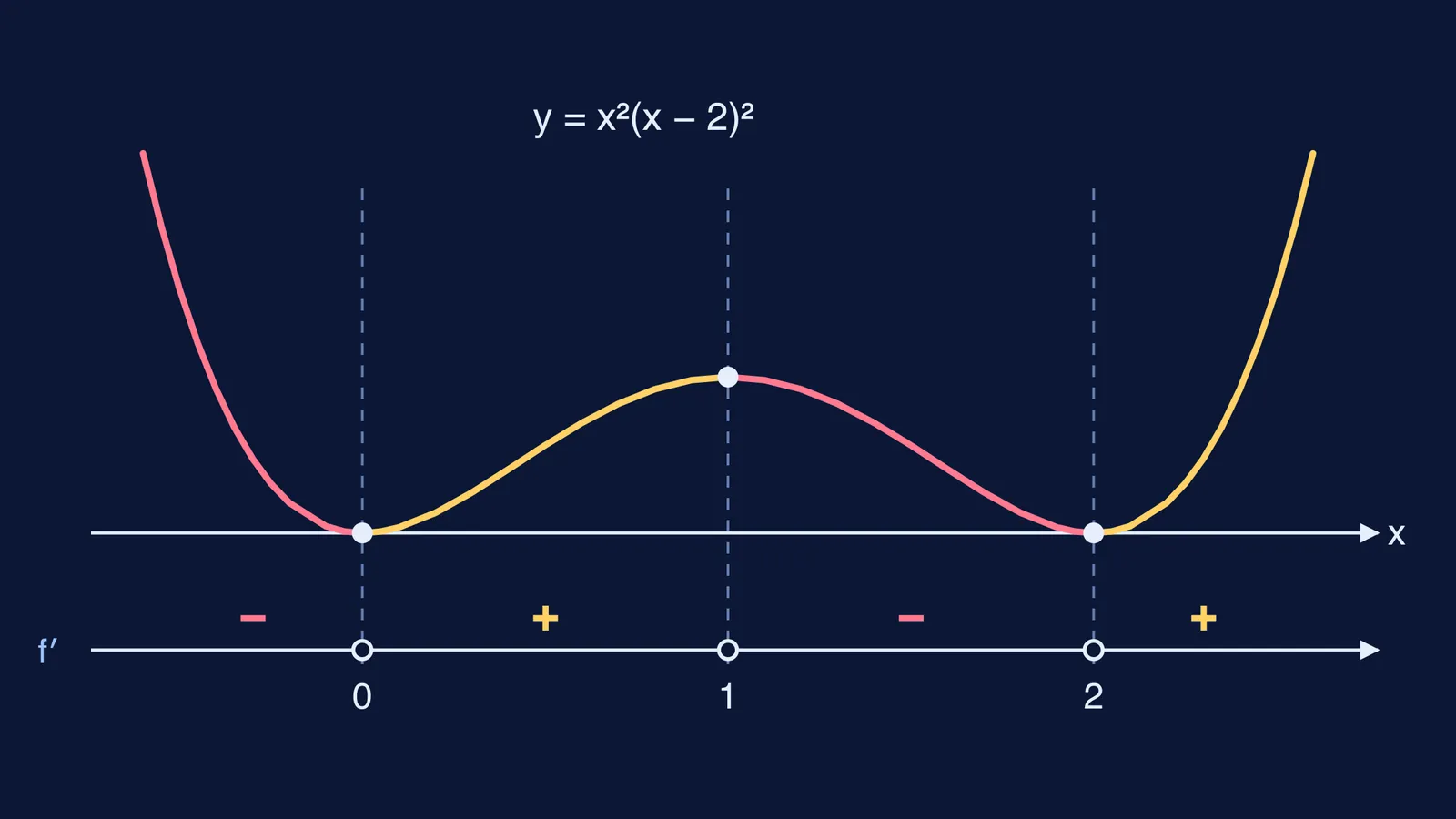
The chart reads − + − +. So f is decreasing on (−∞, 0] and [1, 2], and increasing on [0, 1] and [2, ∞). The diagram above shows this chart under the curve y = x²(x − 2)².
Should the critical points be in brackets or parentheses?
Conventions differ, so check how your textbook or board writes them. OpenStax gives its answers as open intervals (section 4.5). Square brackets at a critical point are also correct when f is continuous there, because a function that rises up to c and keeps rising from c is increasing across c. What is never correct is closing a bracket at a point outside the domain.
Three rules to apply before you write the answer:
Even powers do not flip the sign. If f′(x) = (x − 1)²(x + 2), the sign changes only at x = −2, so f is increasing on −2, ∞). The same thing happens with f(x) = x³: f′(0) = 0, yet [OpenStax 4.3 notes that x³ is increasing over (−∞, ∞).
Never join intervals across a gap in the domain. For f(x) = x + 1/x, f′(x) = (x − 1)(x + 1)/x². It is negative on (−1, 0) and on (0, 1), but f is not decreasing on "(−1, 1)": x = 0 is not in the domain, and f(−0.5) = −2.5 is less than f(0.5) = 2.5. Write: decreasing on [−1, 0) and (0, 1].
Be careful with ∪ across a break. "Decreasing on A ∪ B" claims more than "decreasing on A and on B", as x + 1/x shows.
For points where f′ is undefined, see stationary points versus critical points, which covers corners where f′ does not exist.
How do you practise this until it sticks?
Do five questions writing only the factorised f′ and its sign chart, then five writing only the final intervals from a given chart, to see which half you get wrong. Include one with a squared factor, one with a denominator, and one with a restricted domain, like ln x.
When your answer differs from the key and you cannot see why, the Fermi Problem Library has worked problems with a step-by-step solver that explains the reasoning rather than printing an answer, so you can look for the line where your chart went wrong. If the gap is further back, in derivatives or factorising, the Fermi Concept Library gives each mathematics concept its own lesson.


