On this page
These eight NEET-UG Biology questions on Biomolecules are new, not copied or reworded from NCERT, exemplar or past papers. They run from building blocks to enzymes and end with two short calculations.
Which parts of Biomolecules does this NEET set cover?
The NEET (UG)-2026 syllabus finalised by the National Medical Commission lists "Chemical constituents of living cells" in Biology Unit 3: the structure and function of proteins, carbohydrates, lipids and nucleic acids, and enzyme types, properties, action, classification and nomenclature. Every fact these questions rely on is in Chapter 9 of the NCERT Class 11 Biology book, Reprint 2026-27.
New to the chapter? Read our guide on how to prepare Biomolecules for NEET first, or the Class 11 Biomolecules walkthrough for the theory.
How should you use these practice questions?
Cover each answer and give yourself about a minute per question.
For Q7 and Q8, write units and steps on paper.
Read the trap line even when you were right.
List every trap that caught you and reread it before your next mock test.
Easy: do you know the building blocks?
All three answers come from sections 9.1 to 9.6 of NCERT Chapter 9.
Q1 (easy). A student grinds a spinach leaf in trichloroacetic acid and strains the slurry through cheesecloth. Which pair would both be found in the retentate, the acid-insoluble fraction?
(A) Cellulose and membrane phospholipids (B) Glucose and alanine (C) Adenylic acid and sucrose (D) DNA and uridine
Answer: (A). NCERT says the acid-insoluble fraction holds only proteins, nucleic acids, polysaccharides and lipids. Lipids land there because ground membranes form insoluble vesicles. Trap: (D) is half right; DNA is insoluble, but uridine is a small nucleoside that stays in the acid-soluble pool.
Q2 (easy). Which compound has a purine base and a phosphate group esterified to its sugar?
(A) Adenosine (B) Guanylic acid (C) Cytidylic acid (D) Guanine
Answer: (B). Guanylic acid is a nucleotide (phosphate on the sugar) of guanine, a purine. Trap: (A) has a purine but no phosphate; adenosine is a nucleoside.
Q3 (easy). A lab assistant adds iodine solution to two white powders. Powder P turns blue. Powder Q, made only of glucose units, shows no blue colour. What are P and Q?
(A) P is starch, Q is cellulose (B) P is cellulose, Q is starch (C) P is starch, Q is inulin (D) P is inulin, Q is cellulose
Answer: (A). Starch forms helices that hold iodine and turn blue; cellulose, also a glucose polymer, has no complex helices and cannot hold iodine. Trap: (C) ignores the stem's clue, because inulin is a polymer of fructose, not glucose.
Medium: can you apply the rules on proteins and enzymes?
These use sections 9.7 and 9.8 of NCERT Chapter 9.
Q4 (medium). Consider these statements about proteins.
(i) Only right-handed helices are observed in proteins.
(ii) The N-terminal amino acid is the last amino acid in the chain.
(iii) Adult human haemoglobin has two α and two β subunits.
(iv) Tertiary structure is necessary for many biological activities of proteins.
(A) i, iii and iv (B) i, ii and iii (C) ii and iv only (D) iii and iv only
Answer: (A). Statement (ii) is wrong: the N-terminal amino acid is the first one, and the last is the C-terminal amino acid. Trap: (D) drops (i) because "only right-handed" sounds too absolute, but NCERT states it exactly that way.
Q5 (medium). Enzyme X moves a phosphate group from ATP to glucose. Enzyme Y removes a group from its substrate without using water and leaves a C=C double bond. Which classes do X and Y belong to?
(A) Transferase, hydrolase (B) Ligase, lyase (C) Transferase, lyase (D) Isomerase, hydrolase
Answer: (C). A transferase moves a group other than hydrogen between two substrates. A lyase removes groups by a route other than hydrolysis and leaves double bonds. Trap: (A) treats every removal as hydrolysis; "without using water" rules out a hydrolase.
Q6 (medium). An enzyme loses activity when a small organic molecule is washed away, and regains it when the molecule is added back. The molecule binds the protein only briefly during each reaction, and the same molecule helps several different enzymes. What is it?
(A) A prosthetic group (B) A metal ion (C) The apoenzyme (D) A co-enzyme
Answer: (D). NCERT describes co-enzymes as organic co-factors whose link to the apoenzyme is transient and which serve many different enzyme reactions; its example is NAD and NADP, which contain the vitamin niacin. Trap: (A) is also organic, but a prosthetic group, like haem in catalase, is tightly bound.
Hard: can you handle numbers in the enzyme section?
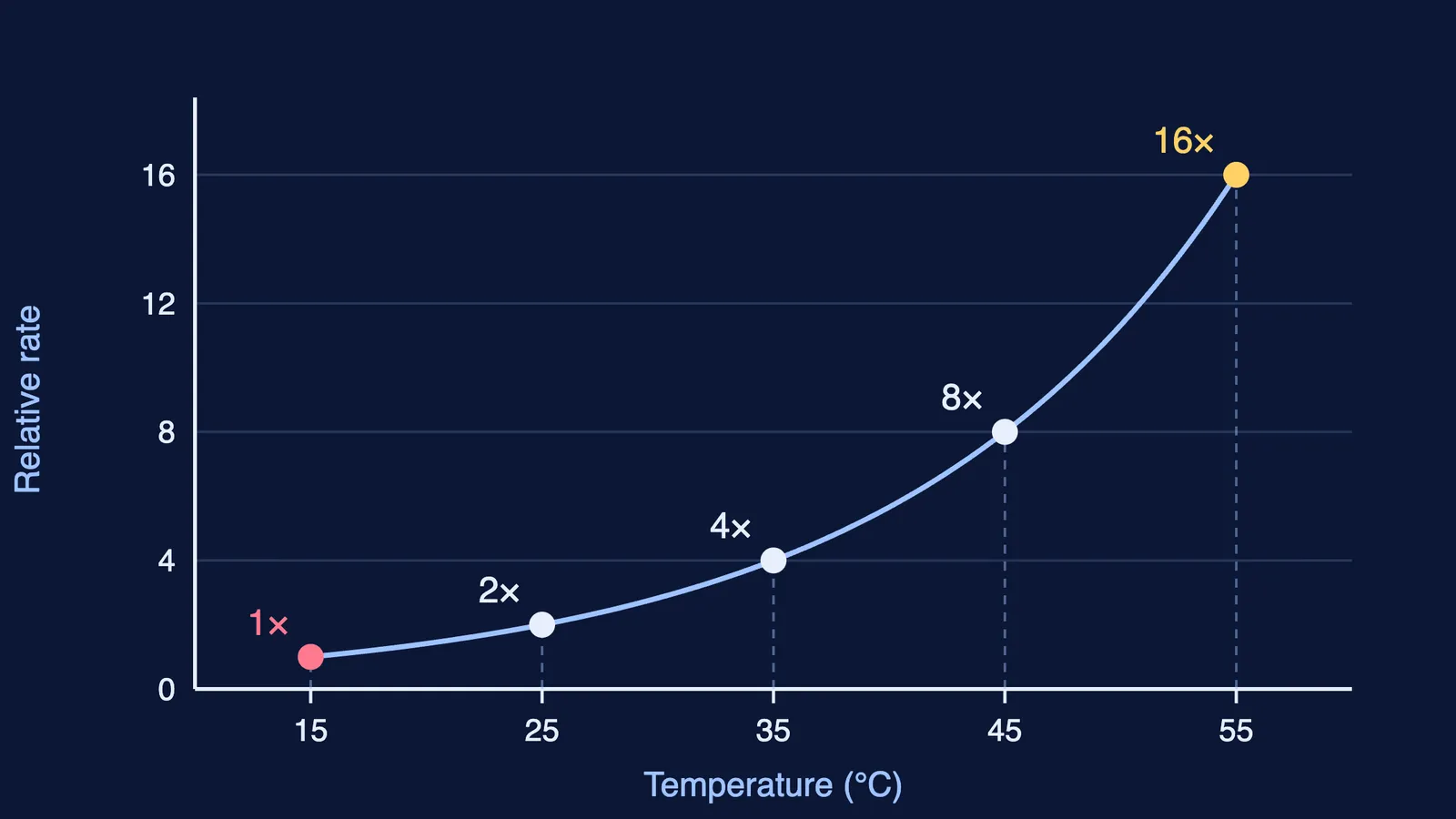
Both use section 9.8.1 of Chapter 9: rate is product formed per unit time, and as a rule of thumb a rate doubles or halves for every 10°C change. Both answers were checked in Python.
Q7 (hard). Without an enzyme, a reaction forms 300 product molecules per minute. With the enzyme, it forms 450,000 molecules per second. By what factor has the enzyme raised the rate?
(A) 1,500 (B) 90,000 (C) 5,400,000 (D) 9,000
Answer: (B). Put both rates in the same unit first: 300 per minute is 5 per second, and 450,000 ÷ 5 = 90,000. Trap: (A) divides 450,000 by 300 without converting minutes to seconds.
Q8 (hard). An uncatalysed chemical reaction runs at rate R at 15°C. Using NCERT's rule of thumb, how many times faster does it run at 55°C?
(A) 4 (B) 8 (C) 16 (D) 32
Answer: (C). The rise is 40°C, which is four steps of 10°C, and each step doubles the rate: 2 × 2 × 2 × 2 = 16. Trap: (B) multiplies 2 by the number of steps (2 × 4) instead of doubling four times, and (D) counts the five temperatures 15, 25, 35, 45 and 55 as five steps.
If a method slip rather than a fact cost you a question, work similar problems in the Fermi Problem Library, where a step-by-step solver explains the reasoning rather than printing an answer. Next, try our cell cycle and cell division NEET practice questions.