On this page
Biomolecules is Chapter 9 of Class 11 NCERT Biology. Here is what the 2026-27 syllabus keeps, the chapter in brief and our own practice questions.
What does the 2026-27 CBSE syllabus include for Biomolecules?
The CBSE Biology curriculum for 2026-27 places it in Unit III, Cell: Structure and Function, which carries 15 marks of the 70-mark Class XI theory paper. Chapters 8, 9 and 10 share those 15 marks; CBSE gives no per-chapter figure.
It covers how proteins, carbohydrates, lipids and nucleic acids are built and what they do, plus enzyme types, properties and action. Practical experiment 7, testing for sugar, starch, proteins and fats, uses the same ideas.
The NCERT rationalised content booklet removes the same sections. We followed the current NCERT chapter (Reprint 2026-27), sections 9.1 to 9.8.
What are biomolecules, and how do we find them?
Grind tissue in trichloroacetic acid and filter it, as the NCERT chapter describes, and you get two fractions:
Acid-soluble pool (filtrate): small molecules of about 18 to 800 Da, such as amino acids and sugars; roughly the cytoplasm.
Acid-insoluble fraction (retentate): proteins, nucleic acids, polysaccharides and lipids. All except lipids are above about 10,000 Da.
Lipids stay under 800 Da, yet end up in the retentate: membranes shatter into vesicles that water cannot dissolve.
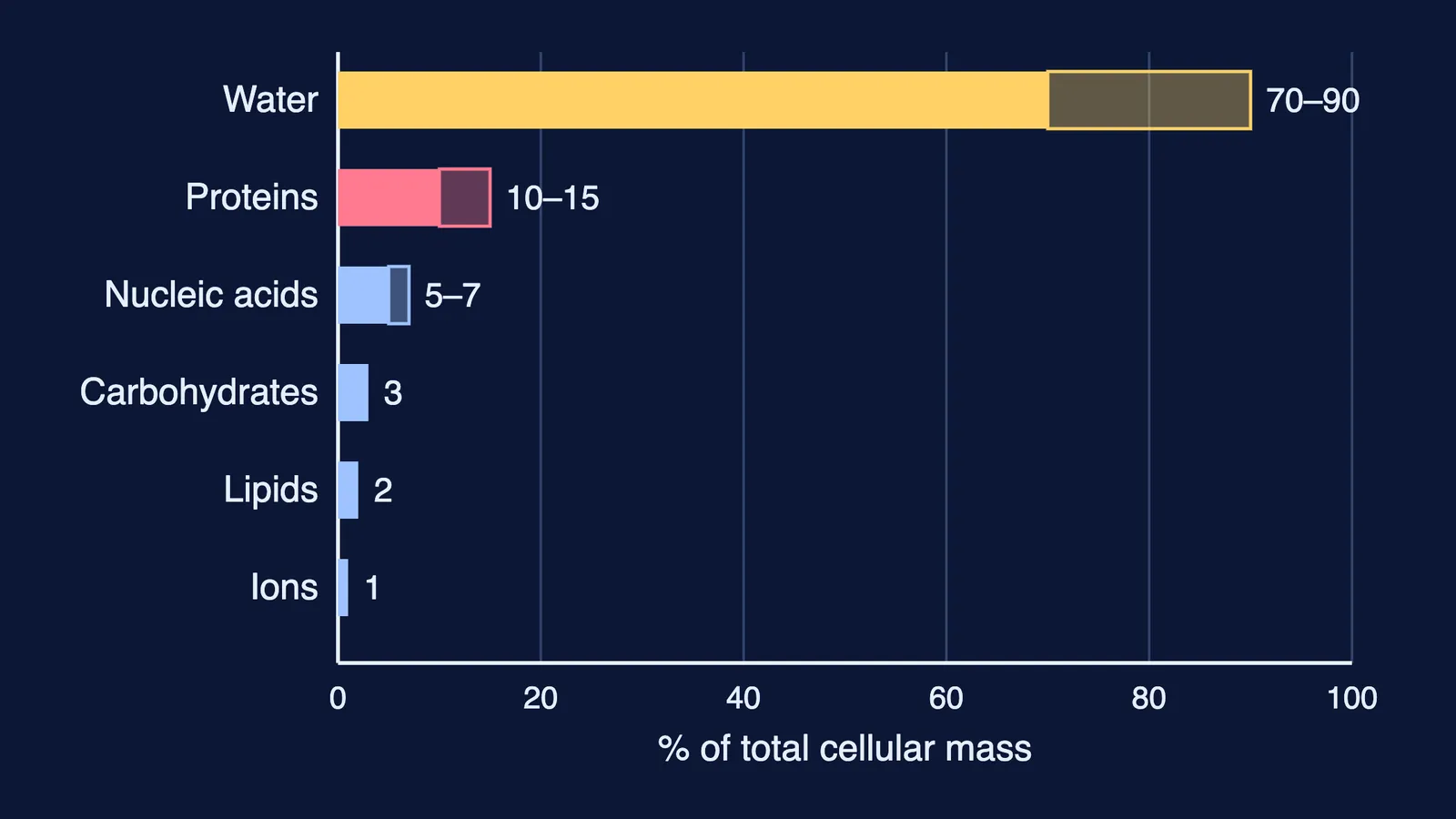
Water is the most abundant chemical in cells: 70-90% of cellular mass, against 10-15% for proteins (NCERT Table 9.4, charted above).
How are the four big classes built?
Proteins: chains of amino acids joined by peptide bonds; with 20 types, a protein is a heteropolymer. Collagen is the most abundant animal protein; RuBisCO, the most abundant in the biosphere.
Protein structure: primary is the amino acid sequence; secondary includes the right-handed helix; tertiary, the chain folded on itself, is needed for activity; quaternary is subunit arrangement, as in adult haemoglobin (two α, two β).
Polysaccharides: cellulose uses glucose alone (a homopolymer); plants keep energy as starch, animals as glycogen; inulin is made of fructose. Iodine fits in starch's helices, turning it blue; cellulose lacks them.
Lipids: glycerol esterified with fatty acids gives mono-, di- and triglycerides (fats and oils); lecithin, a phospholipid, sits in cell membranes.
Nucleic acids: polynucleotides; a nucleotide is a nitrogen base, a pentose sugar and phosphate. Adenine and guanine are purines; cytosine, uracil and thymine are pyrimidines. Deoxyribose makes DNA; ribose makes RNA.
How do enzymes work, and what affects their activity?
Almost all enzymes are proteins; catalytic nucleic acids are called ribozymes. The substrate binds the active site: E + S → ES → EP → E + P. Enzymes lower the activation energy.
Temperature and pH: activity peaks at an optimum and falls on both sides. Cold inactivates temporarily; heat denatures.
Substrate concentration: velocity rises, then levels off at Vmax.
Inhibitors: a competitive inhibitor resembles the substrate, as malonate resembles succinate and blocks succinic dehydrogenase.
Cofactors: prosthetic groups bind tightly (haem in catalase); coenzymes bind briefly (NAD contains niacin); metal ions help too (zinc in carboxypeptidase).
The six classes: oxidoreductases, transferases, hydrolases, lyases, isomerases, ligases.
What practice questions should you try?
Mark labels are ours, modelled on the Class XII Biology sample paper for 2026-27; CBSE has no Class XI paper.
(1 mark) Spinach is ground in trichloroacetic acid and filtered. Which fraction holds RuBisCO?
(1 mark) Assertion: lipids separate with the acid-insoluble fraction. Reason: lipids have molecular weights above 10,000 Da.
(2 marks) An enzyme forms 30 units of product per minute at 20°C. Use NCERT's rule of thumb to estimate the rate at 30°C and at 10°C.
(3 marks) Name the cofactor and its type for catalase, carboxypeptidase and an enzyme that uses NAD.
(3 marks) Malonate is added to succinic dehydrogenase. Name the type of inhibition and explain it.
(5 marks) An enzyme from a hot-spring bacterium and one from human cells are tested at 37°C and 75°C. Predict the results and explain them using tertiary structure and the active site.
Answers: 1. Acid-insoluble fraction (it is a protein). 2. Assertion true, reason false. 3. About 60 and 15 units per minute. 4. Haem, prosthetic group; zinc, metal ion; NAD, coenzyme. 5. Competitive; malonate resembles succinate and occupies the active site. 6. At 37°C the human enzyme is near its optimum; the thermophile's is active but likely below its optimum. At 75°C the human enzyme denatures, losing its active site; the thermophile's keeps its shape.
How should you revise this chapter?
Redraw the composition chart from memory. Read Cell: The Unit of Life for Class 11 before this chapter and Cell Cycle and Cell Division for Class 11 after it. For NEET, see how to prepare Biomolecules for NEET.
Not sure where to begin? Fermi's AI tutor works out what you already know, builds a plan for the session, and teaches through it.