On this page
Here are eight original JEE Main-style questions on electromagnetic induction and alternating current, easy to hard. Each has a worked solution and a trap line on the likeliest wrong option. Q3 and Q7 are numerical.
How should you use this EMI and AC question set?
Unit 14 of the Syllabus for JEE (Main) - 2027 covers Faraday's and Lenz's laws, self and mutual inductance, RMS values, impedance, the LCR series circuit, resonance, power and the transformer. All eight stay inside that list and NCERT Class 12 Physics Chapter 6 and Chapter 7. The JEE (Main) 2027 information bulletin gives +4 for a correct answer and −1 for a wrong one, and Section B answers are rounded to the nearest integer.
Give yourself 25 minutes, on paper, without a calculator.
Before any formula, write down what is changing: field, area, angle or frequency.
Read every trap line, even where you were right.
New to the chapter? Start with our guide on how to prepare electromagnetic induction and AC for JEE Main.
Easy: can you apply Faraday's law and RMS values?
Q1 (easy). A 200-turn coil of area 25 cm² lies with its plane perpendicular to a uniform field. The field falls steadily from 0.60 T to 0.10 T in 0.050 s. The average induced emf is:
(A) 0.025 V
(B) 5.0 V
(C) 6.0 V
(D) 500 V
Answer: (B). emf = NAΔB/Δt = 200 × 25 × 10⁻⁴ m² × 0.50 T / 0.050 s = 5.0 V. Trap: (C), which uses the starting 0.60 T instead of the 0.50 T change.
Q2 (easy). The voltage v = 311 sin(100πt) V is applied across a 50 Ω resistor. The average power it dissipates is closest to:
(A) 1934 W
(B) 1368 W
(C) 967 W
(D) 484 W
Answer: (C). Vrms = 311/√2 ≈ 220 V, so P = Vrms²/R ≈ 967 W. Trap: (A), which puts the peak 311 V into V²/R.
Q3 (easy, numerical). An ideal transformer steps 230 V mains down to 12 V for a 36 W lamp. Find the primary current in mA.
Answer: 157. With no losses, VpIp = 36 W, so Ip = 36/230 A = 156.5 mA, which rounds to 157. Trap: 3000, which is the secondary current, 36 W/12 V.
Medium: where do rotating rods, coupled coils and LCR power trip you up?
Q4 (medium). A metal rod 0.60 m long turns at 20 rad/s in a plane perpendicular to a 0.50 T field, about an axis through a point 0.20 m from one end. The emf between the two ends of the rod is:
(A) 0
(B) 0.60 V
(C) 1.0 V
(D) 1.8 V
Answer: (B). Each arm of length r gives ½Bωr² from pivot to tip, in the same sense. With arms of 0.40 m and 0.20 m, the ends differ by ½ × 0.50 × 20 × (0.40² − 0.20²) = 0.60 V. Trap: (C), which adds the two arm emfs. Both point from the pivot outward, so between the tips they subtract.
Q5 (medium). Two coaxial solenoids are each 0.50 m long. The inner one has radius 2.0 cm and 500 turns; the outer one has radius 3.0 cm and 1000 turns. Take μ₀ = 4π × 10⁻⁷ T m A⁻¹. Their mutual inductance is closest to:
(A) 0.39 mH
(B) 1.6 mH
(C) 3.6 mH
(D) 6.3 mH
Answer: (B). The outer coil's field μ₀(N₂/l)I links the inner coil only through its area, so M = μ₀N₁N₂πr₁²/l = 1.58 × 10⁻³ H. Trap: (C), which uses the outer radius. Flux outside the inner coil never passes through its turns.
Q6 (medium). A series circuit has R = 60 Ω, L = 0.40 H and C = 50 μF, driven at 220 V rms and ω = 200 rad/s. The average power drawn is closest to:
(A) 81 W
(B) 726 W
(C) 765 W
(D) 1452 W
Answer: (B). XL = ωL = 80 Ω and XC = 1/(ωC) = 100 Ω, so Z = √(60² + 20²) = 63.2 Ω and Irms = 3.48 A. Only R takes power: P = Irms²R = 726 W. Trap: (C), which is VrmsIrms with the power factor of 60/63.2 left out.
Hard: what happens at resonance and at terminal speed?
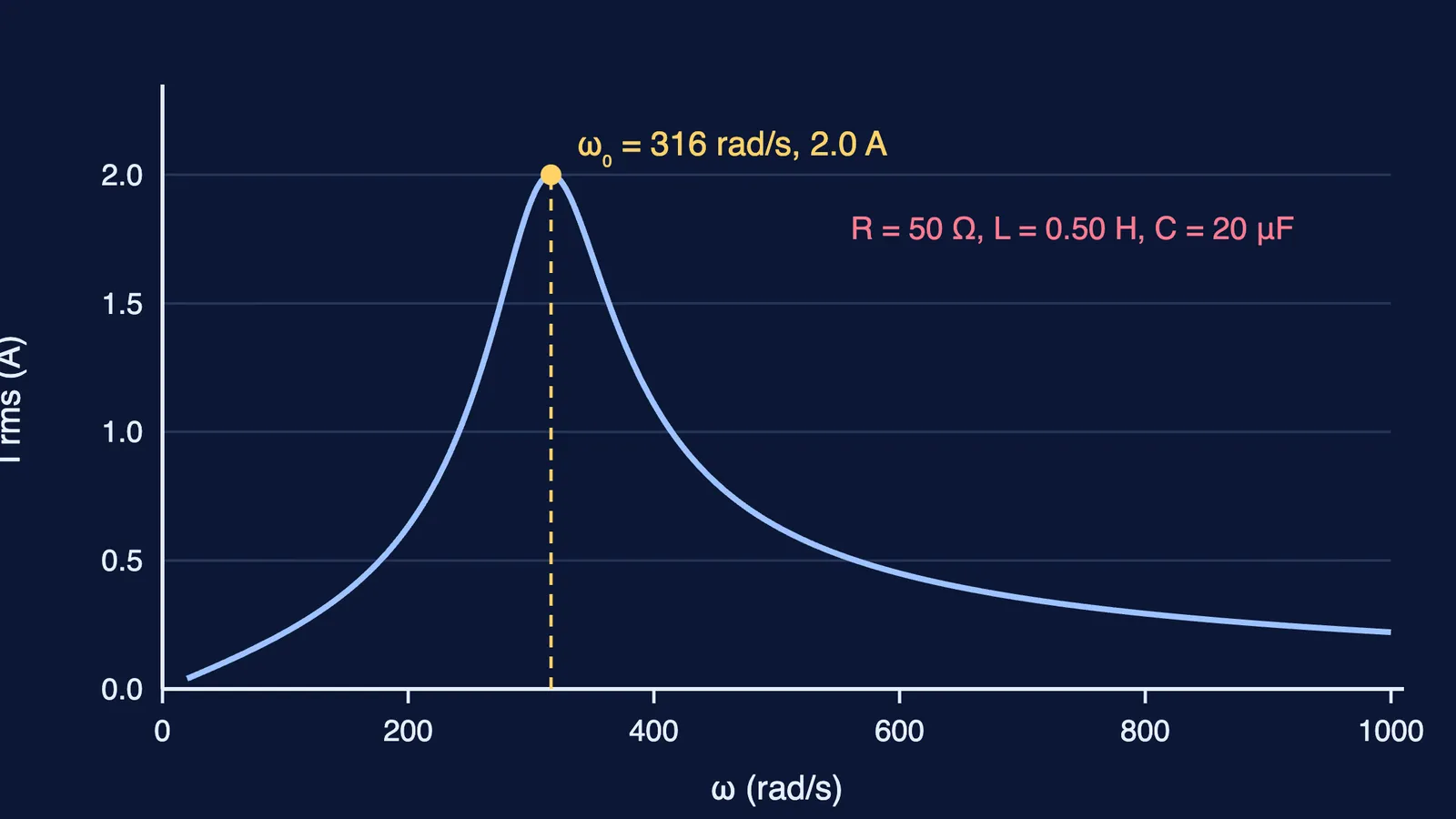
Q7 (hard, numerical). A series LCR circuit with L = 0.50 H and C = 20 μF is driven at its resonant frequency by a 100 V rms source, and the rms current is 2.0 A. Find the rms voltage across the capacitor, in volts.
Answer: 316. ω₀ = 1/√(LC) = 1/√(1.0 × 10⁻⁵) = 316 rad/s, so XC = 1/(ω₀C) = 158 Ω and VC = IXC = 316 V. Trap: 100, from assuming no part can exceed the source voltage. At resonance VL and VC cancel, so each can far exceed 100 V.
Q8 (hard). A rod of mass 20 g and length 0.50 m slides without friction down two vertical rails joined at the top. A horizontal 0.40 T field is perpendicular to the plane of the rails. The circuit resistance is 0.10 Ω; take g = 10 m s⁻². The rod's terminal speed is:
(A) 0.10 m/s
(B) 0.25 m/s
(C) 0.50 m/s
(D) 2.0 m/s
Answer: (C). At speed v the current is BLv/R and the upward force is B²L²v/R. Equating it to mg gives v = mgR/(B²L²) = 0.020 × 10 × 0.10/(0.16 × 0.25) = 0.50 m/s. Trap: (A), mgR/(BL), which keeps only one factor of BL. The emf and the force each bring one.
What should you do after marking this set?
Sort each miss into one bin: what is changing (Q1, Q4), RMS and power (Q2, Q3, Q6) or geometry and balance (Q5, Q7, Q8). Practise the fullest bin this week and redo your misses in two days, without solutions. Our explainer on phasors, impedance and resonance helps with the AC bin. For Q8-style rods, see how far a rod on rails slides before it stops.
When a whole method breaks down rather than one step, the Fermi Problem Library has worked problems with a step-by-step solver that explains the reasoning rather than printing an answer.