On this page
Eight original JEE Main-style wave optics questions, easy to hard. Each has a worked solution and a trap line naming the wrong option most students pick. Q6 is a numerical-value question.
How should you use this wave optics question set?
The Wave optics paragraph in Unit 16 of NTA's Syllabus for JEE (Main) - 2027 lists Huygens' principle, Young's double-slit experiment and fringe width, coherent sources, single-slit diffraction with the width of the central maximum, and plane-polarised light with Polaroids. Every question here stays inside that list and inside NCERT Class 12 Physics Chapter 10, Wave Optics (Reprint 2026-27).
Take 20 minutes, on paper, without a calculator.
Before substituting, write the condition you are using: bright or dark, interference or diffraction.
Read every trap line, even where you were right.
New to the chapter? Start with our guide on how to prepare wave optics for JEE Main.
Easy: can you handle wavefronts, fringe positions and Malus's law?
Q1 (easy). A plane wavefront of light has wavelength 630 nm in air. After it enters a transparent liquid, its wavelength is 450 nm. Taking c = 3.0 × 10⁸ m/s, the speed of light in the liquid, according to the wave model, is:
(A) 1.53 × 10⁸ m/s
(B) 2.14 × 10⁸ m/s
(C) 3.00 × 10⁸ m/s
(D) 4.20 × 10⁸ m/s
Answer: (B). Frequency stays the same at the boundary, so v = c × (450/630) = c/1.4 ≈ 2.14 × 10⁸ m/s. Trap: (C), which assumes only the wavelength changes and the speed stays at c.
Q2 (easy). In a Young's double-slit set-up, the slits are 0.25 mm apart, the screen is 1.2 m away and the light has wavelength 500 nm. The distance between the second bright fringe on one side of the centre and the second dark fringe on the other side is:
(A) 1.2 mm
(B) 8.4 mm
(C) 9.6 mm
(D) 10.8 mm
Answer: (B). Fringe width β = λD/d = 2.4 mm. The second bright fringe sits at 2β = 4.8 mm and the second dark fringe at 1.5β = 3.6 mm on the other side, so they are 8.4 mm apart. Trap: (A), which subtracts the two positions as if both fringes were on the same side.
Q3 (easy). Unpolarised light of intensity 80 W/m² passes through two Polaroids whose pass axes make 30° with each other. The intensity that emerges is:
(A) 60 W/m²
(B) 34.6 W/m²
(C) 30 W/m²
(D) 10 W/m²
Answer: (C). The first sheet passes half, 40 W/m²; Malus's law then gives 40 × cos²30° = 40 × 0.75 = 30 W/m². Trap: (A), which applies cos²θ to the unpolarised beam and skips the halving.
Medium: what changes in a liquid, with unequal slits and with a single slit?
Q4 (medium). A double-slit pattern shows 24 bright fringes in a fixed stretch of the screen. When the whole apparatus is placed in a transparent liquid, 32 bright fringes fit in the same stretch. The refractive index of the liquid is:
(A) 0.75
(B) 1.33
(C) 1.50
(D) 1.78
Answer: (B). In the liquid λ becomes λ/n, so β becomes β/n and n times as many fringes fit: n = 32/24 = 1.33. Trap: (A), the inverted ratio, which implies faster light in the liquid.
Q5 (medium). In a double-slit experiment, the light reaching the screen from the two slits has intensities in the ratio 49 : 9. The ratio of maximum to minimum intensity in the pattern is:
(A) 2.10
(B) 2.5
(C) 5.44
(D) 6.25
Answer: (D). Intensity goes as amplitude squared, so the amplitudes are in the ratio 7 : 3. Then I_max/I_min = (7 + 3)²/(7 − 3)² = 100/16 = 6.25. Trap: (A), which treats 49 and 9 as amplitudes.
Q6 (medium, numerical). Light of wavelength 550 nm passes through a single slit onto a screen 2.0 m away. The central bright band is 11 mm wide. Find the slit width in micrometres.
Answer: 200. The central maximum runs between the first minima at ±λ/a, so its width is 2λD/a. Then a = 2 × 550 × 10⁻⁹ × 2.0 / 0.011 m = 2.0 × 10⁻⁴ m. Trap: 100, which treats 11 mm as the distance from the centre to one minimum.
Hard: can you combine diffraction with interference, and chain Polaroids?
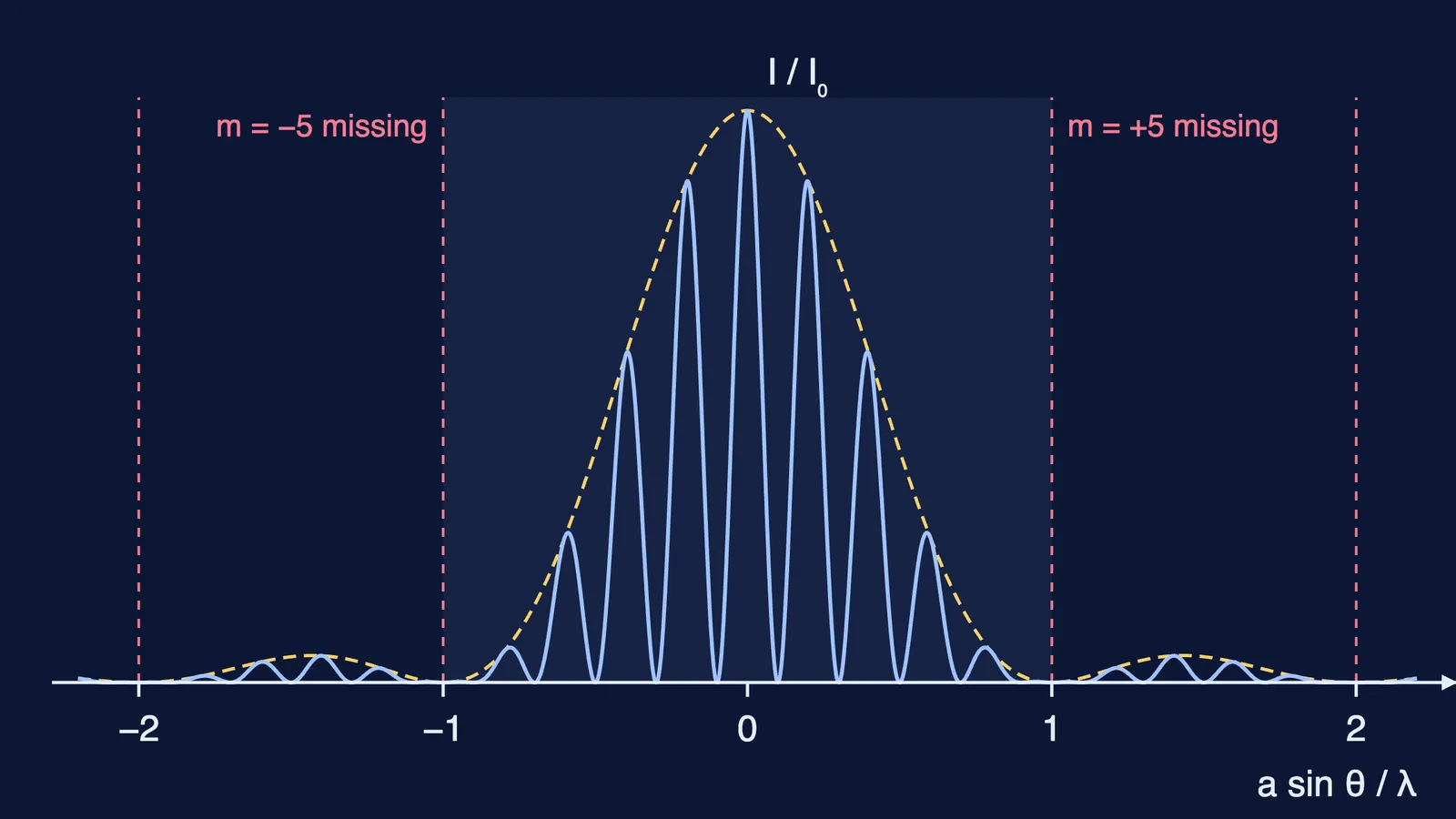
Q7 (hard). Two slits, each 0.10 mm wide, have their centres 0.50 mm apart. How many bright interference fringes (orders m with d sin θ = mλ) lie inside the central maximum of the single-slit diffraction envelope?
(A) 5
(B) 9
(C) 10
(D) 11
Answer: (B). NCERT notes that the double-slit pattern combines single-slit diffraction with two-slit interference. Bright fringes sit at sin θ = mλ/d, and the envelope's first minima at sin θ = ±λ/a. Since d/a = 5, orders m = 0, ±1, ±2, ±3, ±4 fall inside: 9 fringes. The m = ±5 fringes land exactly on the diffraction minima and vanish. Trap: (D), which counts the m = ±5 fringes that are missing.
Q8 (hard). Plane-polarised light of intensity 64 units must have its plane of polarisation turned through 90°. You use three Polaroids, the first at 30° to the incoming polarisation and each next one turned a further 30°. The intensity that finally emerges is:
(A) 0
(B) 13.5 units
(C) 27 units
(D) 48 units
Answer: (C). The light is already polarised, so every sheet follows Malus's law: 64 × (cos²30°)³ = 64 × (3/4)³ = 27 units. Trap: (B), which halves the beam at the first sheet as if it were unpolarised.
What should you do after checking your answers?
Sort each miss into a bin: wrong condition (bright versus dark, Q2 and Q6), wrong quantity (amplitude versus intensity, Q5) or wrong starting light (polarised or not, Q3 and Q8). Redo the misses the next day without the solutions.
When a solution goes wrong and you cannot see the step where it broke, the Fermi Problem Library has worked problems with a step-by-step solver that explains the reasoning rather than printing an answer.
For long answers on the same chapter, see our Wave Optics Class 12 board exam guide.