On this page
What does JEE Main ask from sets, relations and functions?
The NTA's Syllabus for JEE (Main) 2027 makes sets, relations and functions Unit 1 of mathematics. It lists sets and their representation, union, intersection and complement with their algebraic properties, power sets, types of relations, equivalence relations, one-one, into and onto functions, and composition. The eight original questions below touch each of those, from a two-set count to counting onto functions. For the theory first, read our guide on how to prepare sets, relations and functions for JEE Main.
How should you use this set?
Cover the solutions. Give yourself about two minutes for an easy question and up to four for a hard one.
Write your option down before you read the answer.
Q6 is a numerical-value question: work out the number, with no options to lean on.
For each miss, note which trap caught you and redo that question three days later.
Easy: sets, power sets and domains
Q1 (easy). In a hostel of 120 students, 72 play cricket, 50 play badminton and 18 play neither. How many play both?
(A) 2
(B) 20
(C) 32
(D) 52
Answer: (B). n(C ∪ B) = 120 − 18 = 102, so n(C ∩ B) = 72 + 50 − 102 = 20. Trap: (A) takes the union as 120 and forgets the 18 who play neither.
Q2 (easy). If A = {0, {1, 2}, ∅, {∅}}, the number of elements in the power set P(A) is
(A) 8
(B) 16
(C) 32
(D) 64
Answer: (B). A has four elements: the number 0, the set {1, 2}, the empty set and the set {∅}. So P(A) has 2⁴ = 16 elements. Trap: (C) unpacks {1, 2} into two elements and counts five; (A) treats ∅ and {∅} as the same element.
Q3 (easy). The domain of f(x) = 1/√(8 + 2x − x²) is
(A) [−2, 4]
(B) (−2, 4)
(C) (−4, 2)
(D) (−∞, −2) ∪ (4, ∞)
Answer: (B). You need 8 + 2x − x² > 0, that is (x − 4)(x + 2) < 0, so −2 < x < 4. Trap: (A) keeps the endpoints, where the denominator becomes zero.
Medium: which relations are equivalence relations?
Q4 (medium). A set A has 5 elements. How many relations on A are both reflexive and symmetric?
(A) 2¹⁰
(B) 2¹⁵
(C) 2²⁰
(D) 2²⁵
Answer: (A). All 5 diagonal pairs (a, a) must be in. The other 20 ordered pairs form 10 mirror pairs {(a, b), (b, a)}, each in or out together, giving 2¹⁰ = 1024. Trap: (C) is 2²⁰, the number of reflexive relations, which ignores symmetry; (B) is the number of symmetric relations, which ignores reflexivity. Our post on counting relations and functions between finite sets has the general formulas.
Q5 (medium). On the integers, define a R b if 2a + 5b is divisible by 7. Then R is
(A) reflexive only
(B) reflexive and symmetric, but not transitive
(C) an equivalence relation
(D) symmetric only
Answer: (C). Since 5 ≡ −2 (mod 7), 2a + 5b ≡ 2(a − b) (mod 7). As 7 does not divide 2, a R b exactly when 7 divides a − b, which is reflexive, symmetric and transitive. Trap: (A) swaps a and b, sees 2b + 5a, and stops before reducing mod 7. Our explainer on equivalence relations: reflexive, symmetric and transitive walks through each check.
Q6 (medium, numerical value). Let f(x) = 2x + 3 and g(x) = x² − 1. The sum of all real x for which f(g(x)) = g(f(x)) is ____.
Answer: −6. f(g(x)) = 2(x² − 1) + 3 = 2x² + 1 and g(f(x)) = (2x + 3)² − 1 = 4x² + 12x + 8. Equating them gives 2x² + 12x + 7 = 0. Its discriminant is 144 − 56 = 88 > 0, so both roots are real and they add to −12/2 = −6. Trap: 3.5 is the product of the roots, not the sum.
Hard: is the function one-one and onto?
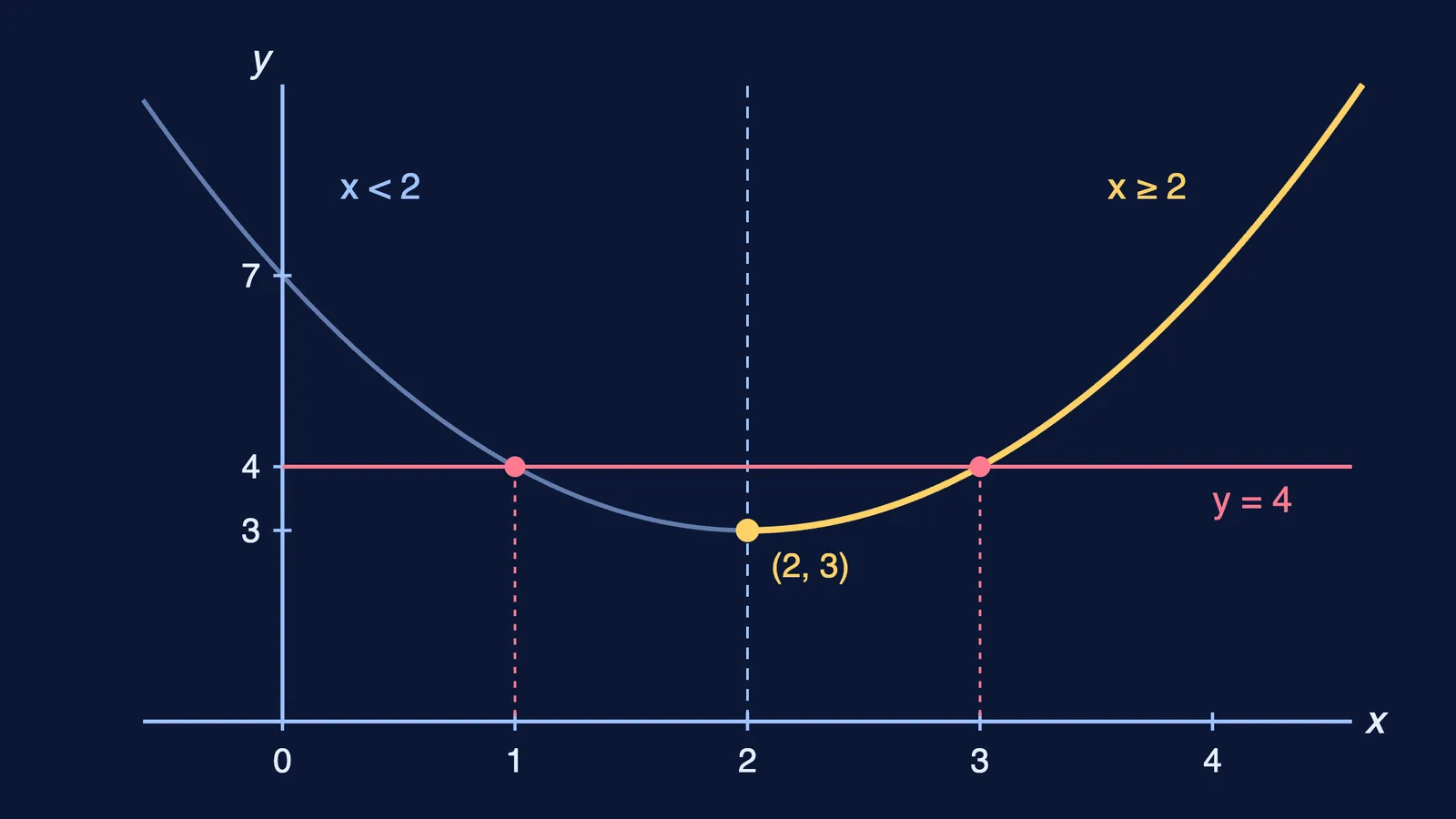
Q7 (hard). The function f(x) = x² − 4x + 7, from [k, ∞) to [3, ∞), is one-one and onto exactly when k equals
(A) 0
(B) 1
(C) 2
(D) 3
Answer: (C). f(x) = (x − 2)² + 3 takes its least value 3 at x = 2 and increases for x ≥ 2. With k = 2, f is one-one with range [3, ∞), and f⁻¹(y) = 2 + √(y − 3). Trap: (D) is one-one, but its range is [4, ∞), so 3 is never reached. (A) and (B) are onto, but f(1) = f(3) = 4, as the line y = 4 in the diagram above shows.
Q8 (hard). The number of onto functions from a set of 6 elements to a set of 3 elements is
(A) 120
(B) 537
(C) 540
(D) 729
Answer: (C). There are 3⁶ = 729 functions in all. By inclusion-exclusion, remove those that miss at least one element of the codomain: 729 − 3 × 2⁶ + 3 × 1⁶ = 729 − 192 + 3 = 540. Trap: (B) subtracts the functions that miss one element but forgets to add back the 3 constant functions, which were removed twice.
What should you do after this set?
7 or 8 right: move on to timed mixed papers, and keep this unit for quick revision.
4 to 6 right: redo the questions you missed without notes, then write the trap for each in one line.
0 to 3 right: go back to the chapter guide, rebuild the definitions of reflexive, symmetric, transitive, one-one and onto, and retry this set in a week.
If a step in a solution lost you, the Fermi Problem Library has worked problems with a step-by-step solver that explains the reasoning rather than printing an answer.