On this page
Work, energy and power rewards choosing the right method. These 8 new questions climb from easy to hard, each with a worked solution and the trap behind the likeliest wrong option. Take g = 10 m/s² throughout.
Unit 4 of the NTA syllabus for JEE (Main) 2027 lists work by constant and variable forces, the work-energy theorem, power, spring potential energy, conservation of mechanical energy, motion in a vertical circle, and elastic and inelastic collisions in one and two dimensions. The same ideas fill Chapter 5 of the NCERT Class 11 Physics textbook. If the chapter is new to you, start with our guide to preparing work, energy and power for JEE Main.
How should you use this practice set?
The JEE (Main) 2027 information bulletin gives Physics 20 multiple-choice questions (Section A) and 5 numerical-value questions (Section B), with +4 for a correct answer and −1 for a wrong one in both sections.
Allow 25 minutes. Q6 asks for a number, as in Section B.
Before solving, write one word: forces, energy, momentum or power.
Commit to an option before you read the solution.
For every miss, note which trap caught you.
When a wrong option keeps catching you, the Fermi Problem Library has worked problems with a step-by-step solver that explains the reasoning rather than printing an answer.
Easy: can you find work, kinetic energy and power quickly?
Q1 (easy). A constant force F = (3î + 4ĵ − 2k̂) N moves a particle from the point (1, 2, 0) m to the point (4, −1, 2) m. The work done by F is
(A) 4 J (B) −7 J (C) 25.3 J (D) 7 J
Answer: (B). The displacement is d = (3, −3, 2) m, so W = F·d = 9 − 12 − 4 = −7 J. Trap: (A) dots F with the final position vector instead of the displacement.
Q2 (easy). A cyclist's momentum increases by 30%. By what percentage does the kinetic energy increase?
(A) 30% (B) 60% (C) 69% (D) 90%
Answer: (C). K = p²/2m, so K rises by a factor of 1.3² = 1.69, an increase of 69%. Trap: (B) doubles the 30%, which only works for very small changes.
Q3 (easy). A pump lifts 600 kg of water per minute into a tank 15 m above the sump. If the pump is 75% efficient, its input power is
(A) 1500 W (B) 2000 W (C) 1125 W (D) 90 kW
Answer: (B). Useful power = mgh/t = (600 × 10 × 15)/60 = 1500 W, and input = 1500/0.75 = 2000 W. Trap: (C) multiplies by the efficiency instead of dividing.
Medium: when do energy methods beat forces?
Q4 (medium). A 2 kg block starts from rest at x = 0 on a smooth floor. The only horizontal force on it is F = (6x − 3x²) N, with x in metres. Its speed at x = 2 m is
(A) 0 (B) 1.41 m/s (C) 2 m/s (D) 3.46 m/s
Answer: (C). W = ∫₀² (6x − 3x²) dx = [3x² − x³]₀² = 4 J. Then ½(2)v² = 4, so v = 2 m/s. Trap: (A) uses F(2) × 2. F is zero there but did work on the way.
Q5 (medium). A 1 kg block slides at 3 m/s on a rough floor (μ = 0.25) into a light spring of stiffness 200 N/m, and friction acts throughout the compression. The maximum compression is
(A) 20 cm (B) 21.2 cm (C) 22.5 cm (D) 14.4 cm
Answer: (A). ½mv² = ½kx² + μmgx gives 4.5 = 100x² + 2.5x, so x = 0.2 m. Trap: (B) ignores friction. (C) has friction adding energy.
Q6 (medium, numerical). A 0.2 kg bob on a light string 0.5 m long is whirled in a vertical circle with just enough speed to complete it. Find the tension in newtons when the string is horizontal.
Answer: 6. At the top, tension is zero, so v² = gL there. Energy conservation gives v² = 5gL at the bottom and v² = 3gL with the string horizontal. There, tension alone provides the centripetal force: T = mv²/L = 3mg = 6 N. Trap: 4 assumes the bob can just reach the top at zero speed, which is true for a rod but not a string.
Hard: what changes in collisions and at constant power?
Q7 (hard). A 2 kg ball moving at 5 m/s hits a 3 kg ball at rest head-on. The coefficient of restitution is 0.5. The kinetic energy lost in the collision is
(A) 11.25 J (B) 15 J (C) 18.75 J (D) 12.5 J
Answer: (A). Momentum gives 2v₁ + 3v₂ = 10 and restitution gives v₂ − v₁ = 2.5, so v₁ = 0.5 m/s and v₂ = 3 m/s. KE falls from 25 J to 0.25 + 13.5 = 13.75 J, a loss of 11.25 J. Trap: (C) applies (1 − e²) to the full 25 J. That factor belongs to the 15 J that a perfectly inelastic collision would lose, which is option (B).
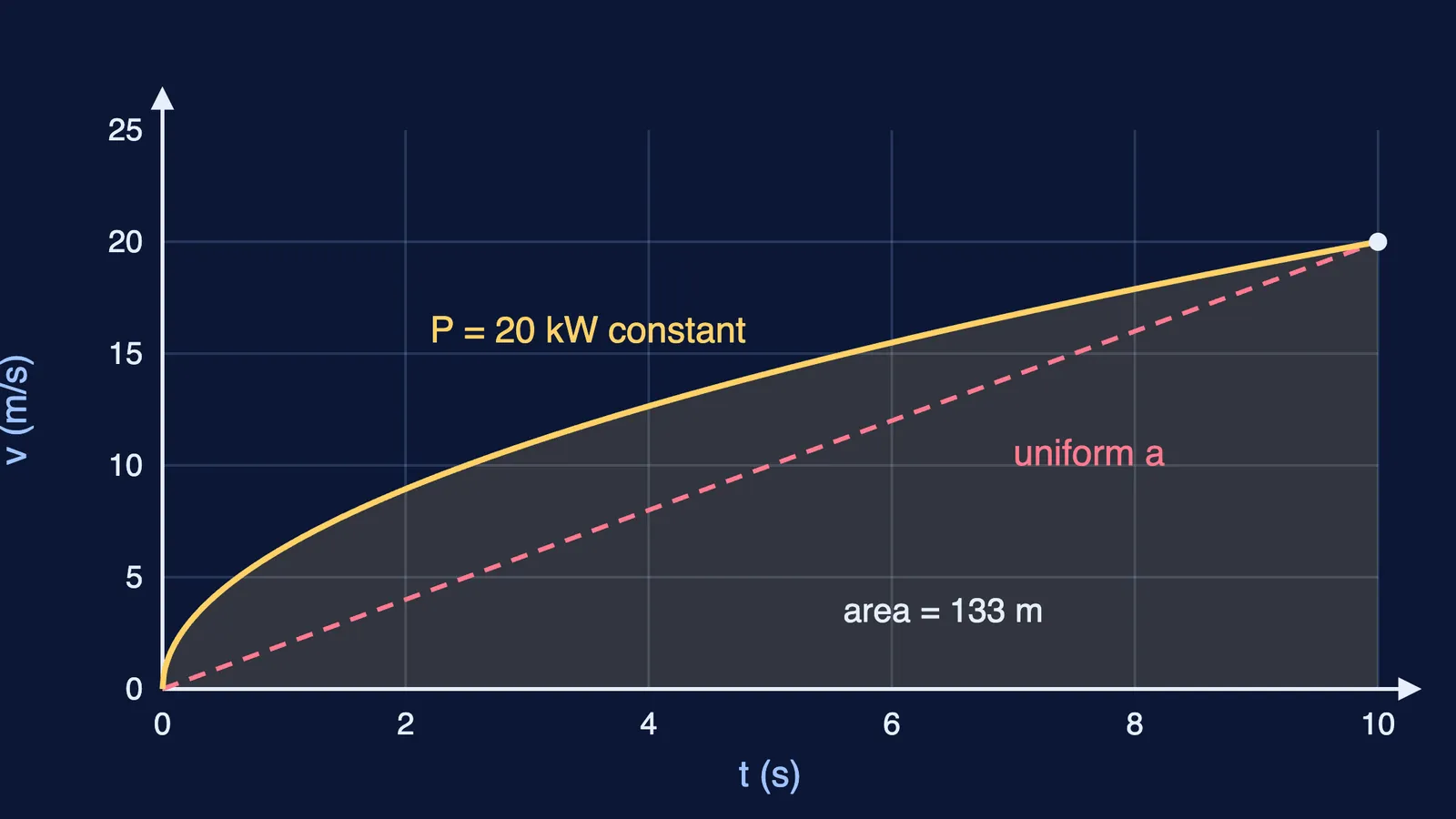
Q8 (hard). A 1000 kg car starts from rest, and its engine delivers a constant 20 kW. Ignoring friction and air drag, how far does it travel in the first 10 s?
(A) 200 m (B) 100 m (C) 133 m (D) 66.7 m
Answer: (C). Pt = ½mv² gives v = √(2Pt/m) = √(40t), so v = 20 m/s at 10 s. Integrating, x = (2/3)√40 × t^(3/2) = 133 m. Trap: (B) assumes uniform acceleration and uses vt/2. At constant power the car accelerates hardest early.
What should you revise if you got these wrong?
Q1 or Q4: work as a dot product and as an integral, NCERT sections 5.3 and 5.5.
Q5 or Q6: the work-energy theorem with friction, and the vertical circle.
Q7: momentum conservation with restitution; check whether kinetic energy should be conserved.
Q3 or Q8: power as rate of work and as Fv.
For more on choosing the method, read the work-energy theorem: solving JEE problems faster than forces and three work-energy mistakes that quietly cost marks.