On this page
JEE Advanced often joins elasticity, buoyancy, surface tension and Bernoulli in one question. Below: the official syllabus, the gap from JEE Main, three solved problems and a practice plan.
What is in the JEE Advanced fluids and elasticity syllabus?
The official JEE (Advanced) 2026 syllabus lists "Hooke's law, Young's modulus" under Mechanics, and then: "Pressure in a fluid; Pascal's law; Buoyancy; Surface energy and surface tension, angle of contact, drops, bubbles and capillary rise. Viscosity (Poiseuille's equation excluded), Modulus of rigidity and bulk modulus in mechanics. Stoke's law; Terminal velocity, Streamline flow, equation of continuity, Bernoulli's theorem and its applications." Its General section adds methods of measurement and error analysis for two experiments: Young's modulus, and surface tension of water by capillary rise and effect of detergents. The document says the 2026 syllabus is unchanged from 2025. The 2027 syllabus is not yet published (as of 19 November 2026).
Announced so far: JEE (Advanced) 2027 will be held on 23 May 2027 (Sunday), organised by IIT Delhi. To appear, you must be among the top 2,50,000 successful candidates in the B.E./B.Tech. paper of JEE (Main) 2027, plus the other criteria there.
How is JEE Advanced different from JEE Main here?
Unit 7 of the JEE (Main) 2027 syllabus names stress-strain, turbulent flow and critical velocity, which the Advanced list does not. The Advanced list names buoyancy and the equation of continuity explicitly, and excludes Poiseuille's equation. Both list the Young's modulus and capillary-rise experiments; Main asks for familiarity, Advanced for error analysis. If you have finished our Properties of Solids and Liquids guide for JEE Main, the gap is depth, not topics.
The JEE (Advanced) 2026 Information Brochure stated that the 2026 exam had two compulsory papers of three hours each. Question types and marking changed from year to year and were announced in the paper itself, so practise single-correct, multiple-correct and numerical answers. Read how partial marking works in multiple-correct questions.
Three habits matter most:
Draw forces before formulas. Buoyancy, tension and surface force can act on one body.
Ask what is fixed. Tank depth fixes exit speed; tube height can fix the meniscus.
Check a limit and the units. Push a density, area or height to an extreme; does the answer still make sense?
Worked examples at Advanced level
All numbers are our own. Take g = 9.8 m/s².
1. A loaded wire, then immersed. A steel wire 2.0 m long, radius 0.50 mm (Y = 2.0 × 10¹¹ Pa) holds a 2.0 kg aluminium block (density 2700 kg/m³). Area A = 7.85 × 10⁻⁷ m², so the extension in air is ΔL = FL/(AY) = 19.6 × 2.0/(7.85 × 10⁻⁷ × 2.0 × 10¹¹) = 0.250 mm. Fully immersed in water, tension becomes 19.6(1 − 1000/2700) = 12.3 N, so ΔL = 0.157 mm. The ratio, 0.630, is independent of the wire. Limit check: if the block's density equalled water's, the extension would be zero. A scale under the beaker gains 7.26 N, the buoyant force.
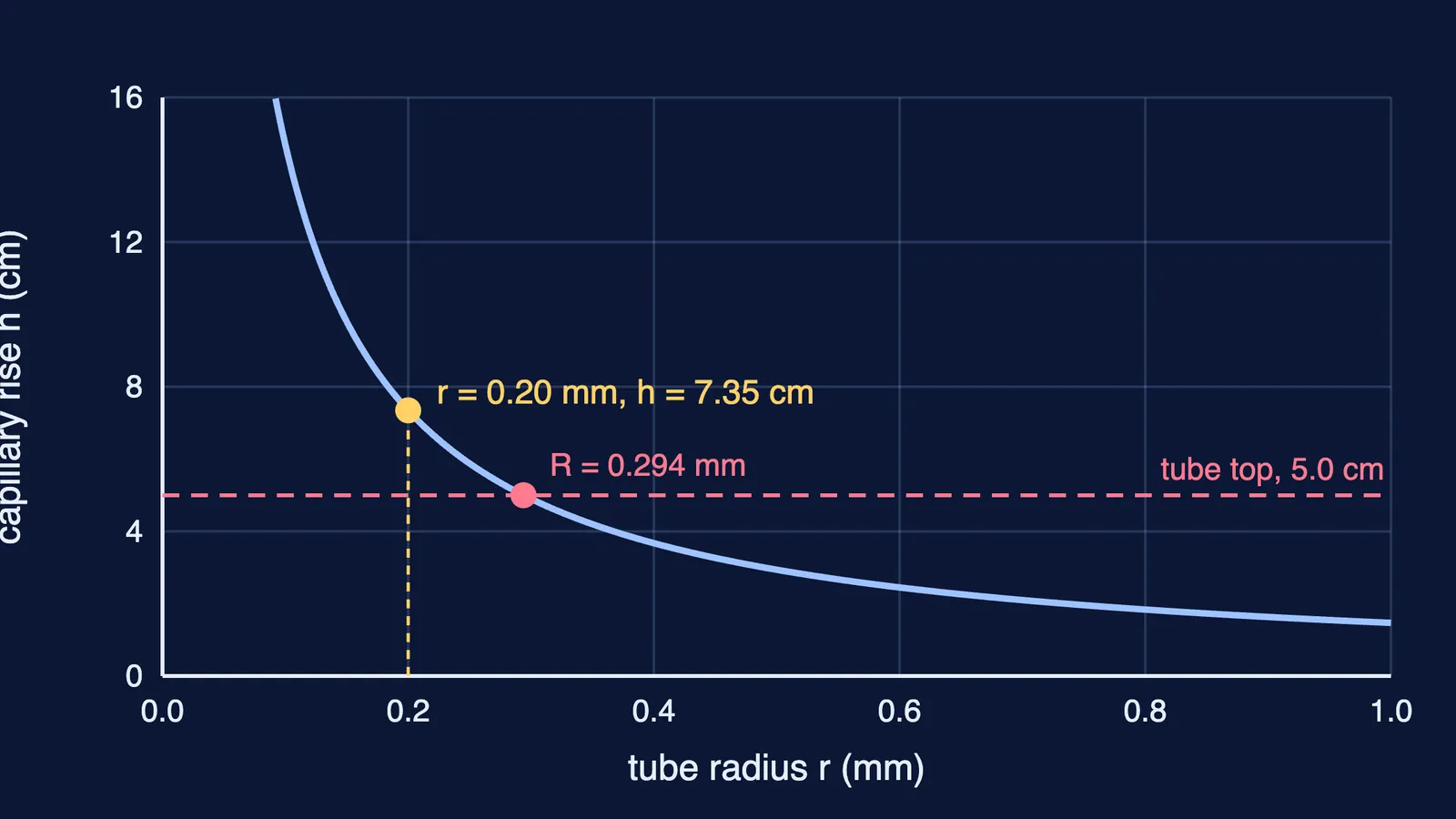
2. A capillary that is too short. Water (T = 0.072 N/m, contact angle 0°) in a glass tube of radius 0.20 mm would rise h = 2T/(ρgr) = 7.35 cm. The tube sticks out only 5.0 cm. Water does not overflow: the meniscus flattens to radius R = 2T/(ρg × 0.050) = 0.294 mm, so the contact angle there becomes cos⁻¹(0.20/0.294) = 47.1°. In the full tube, surface tension does work 2πrTh; the water gains only half of that as potential energy, and the rest becomes heat.
3. Tank, nozzle and jet. A tank holds water 1.8 m deep. A horizontal pipe of area 4.0 cm² leaves its base, 0.80 m above the floor, and ends in a nozzle of area 1.0 cm². Exit speed v = √(2gH) = 5.94 m/s, whatever the nozzle size. Continuity gives 1.48 m/s in the wide pipe, and Bernoulli gives its gauge pressure as ½ρ(5.94² − 1.48²) = 16.5 kPa. The jet lands 5.94 × √(2 × 0.80/9.8) = 2.40 m away, which equals 2√(Hy): a quick unit check.
Hard to picture pressure along a narrowing pipe? The Fermi Simulation Lab has interactive simulations for the ideas that are easier to see than to read.
How should you practise fluids and elasticity?
Revise with our Class 11 guide to mechanical properties of fluids.
Week one: elasticity, pressure and buoyancy.
Week two: surface tension, drops, bubbles and capillaries, with energy checks.
Week three: viscosity, terminal velocity, continuity and Bernoulli, then mixed multiple-correct sets.
For each problem, write one limiting case and one unit check.
Practice:
A steel ball of radius 1.0 mm (density 7800 kg/m³) falls through oil (density 900 kg/m³, viscosity 0.80 Pa s). Find its terminal velocity.
Water has bulk modulus 2.2 × 10⁹ Pa. By what percentage does its volume shrink 1.0 km down in sea water of density 1030 kg/m³?
Redo example 3 with a 2.0 cm² nozzle. What is the gauge pressure in the wide pipe?
Answers: 1.88 cm/s; 0.459%; 13.2 kPa.