

On this page
This identity turns up in Class 11 binomial theorem chapters and JEE Main practice sets. The trick: write the same expansion forwards and backwards, then multiply.
Throughout, Cᵣ means ⁿCᵣ, the number of ways to choose r things from n.
What does C₀² + C₁² + … + Cₙ² = ²ⁿCₙ say?
Take row n of Pascal's triangle, square every entry and add. The total is the middle entry of row 2n. For n = 1, 2, 3, 4 the totals are 2, 6, 20 and 70, which are the central binomial coefficients listed in the OEIS entry A000984; that entry states that each term equals the sum of the squares of the binomial coefficients in row n.
Since ⁿCₙ₋ᵣ = ⁿCᵣ, the result is the m = n = r case of Vandermonde's identity, which says that choosing r items from m + n can be split by how many come from the first m. The identity is named after Alexandre-Théophile Vandermonde (1772), but it was already known in 1303 to the Chinese mathematician Zhu Shijie, according to the same Wikipedia article.
How do you prove C₀² + C₁² + … + Cₙ² = ²ⁿCₙ?
The standard textbook method compares the coefficient of xⁿ on both sides of one equation.
Write the expansion forwards: (1 + x)ⁿ = C₀ + C₁x + C₂x² + … + Cₙxⁿ.
Write it backwards: (x + 1)ⁿ = C₀xⁿ + C₁xⁿ⁻¹ + C₂xⁿ⁻² + … + Cₙ. This is the same expansion read from the other end, so the coefficient of xⁿ⁻ʳ is Cᵣ.
Multiply the two. A term in xⁿ appears only when xʳ from the first bracket meets xⁿ⁻ʳ from the second. Their coefficients are Cᵣ and Cᵣ, so each such pair contributes Cᵣ².
Adding over r = 0, 1, …, n, the coefficient of xⁿ in the product is C₀² + C₁² + … + Cₙ².
But (1 + x)ⁿ(x + 1)ⁿ = (1 + x)²ⁿ, and the coefficient of xⁿ there is ²ⁿCₙ.
The same coefficient, found two ways, must be equal. So C₀² + C₁² + … + Cₙ² = ²ⁿCₙ.
Step 2 is the key: writing the second bracket backwards pairs Cᵣ with itself. For more practice, our explainer on the coefficient of xⁿ in the product of two binomial expansions works through several versions.
Is there a proof without algebra?
Yes. Picture n girls and n boys choosing a committee of exactly n students.
Count it once directly: you are choosing n people from 2n, so there are ²ⁿCₙ committees.
Now count the same committees by how many girls they contain. If the committee has r girls, it must have n − r boys. The girls can be chosen in ⁿCᵣ ways and the boys in ⁿCₙ₋ᵣ ways. Since ⁿCₙ₋ᵣ = ⁿCᵣ, that is Cᵣ × Cᵣ = Cᵣ² committees with exactly r girls. Adding over r = 0 to n gives C₀² + C₁² + … + Cₙ².
Both counts describe the same set of committees, so they are equal. This is called double counting, and our guide to double counting as a proof technique shows the same idea on other problems.
Does it work for n = 3?
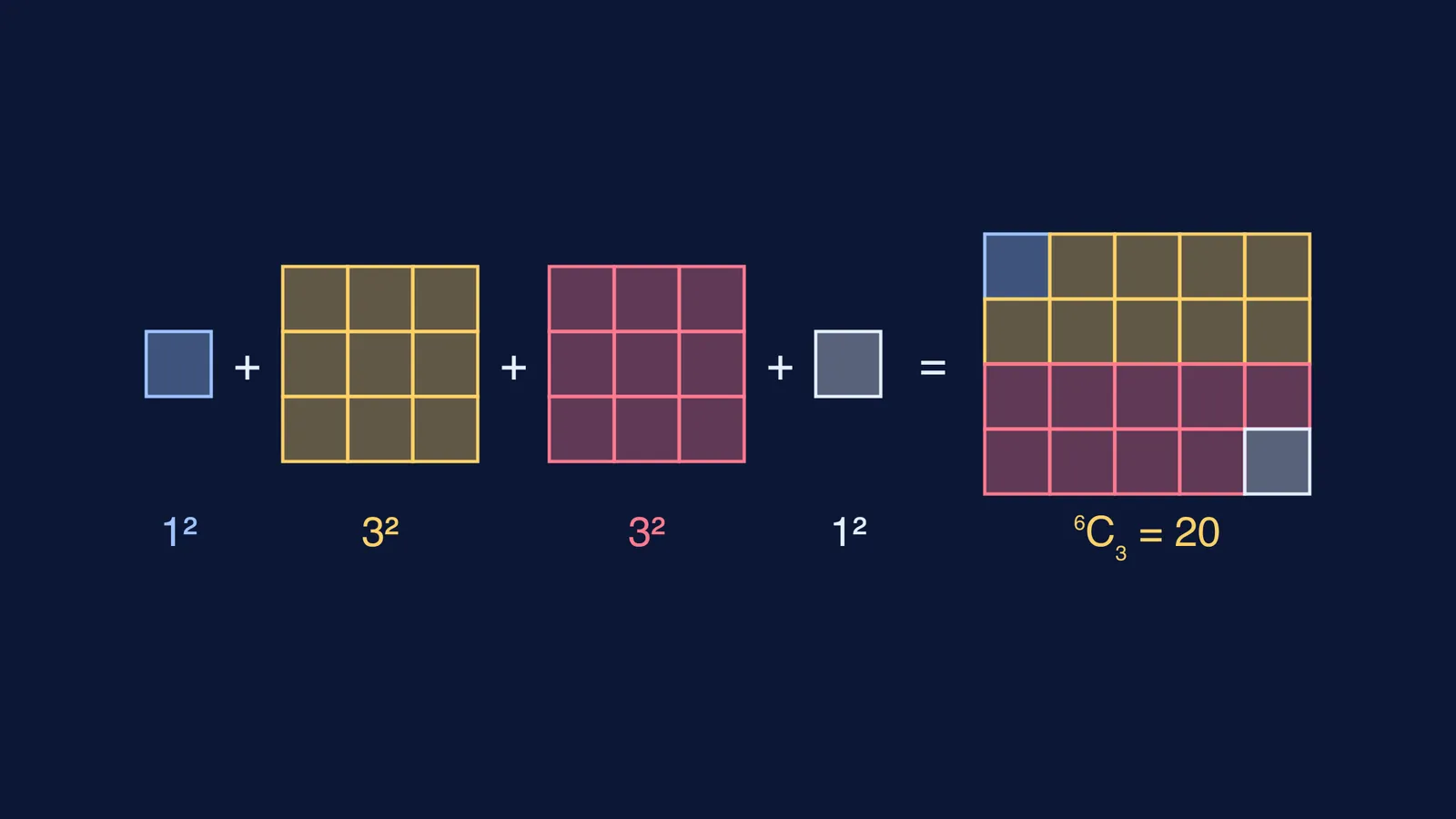
Row 3 of Pascal's triangle is 1, 3, 3, 1.
Squares: 1, 9, 9, 1.
Sum: 1 + 9 + 9 + 1 = 20.
⁶C₃ = (6 × 5 × 4) ÷ (3 × 2 × 1) = 20.
They match. In committee terms, with 3 girls and 3 boys choosing a committee of 3: 1 committee is all boys, 9 have one girl and two boys (3 × 3), 9 have two girls and one boy, and 1 is all girls. That is 20, the same as choosing any 3 of the 6.
How do exam questions twist this identity?
Use this checklist when you meet a variant.
Shifted products. C₀C₁ + C₁C₂ + … + Cₙ₋₁Cₙ is the coefficient of xⁿ⁻¹ in the same product, so it equals ²ⁿCₙ₋₁. Check with n = 3: 3 + 9 + 3 = 15 = ⁶C₂.
Find the target power first. Decide which power of x collects the products you want, then read it from (1 + x)²ⁿ.
Do not confuse it with the plain sum. C₀ + C₁ + … + Cₙ = 2ⁿ comes from putting x = 1. Our post on sums of binomial coefficients covers that family.
Always test n = 2 or 3. A small case catches an off-by-one index in seconds.
If you keep getting the right method but the wrong index, the Fermi Problem Library has worked problems with a step-by-step solver that explains the reasoning rather than printing an answer. If the gap is earlier, in what ⁿCᵣ means or why Pascal's rule holds, the Fermi Concept Library gives each concept its own lesson.
Next time, write both expansions out, pick the power of x, and check n = 3.


