

On this page
Questions like "evaluate C(n, 0)² + C(n, 1)² + … + C(n, n)²" look like they need a long expansion. They rest on one idea: when you multiply two terms, their powers of x add. We write C(n, k) for ⁿCₖ throughout.
How do you find the coefficient of xⁿ in a product of two expansions?
Start from the general term. In NCERT's Class 11 chapter on the binomial theorem, each term of (a + b)ⁿ is C(n, r)aⁿ⁻ʳbʳ, and in every term the indices of a and b add up to n. So the general term of (1 + x)ᵐ is C(m, k)xᵏ, and the general term of (1 − x)ⁿ is C(n, j)(−1)ʲxʲ.
Each term of the product takes one term from each bracket, so its power is k + j:
Write the general term of each bracket, including signs and constants.
Set the powers to add up to the target: k + j = r.
List every allowed pair, with 0 ≤ k ≤ m and 0 ≤ j ≤ n.
Multiply the coefficients in each pair and add.
First check whether the brackets combine into one binomial; if so, skip steps 2 to 4.
Worked example: find the coefficient of x² in (1 + 2x)³(1 − x)⁴. The general terms are C(3, k)2ᵏxᵏ and C(4, j)(−1)ʲxʲ. The pairs with k + j = 2 are (0, 2), (1, 1) and (2, 0).
(0, 2): 1 × C(4, 2) = 6
(1, 1): C(3, 1)·2 × C(4, 1)·(−1) = 6 × (−4) = −24
(2, 0): C(3, 2)·4 × 1 = 12
The coefficient is 6 − 24 + 12 = −6. The middle pair carries both the 2 and the minus sign, so check it twice.
What is the Vandermonde identity?
Vandermonde's identity says that the sum over k of C(m, k)·C(n, r − k) equals C(m + n, r), for non-negative integers m, n and r (Vandermonde's identity, Wikipedia). The same page notes that it is named after Alexandre-Théophile Vandermonde (1772), although the Chinese mathematician Zhu Shijie already knew it in 1303.
The proof is the pairing method applied to (1 + x)ᵐ(1 + x)ⁿ = (1 + x)ᵐ⁺ⁿ. On the left, the coefficient of xʳ is the pairing sum; on the right, it is C(m + n, r). So the coefficient of x³ in (1 + x)⁵(1 + x)⁴ is simply C(9, 3) = 84.
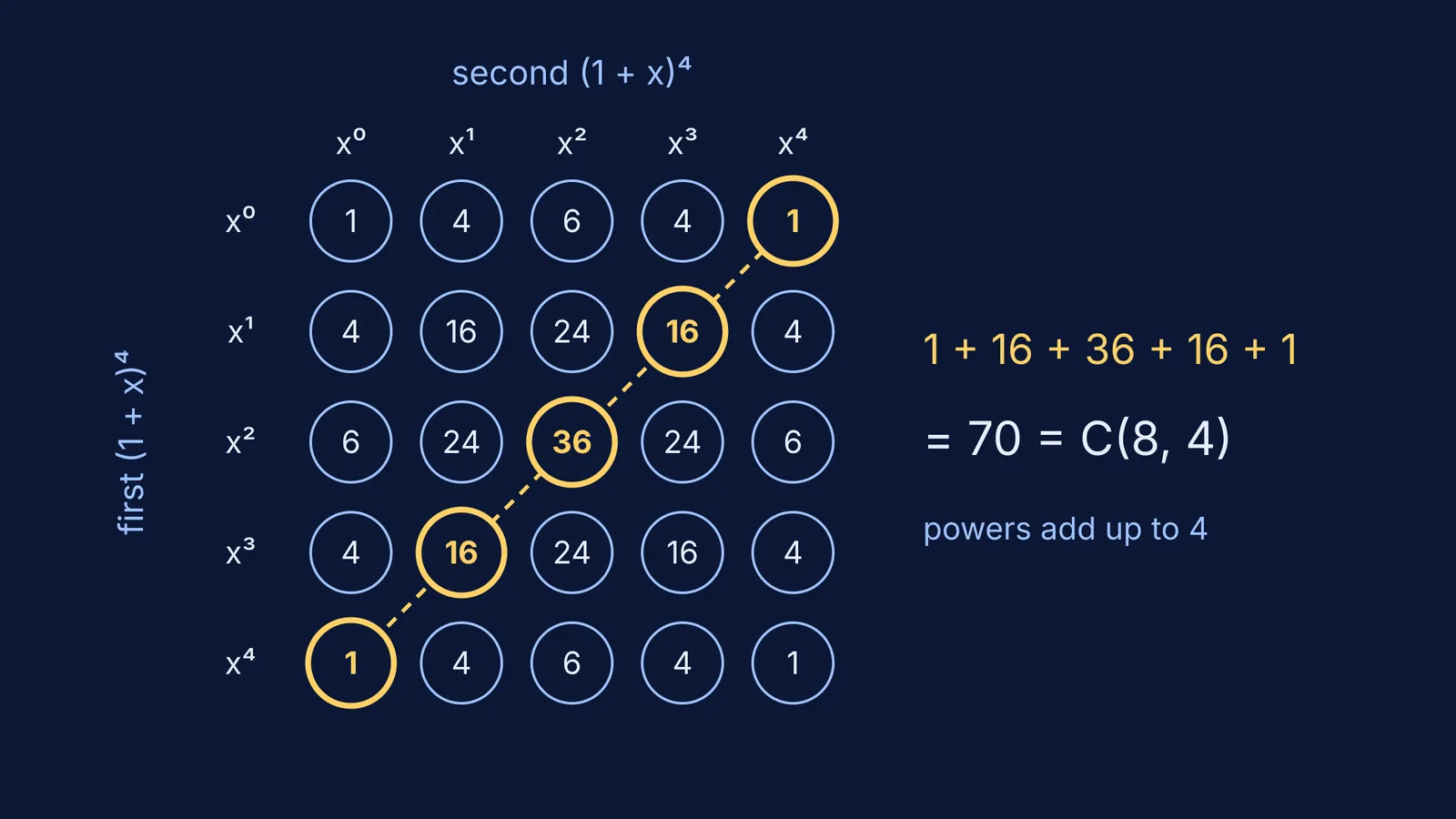
The best-known special case puts m = n = r. Because C(n, k) = C(n, n − k), each square C(n, k)² is really C(n, k)·C(n, n − k), a pair whose lower numbers add up to n. So C(n, 0)² + C(n, 1)² + … + C(n, n)² = C(2n, n). For n = 3: 1 + 9 + 9 + 1 = 20 = C(6, 3).
Shifted sums work the same way. In C(n, k)·C(n, k + 2), rewrite the second factor as C(n, n − k − 2). The lower numbers now add up to n − 2, so the sum is C(2n, n − 2). For n = 5: 10 + 50 + 50 + 10 = 120 = C(10, 3).
What is the coefficient of xⁿ in (1 + x)ⁿ(1 − x)ⁿ?
Step 5 pays off here: (1 + x)ⁿ(1 − x)ⁿ = (1 − x²)ⁿ, whose general term C(n, s)(−1)ˢx²ˢ has only even powers.
If n is odd, the coefficient of xⁿ is 0.
If n is even, it is (−1)ⁿᐟ²·C(n, n/2).
Pairing xᵏ from (1 + x)ⁿ with (−x)ⁿ⁻ᵏ from (1 − x)ⁿ gives the same coefficient as the sum of (−1)ⁿ⁻ᵏ·C(n, k)². So the alternating sum C(n, 0)² − C(n, 1)² + C(n, 2)² − … is 0 for odd n and (−1)ⁿᐟ²·C(n, n/2) for even n. Check n = 4: 1 − 16 + 36 − 16 + 1 = 6 = C(4, 2).
Which mistakes cost marks on these questions?
Dropping the sign of (−x)ʲ, or the 2ᵏ inside (2x)ᵏ.
Listing a pair that cannot exist, such as k = 5 from a cube.
Writing C(2n, n) when a shifted sum needs C(2n, n − 1).
Multiplying out when the brackets combine into (1 − x²)ⁿ.
Skipping the small-case check: try n = 2 or 3 by hand.
If you cannot see which pair went missing, the Fermi Problem Library has worked problems with a step-by-step solver that explains the reasoning rather than printing an answer. If the general term itself is shaky, the Fermi Concept Library gives every mathematics concept its own lesson.
Related reading: sums of binomial coefficients and alternating sums, remainder and divisibility problems with the binomial expansion and Al-Karaji's binomial table.
Try these three
The coefficient of x³ in (1 + x)⁴(1 − x)².
C(6, 0)² − C(6, 1)² + C(6, 2)² − … + C(6, 6)².
The sum of C(7, k)·C(7, k + 1) for k = 0 to 6.
Answers: −4, −20 and C(14, 6) = 3003. If one doesn't match, list the pairs again.


