On this page
JEE Advanced problems in this unit usually join two ideas: an AP to a GP, or a series sum to a binomial coefficient.
What does the JEE Advanced syllabus include for sequences, series and binomial theorem?
The official JEE (Advanced) 2026 syllabus lists, under Algebra: "Arithmetic and geometric progressions, arithmetic and geometric means, sums of finite arithmetic and geometric progressions, infinite geometric series, sum of the first n natural numbers, sums of squares and cubes of the first n natural numbers."
The same section lists "binomial theorem for a positive integral index, properties of binomial coefficients." The PDF notes that the 2026 syllabus is the same as 2025. It does not name harmonic progressions; treat them as reciprocals of an AP.
The 2027 syllabus has not been published yet (as of 19 November 2026). The official JEE (Advanced) site says JEE (Advanced) 2027 will be held on 23 May 2027 (Sunday), organised by IIT Delhi.
What does JEE Advanced add beyond JEE Main?
The NTA syllabus for JEE (Main) 2027 lists AP and GP, inserting arithmetic and geometric means, the relation between AM and GM, and the binomial theorem for a positive integral index with the general term and middle term. Only the Advanced list names:
sums of finite APs and GPs, and infinite geometric series
sums of the first n natural numbers, their squares and their cubes
properties of binomial coefficients
For the derivations, read sequences and series for JEE: derive the sums.
Worked example 1: an AP hiding a GP
A non-constant AP has its 2nd, 5th and 11th terms in GP, and the sum of its first 10 terms is 130. Which are true? (A) The common ratio is 2. (B) The 20th term is 42. (C) The sum of the first 20 terms is 460. (D) 1/T₂ + 1/T₅ + 1/T₁₁ + 1/T₂₃ + ... = 1/2.
(a + 4d)² = (a + d)(a + 10d) gives 6d² = 3ad. Since d ≠ 0, a = 2d.
Sum: S₁₀ = 5(2a + 9d) = 65d = 130, so d = 2 and a = 4. Then Tₙ = 2n + 2.
T₂, T₅, T₁₁ = 6, 12, 24: ratio 2. (A) is true.
T₂₀ = 42 and S₂₀ = 10(4 + 42) = 460. (B) and (C) are true.
T₂ₙ₊₁ = 2Tₙ, so T₂₃ = 48 and the reciprocals form a GP with first term 1/6 and ratio 1/2. Sum: (1/6) ÷ (1/2) = 1/3. (D) is false.
The trap is dividing by d without noting d ≠ 0; a constant AP also fits. When more than one option can be correct, test every option; see our guide to JEE Advanced question types.
Worked example 2: a series built from squares
Find Aₙ = 1·3 + 2·5 + 3·7 + ... to n terms, and A₂₀.
The kth term is k(2k + 1) = 2k² + k.
Aₙ = 2 · n(n + 1)(2n + 1)/6 + n(n + 1)/2 = n(n + 1)(4n + 5)/6.
A₂₀ = 20 · 21 · 85/6 = 5950.
Check: n = 1 gives 3 and n = 2 gives 13. The usual slip is multiplying the sums, (3 + 5 + ... + 41)(1 + 2 + ... + 20) = 92,400. A sum of products is not a product of sums.
Worked example 3: the greatest coefficient
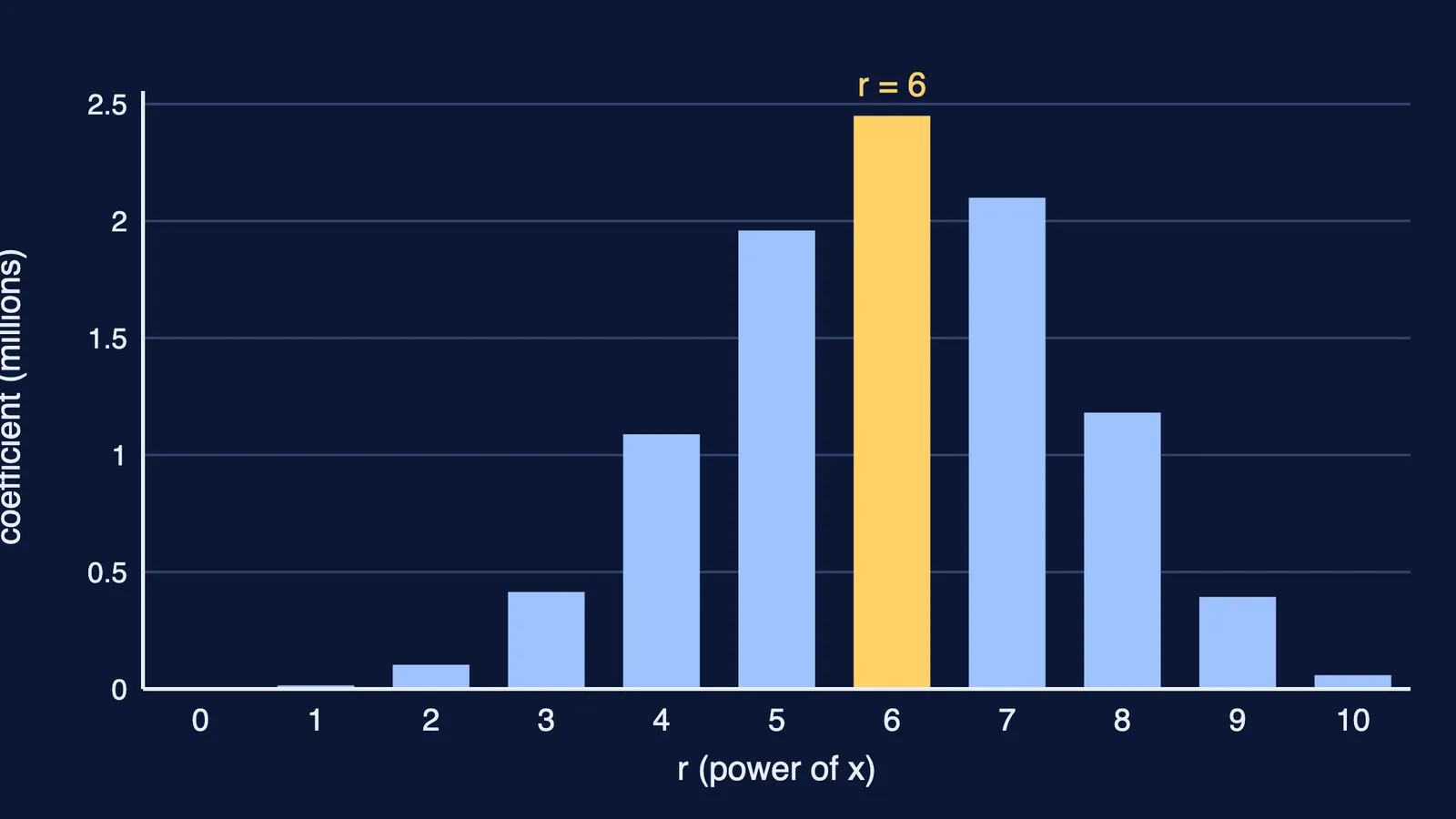
In (2 + 3x)¹⁰, find the greatest coefficient and the sum of the coefficients.
The coefficient of xʳ is cᵣ = C(10, r) 2¹⁰⁻ʳ 3ʳ.
cᵣ/cᵣ₋₁ = 3(11 − r)/(2r) ≥ 1 while r ≤ 6.6, so coefficients rise up to r = 6, then fall.
c₆ = 210 · 16 · 729 = 2,449,440 (c₆/c₅ = 5/4, c₇/c₆ = 6/7).
At x = 1, the coefficient sum is 5¹⁰ = 9,765,625.
The trap is assuming the middle term (r = 5) is largest; the weights 2 and 3 shift the peak. Revisit general and middle terms in our binomial theorem guide.
Stuck partway through a problem? The Fermi Problem Library has worked problems with a step-by-step solver that explains the reasoning rather than printing an answer.
How should you practise this unit in four weeks?
Week 1: AP, GP and means. Write each condition as an equation in a and d (or a and r).
Week 2: sums with n, n² and n³. Split the general term first.
Week 3: general term, greatest coefficient, coefficient sums.
Week 4: timed mixed sets, applying the three checks.
Original practice questions:
Find 1²·2 + 2²·3 + 3²·4 + ... + 15²·16.
An infinite GP with 0 < r < 1 has sum 20, and its terms in even positions add to 4. Find the first term and the ratio.
Find the term independent of x in (x² − 3/x)⁹.
Answers: 15,640; first term 15, ratio 1/4; 61,236.