On this page
A common board and JEE Main question goes like this. A coil is connected to a DC supply and you note the current. The same coil is then connected to an AC supply and the current drops. Find the inductance.
The DC reading gives you only the resistance. The AC reading gives you resistance and reactance mixed together, and you have to separate them.
Why does the same coil draw less current on AC?
A real coil is a long copper wire wound into turns, so it has resistance R as well as inductance L. In a steady DC circuit the current isn't changing, so the inductance doesn't oppose it and only R limits the current.
On AC, the inductor adds an opposition called inductive reactance, defined as X_L = ωL, where ω = 2πf is the angular frequency (OpenStax University Physics, Vol. 2, section 15.2). The same section notes that X_L varies directly as the frequency of the AC source, which means it vanishes at zero frequency (DC).
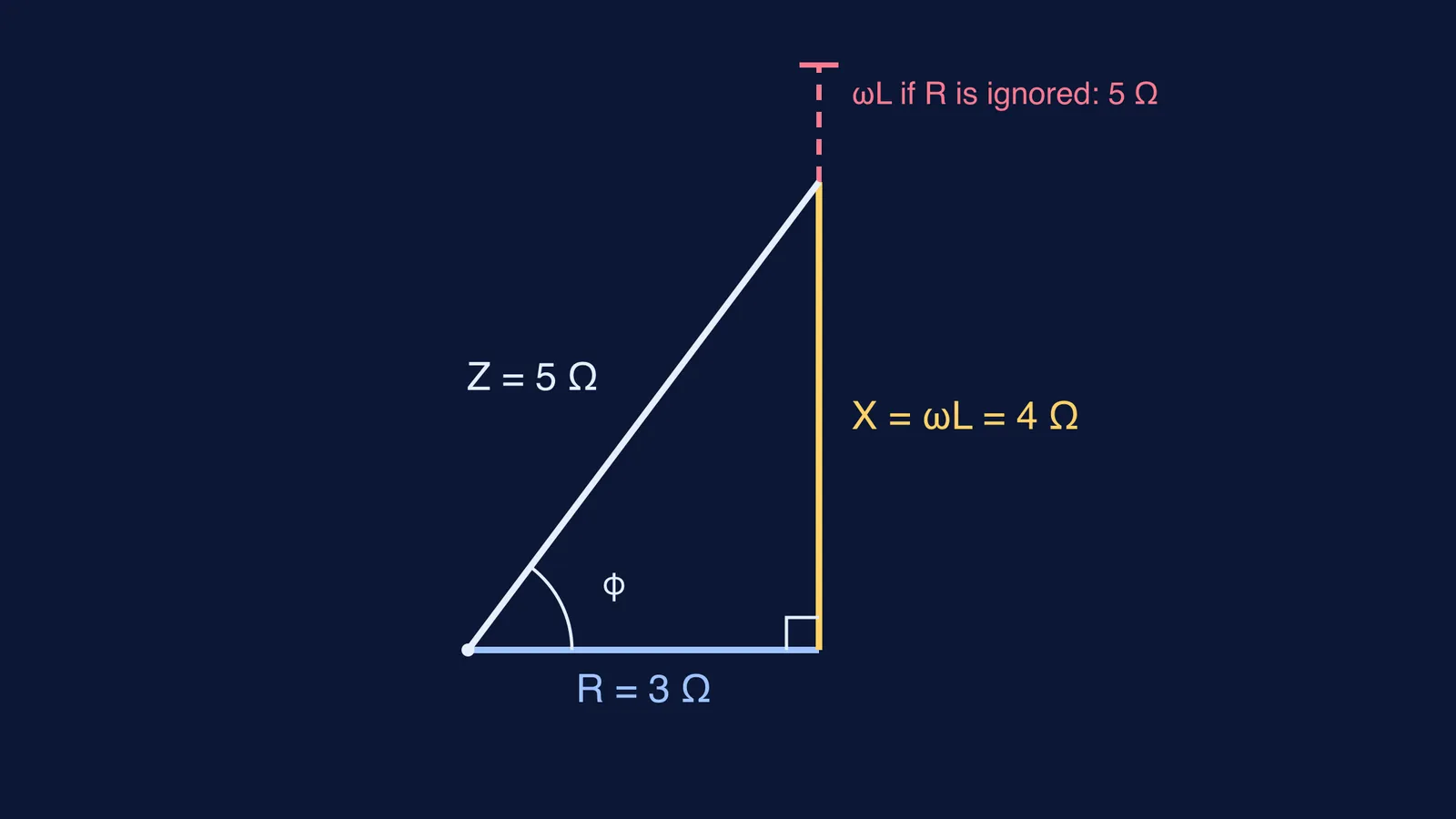
Resistance and reactance don't simply add. For a series circuit the total opposition, the impedance, is Z = √(R² + (X_L − X_C)²), and the peak current is I₀ = V₀/Z (OpenStax, section 15.3). A coil has no capacitor, so X_C = 0 and Z = √(R² + X_L²). If you want to see why they combine at right angles, our post on why current lags voltage by 90° in a pure inductor walks through the phase.
How do you find the inductance of a coil from DC and AC current?
Follow four steps, in this order:
From the DC reading: R = V_DC / I_DC.
From the AC reading: Z = V_rms / I_rms. Peak and rms values both differ by the same factor of √2, so the ratio gives the same Z either way.
Remove the resistance: X_L = √(Z² − R²).
Divide by the angular frequency: L = X_L / 2πf.
For Indian mains, f is 50 Hz; the national grid runs nominally at 50 Hz (National Grid (India))). So ω = 2π × 50 ≈ 314 rad/s, a number worth knowing by heart.
Worked example: 12 V DC, then 12 V AC at 50 Hz
A coil draws 4.0 A from a 12 V DC supply. On a 12 V (rms), 50 Hz AC supply it draws 2.4 A. Find L, using Z = √(R² + X_L²) from OpenStax section 15.3.
R = 12 / 4.0 = 3.0 Ω
Z = 12 / 2.4 = 5.0 Ω
X_L = √(5.0² − 3.0²) = √16 = 4.0 Ω
L = 4.0 / (2π × 50) = 4.0 / 314.2 ≈ 0.0127 H, or about 12.7 mH
As a bonus, you can get the phase angle from the same triangle: tan φ = X_L / R = 4/3, so the current lags the voltage by about 53°, using the phase formula in the same OpenStax section.
What mistake do students make when finding a coil's inductance?
The most common slip is to treat the coil as a pure inductor and write L = Z / 2πf. In the example that gives 5.0 / 314.2 ≈ 15.9 mH instead of 12.7 mH, an answer about 25% too high.
How badly the shortcut misleads depends on how big R is compared with Z. Since Z = √(R² + X_L²) (OpenStax, section 15.3), X_L = √(Z² − R²), and you can work out the overestimate yourself:
R is 30% of Z: X_L ≈ 0.95 Z, so ignoring R overestimates L by about 5%.
R is 60% of Z (our example): X_L = 0.80 Z, an overestimate of 25%.
R is 80% of Z: X_L = 0.60 Z, an overestimate of about 67%.
The rule that follows: ignore R only when the question says the coil is pure or has negligible resistance. If it gives you a DC reading, that reading is there for a reason.
How do you practise this until it's automatic?
Do three versions back to back: one where you find L, one where you are given L and R and must find the AC current, and one where you find the phase angle. The second is the same triangle run backwards. The RC series circuit post on impedance and phase uses the same triangle with a capacitor in place of the coil, which makes a good fourth problem.
If you also want to know where a coil's L comes from in the first place, see the self-inductance of a long solenoid derivation.
If you keep landing on the wrong option, the Fermi Problem Library has worked problems with a step-by-step solver that explains the reasoning rather than printing an answer, so you can see which step went wrong. For the ideas underneath, the Fermi Concept Library gives every concept in physics, chemistry, biology, mathematics and computing its own lesson.