On this page
The self-inductance of a long solenoid comes from three steps: find the field inside, count the flux through every turn, and divide by the current. Once you see why n appears twice, the formula stops being something to memorise.
What is self-inductance?
When the current in a coil changes, the flux through its own turns changes, and an emf is induced in the same coil. The NCERT Class 12 Physics chapter on electromagnetic induction (section 6.7.2) defines self-inductance L through the flux linkage: NΦ = LI, where N is the number of turns and Φ the flux through one turn.
Differentiating gives the self-induced emf, ε = −L dI/dt, which always opposes the change in current (NCERT Eq. 6.14). The SI unit of inductance is the henry (H), and NCERT notes that inductance depends only on the geometry of the coil and the material inside it.
How do you derive the self-inductance of a long solenoid?
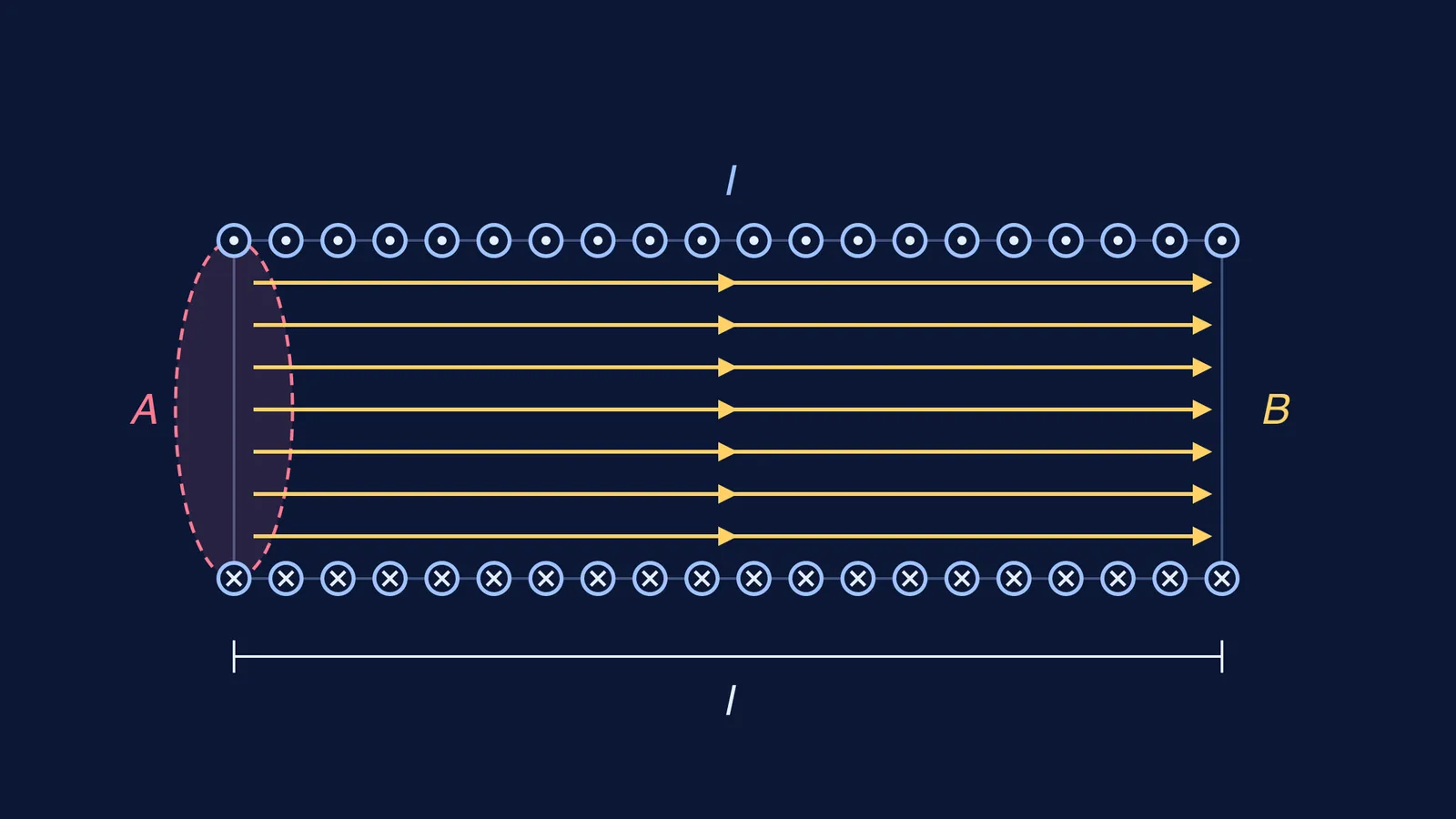
Take a solenoid of length l, cross-sectional area A and n turns per unit length, carrying current I. NCERT's derivation (Eq. 6.15 in the same chapter) runs like this:
Field inside: B = μ0nI. This comes from Ampère's law for an infinitely long solenoid, an idealisation that HyperPhysics calls a good approximation for a long solenoid.
Flux through one turn: Φ = BA = μ0nIA, because the field is uniform across the cross-section.
Total number of turns: N = nl.
Flux linkage: NΦ = (nl)(μ0nI)(A) = μ0n²AlI.
Divide by the current: L = NΦ/I = μ0n²Al.
An equivalent form, handy when a problem gives total turns, is L = μ0N²A/l, since n = N/l. The derivation neglects edge effects, where the field fans out near the ends of the coil.
Worked example: what is L for a 500-turn coil?
Take an air-core coil with N = 500 turns wound over l = 25 cm, radius r = 1.0 cm. Use μ0 = 4π × 10⁻⁷ H/m; the CODATA 2022 value listed by NIST is 1.25663706127 × 10⁻⁶ N/A², which agrees with 4π × 10⁻⁷ to ten significant figures.
Turns per metre: n = 500 / 0.25 m = 2000 per metre.
Area: A = πr² = π × (0.01 m)² = 3.14 × 10⁻⁴ m².
Inductance: L = μ0n²Al = (4π × 10⁻⁷) × (2000)² × (3.14 × 10⁻⁴) × 0.25 ≈ 3.95 × 10⁻⁴ H, about 0.39 mH.
Check it a second way. At I = 2 A, B = μ0nI ≈ 5.0 × 10⁻³ T, the flux through one turn is BA ≈ 1.6 × 10⁻⁶ Wb, and the flux linkage across 500 turns is about 7.9 × 10⁻⁴ Wb. Dividing by 2 A gives 3.95 × 10⁻⁴ H again.
Now the back emf: if that 2 A current is switched off evenly over 2 ms, dI/dt = 1000 A/s, so the induced emf is L dI/dt ≈ 0.39 V.
How does an iron core change the inductance?
If the inside of the solenoid is filled with a material of relative permeability μr, the field and the flux linkage both rise by that factor, so L = μrμ0n²Al (NCERT Eq. 6.16, same chapter). NCERT gives soft iron as an example of a material with high relative permeability.
The catch is that iron has no single μr. The HyperPhysics table of magnetic properties lists 99.8% pure annealed iron with an initial relative permeability of 150 and a maximum of 5000. Applied to our 500-turn coil with the core filling it completely, in the same idealised model:
With μr = 150: L ≈ 150 × 0.395 mH ≈ 59 mH.
With μr = 5000: L ≈ 2.0 H.
So on paper the same coil ranges from tens of millihenries to a couple of henries, depending on how strongly the iron is magnetised. In board and JEE problems, use the single μr you are given.
What mistakes cost marks on this derivation?
Using N (total turns) where the formula needs n (turns per metre), or the other way round.
Writing μ0nAl and dropping one factor of n.
Putting the diameter into πr², or leaving centimetres unconverted.
Forgetting to state the assumption: a long solenoid with edge effects neglected.
Multiplying by μr when the core fills only part of the coil, without saying so.
If the field step is the shaky one, the Fermi Concept Library covers every concept in physics, each with its own lesson, so you can rebuild Ampère's law and magnetic flux before returning to inductance. To practise problems like these, the Fermi Problem Library has worked problems with a step-by-step solver that explains the reasoning rather than printing an answer.
Next step: redo the worked example with 1000 turns on the same 25 cm length, and check that L comes out four times larger.