

On this page
Plot velocity against displacement for a block on a spring and you get a closed oval. Here is why it is an ellipse, what its semi-axes mean, and when it becomes a circle.
Why is the velocity–displacement graph in SHM an ellipse?
Start from the two standard SHM equations. In OpenStax University Physics, section 15.1, position is x(t) = A cos(ωt + φ) and velocity is v(t) = −v_max sin(ωt + φ), with v_max = Aω.
Divide each by its largest value:
x/A = cos(ωt + φ)
v/(Aω) = −sin(ωt + φ)
Square both and add. Since cos²θ + sin²θ = 1 for any angle, time drops out:
x²/A² + v²/(Aω)² = 1
That is the standard form of an ellipse, x²/a² + y²/b² = 1, centred at the origin, with semi-axis A along the displacement axis and semi-axis Aω along the velocity axis. Our post on parametric equations of the parabola, ellipse and hyperbola uses the same trick for x = a cos θ, y = b sin θ.
Can you get the same ellipse from energy conservation?
Yes, without any trigonometry. OpenStax section 15.2 writes the total energy of a spring oscillator as ½kx² + ½mv² = ½kA², and from it the speed at any position, |v| = √(k/m × (A² − x²)).
Divide the energy equation by ½kA² and use ω = √(k/m) from section 15.1, so m/k = 1/ω². You get x²/A² + v²/(A²ω²) = 1 again.
So the ellipse is energy conservation drawn as a picture: every point on it has the same total energy.
When is the v–x graph of SHM a circle?
An ellipse is a circle when its two semi-axes are equal. Here that means A = Aω, so ω = 1.
The catch: A is a length and Aω is a speed, so they can only match once you fix a scale on each axis. With the same number on both scales (say 0.1 m across and 0.1 m/s up), the curve is a circle only when ω = 1 rad/s. Using ω = 2π/T from OpenStax section 15.1, that is a period of 2π s, about 6.28 s.
ω greater than 1 (in those units): the ellipse is tall, stretched along the v-axis.
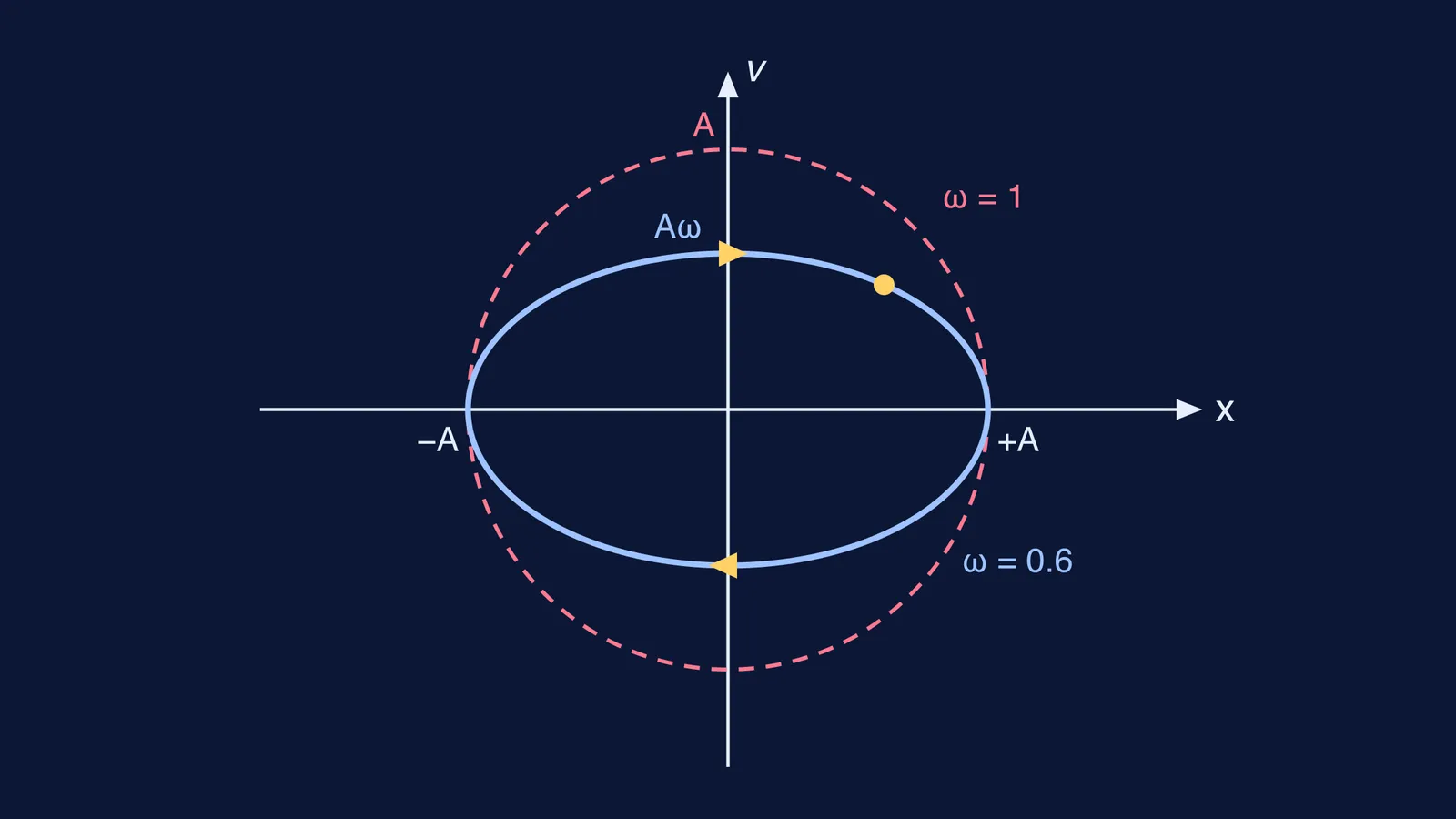
ω less than 1: it is wide and flat, like the blue curve in the diagram above.
ω equal to 1: a circle of radius A, like the dashed pink curve.
To get a circle for any ω, plot v/ω instead of v: both axes then run from −A to +A. That is the reference circle. OpenStax section 15.3 shows that SHM is the shadow of a point going round a circle of radius A at angular frequency ω, and that the point moves with speed v_max = Aω.
Which way does the point move around the ellipse?
Put x across and v up. Above the x-axis v is positive, so x increases and the point moves right; below it, the point moves left. So it goes round clockwise, once every period.
A worked example you can check by hand
A 0.5 kg block on a spring with k = 50 N/m is pulled 0.2 m from equilibrium and released.
ω = √(k/m) = √(50/0.5) = 10 rad/s.
Semi-axes: A = 0.2 m along x, and Aω = 0.2 × 10 = 2 m/s along v.
Speed at x = 0.12 m: v = ω√(A² − x²) = 10 × √(0.04 − 0.0144) = 10 × 0.16 = 1.6 m/s.
Check the point lies on the ellipse: (0.12/0.2)² + (1.6/2)² = 0.36 + 0.64 = 1.
On equal numeric scales this ellipse is ten times as tall as it is wide, because ω = 10. Plot v/ω on the vertical axis instead and it becomes a circle of radius 0.2.
Quick checklist for v–x graph questions
The x-intercepts are ±A.
The v-intercepts are ±Aω, so ω = v-intercept ÷ x-intercept.
A circle on equal scales means ω = 1 in those units; it says nothing about the motion itself being circular.
An ellipse centred at x = x₀ instead of the origin means the mean position is at x₀; write (x − x₀)² in place of x².
The same ellipse appears in two perpendicular SHMs: line, ellipse, circle or figure-eight. And if you first need to decide whether a motion is SHM at all, start with how to check if motion is SHM from its acceleration equation.
For more graph-reading questions on oscillations, the Fermi Problem Library has worked problems with a step-by-step solver that explains the reasoning rather than printing an answer. If the reference circle still feels abstract, the Fermi Simulation Lab has interactive simulations for ideas that are easier to see than to read.
Next time you see an oval on a v–x graph, read the two intercepts first.


