

On this page
Most conic problems ask you to handle a moving point on a curve. Call it (x, y) and you carry two unknowns plus the curve's equation. Call it by one parameter and the equation is already built in, so a page of elimination often shrinks to a few lines.
The JEE (Advanced) 2026 Information Brochure lists, under Analytical Geometry, "parametric equations, equations of tangent and normal" for the parabola, ellipse and hyperbola, followed by "Locus problems" as a separate line.
What are the parametric equations of a parabola, ellipse and hyperbola?
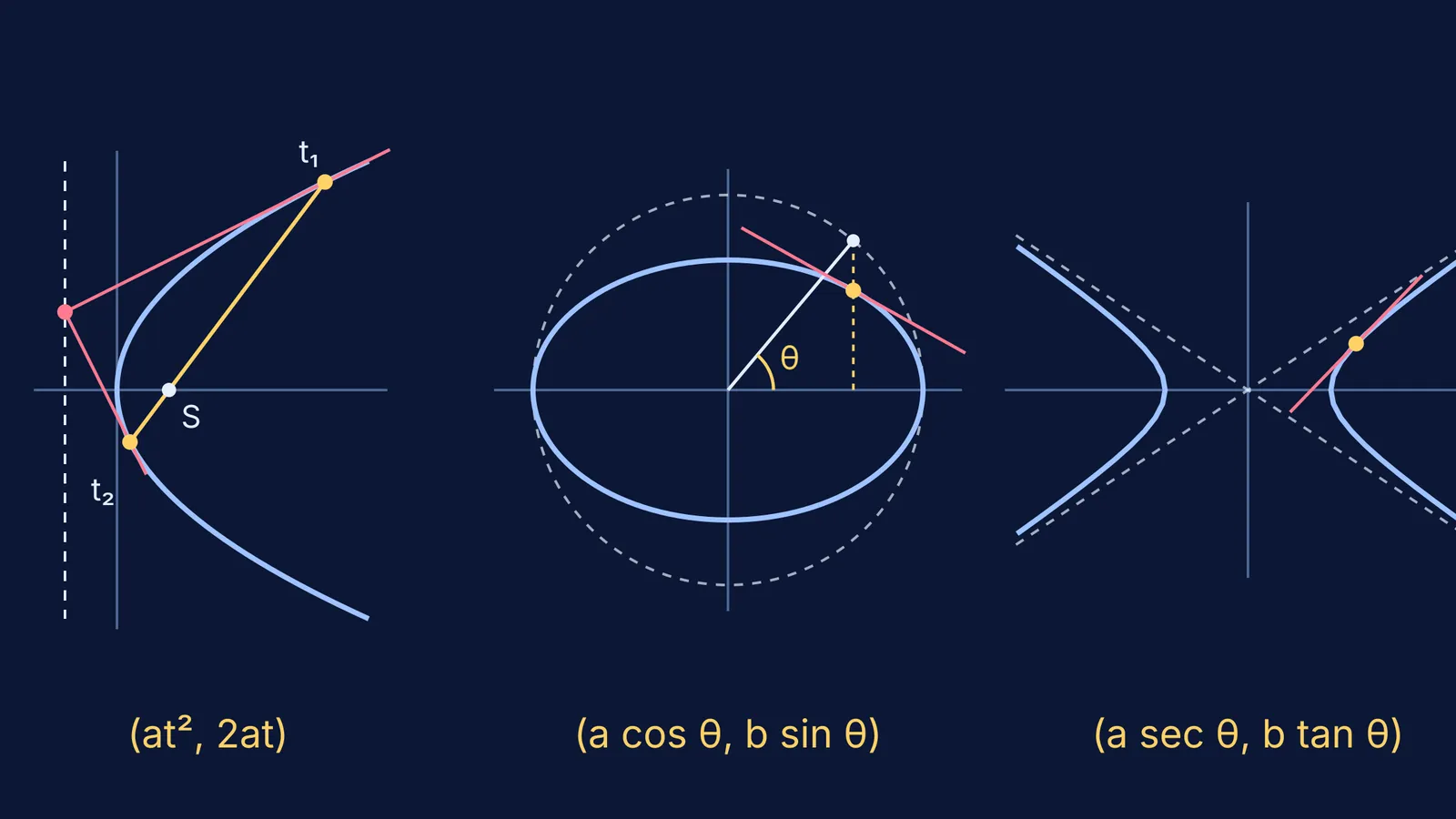
For the parabola y² = 4ax, the standard parametric form is x = at², y = 2at, as given on Wolfram MathWorld's parabola page. Substitute and check: (2at)² = 4a(at²).
For the ellipse x²/a² + y²/b² = 1, the standard form is (a cos θ, b sin θ), with θ running from 0 to 2π, as Wikipedia's ellipse article sets out. θ is the eccentric angle (eccentric anomaly in astronomy) and comes from the auxiliary circle of radius a: drop a perpendicular from the circle point (a cos θ, a sin θ) to the major axis, and it meets the ellipse at your point.
For the hyperbola x²/a² − y²/b² = 1, the trigonometric form is (a sec θ, b tan θ), which covers both branches but breaks at θ = ±π/2, according to Wolfram MathWorld's hyperbola page. The check uses sec²θ − tan²θ = 1.
How do parametric forms simplify chord and tangent equations?
Parabola y² = 4ax:
Chord joining t₁ and t₂: 2x − (t₁ + t₂)y + 2at₁t₂ = 0, because its slope is 2a(t₁ − t₂)/a(t₁² − t₂²) = 2/(t₁ + t₂).
Focal chord: put the focus (a, 0) into the chord to get t₁t₂ = −1.
Tangent at t: ty = x + at², the chord with t₂ = t₁.
Tangents at t₁ and t₂ meet at (at₁t₂, a(t₁ + t₂)).
The same parameters handle normals; our post on how many normals can be drawn to a parabola from a point takes that further.
Ellipse (a cos θ, b sin θ):
Tangent at θ: (x/a)cos θ + (y/b)sin θ = 1.
Chord joining α and β: (x/a)cos((α + β)/2) + (y/b)sin((α + β)/2) = cos((α − β)/2).
Hyperbola (a sec θ, b tan θ):
Tangent at θ: (x/a)sec θ − (y/b)tan θ = 1.
Chord joining α and β: (x/a)cos((α − β)/2) − (y/b)sin((α + β)/2) = cos((α + β)/2).
When the question fixes the chord's midpoint rather than its ends, the T = S₁ method in our post on the chord with a given midpoint for every conic is usually quicker.
How do you solve a locus problem with parameters?
Write the moving point (h, k) in terms of parameters, link them with the given condition, then eliminate.
Worked example. Find the locus of the midpoint of focal chords of y² = 4ax.
Let the ends be t₁ and t₂. The focal-chord condition gives t₁t₂ = −1.
The midpoint is h = a(t₁² + t₂²)/2, k = a(t₁ + t₂).
Write s = t₁ + t₂. Then t₁² + t₂² = s² − 2t₁t₂ = s² + 2, so h = a(s² + 2)/2.
From step 2, s = k/a. Substitute: 2ah = k² + 2a².
The locus is y² = 2a(x − a), a parabola with vertex at the focus.
Check with the latus rectum: t = 1 and t = −1 give (a, 2a) and (a, −2a), midpoint (a, 0), which satisfies y² = 2a(x − a).
A bonus: tangents at the ends of a focal chord meet at (at₁t₂, a(t₁ + t₂)) = (−a, a(t₁ + t₂)), always on the directrix x = −a.
Which parameter should you pick?
Point on y² = 4ax with chords, tangents or normals: use t, and remember t₁t₂ = −1 for focal chords.
Point on an ellipse where the answer involves angles or the auxiliary circle: use θ.
Point on a hyperbola across both branches: use (a sec θ, b tan θ) and avoid θ = ±π/2.
Right branch only: (a cosh t, b sinh t) also works, as MathWorld notes.
Ellipse with its major axis vertical: swap the roles of a and b, as in our guide to the ellipse with its major axis along the y-axis.
If a step in the elimination keeps going wrong, the Fermi Problem Library has worked problems with a step-by-step solver that explains the reasoning rather than printing an answer. If the gap is in the ideas themselves, each mathematics concept has its own lesson in the Fermi Concept Library.
This week, solve three past locus questions twice, once with (x, y) and once with a parameter, and compare.


