

On this page
Many JEE questions on normals to a parabola come down to one move: write the normal in terms of its slope m, put in the given point, and read the answer off a cubic in m.
Where does the slope form of the normal come from?
Take the parabola y² = 4ax. At the point (at², 2at) the tangent has slope 1/t, so the normal has slope −t. Call that slope m, so t = −m and the foot of the normal is (am², −2am).
The normal through that foot is y + 2am = m(x − am²), which tidies up to y = mx − 2am − am³. This is the standard slope form of the normal to y² = 4ax, as set out in this summary of co-normal points. For the general rule, see our post on tangents and normals from derivatives.
How many normals can be drawn to a parabola from a point?
If the normal passes through P(h, k), then k = mh − 2am − am³, or am³ + (2a − h)m + k = 0 (Careers360). Each real root m is one normal, so a point has at most three.
The discriminant decides how many. Dividing by a gives m³ + pm + q = 0 with p = (2a − h)/a and q = k/a. For this depressed cubic the discriminant is −(4p³ + 27q²), and it has three distinct real roots exactly when that discriminant is positive (cubic equation, Wikipedia). Substituting p and q:
27ak² < 4(h − 2a)³: three distinct normals.
27ak² = 4(h − 2a)³ with k ≠ 0: two normals, because one root is repeated.
27ak² > 4(h − 2a)³: one normal.
The right-hand side is positive only when h > 2a, which is why three real normals need h > 2a (Careers360). It is not enough on its own: for (3, 4) and y² = 4x, 27 × 16 = 432 beats 4 × 1³ = 4, so only one normal passes through it.
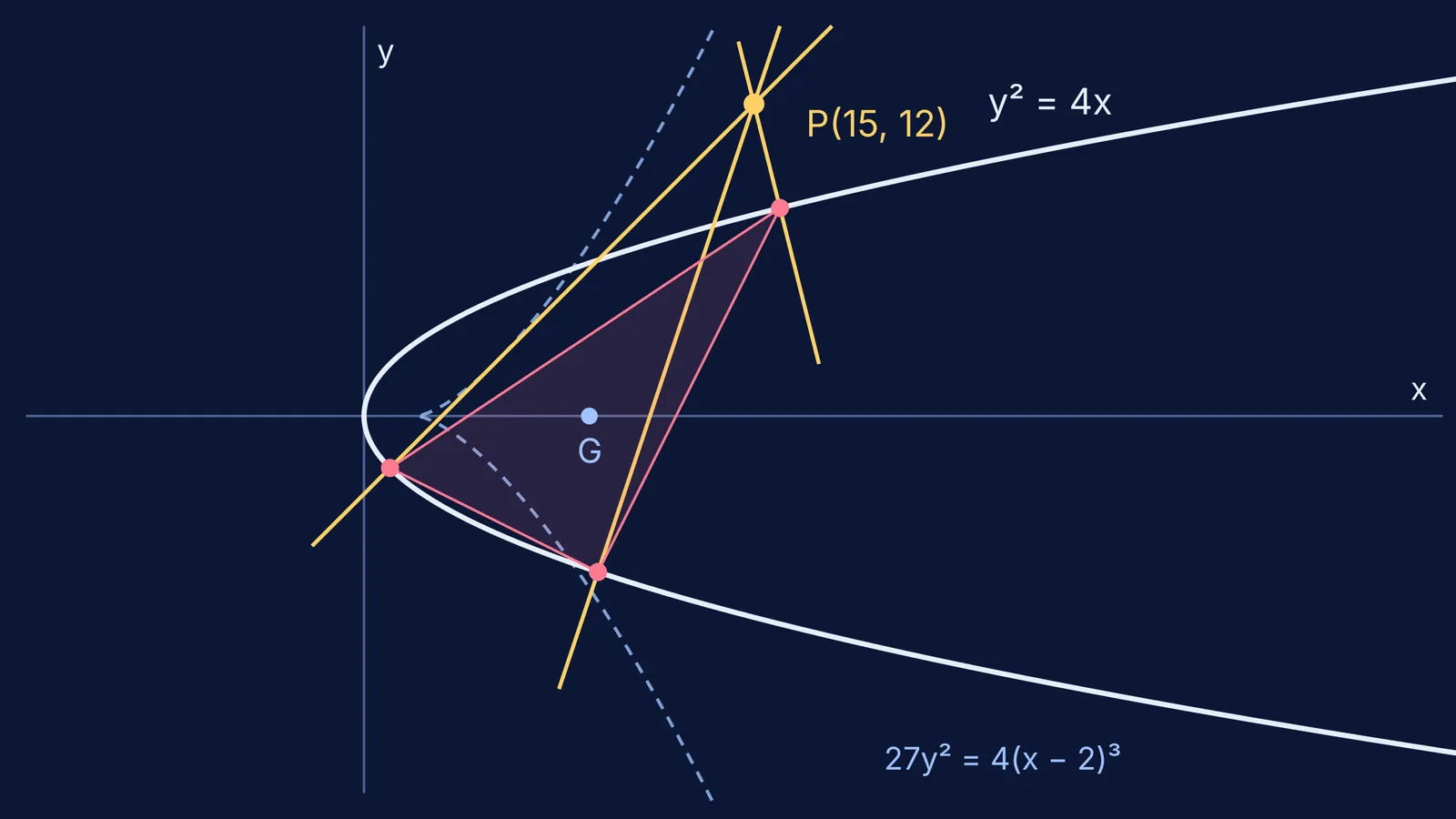
The boundary curve 27ay² = 4(x − 2a)³ is a semicubical parabola called the evolute, the envelope of all the normals (Evolute, Wikipedia). Points on the inner side of it get three normals and points on the outer side get one (Parabola Evolute, Wolfram MathWorld).
What do the feet of the three normals have in common?
The feet are called co-normal points. Because the cubic am³ + 0·m² + (2a − h)m + k = 0 has no m² term, the three slopes add to zero: m₁ + m₂ + m₃ = 0 (Careers360). Vieta's rules also give m₁m₂ + m₂m₃ + m₃m₁ = (2a − h)/a and m₁m₂m₃ = −k/a.
Three properties follow:
Each foot has ordinate −2am, so the ordinates of the co-normal points add to zero.
The centroid of the triangle of feet therefore lies on the axis of the parabola.
Its x-coordinate is a(m₁² + m₂² + m₃²)/3. Since m₁² + m₂² + m₃² = 0² − 2(2a − h)/a, the centroid is at (2(h − 2a)/3, 0).
A worked example: normals from (15, 12) to y² = 4x
Here a = 1, so the test reads 27 × 144 = 3888 against 4 × 13³ = 8788. Since 3888 < 8788, expect three normals.
Write the cubic: m³ + (2 − 15)m + 12 = 0, that is m³ − 13m + 12 = 0.
Try small integers: m = 1 works, and dividing out gives m² + m − 12 = (m + 4)(m − 3). The slopes are 1, 3 and −4, which add to zero.
Feet (m², −2m): (1, −2), (9, −6) and (16, 8). The ordinates add to zero.
Normals: y = x − 3, y = 3x − 33 and y = −4x + 72, each passing through (15, 12).
Centroid: x = (1 + 9 + 16)/3 = 26/3 = 2(15 − 2)/3, as predicted. The diagram above shows this example.
How do you use the cubic in a locus question?
A favourite question asks for the locus of P when two of its three normals are perpendicular. Set m₁m₂ = −1. Then m₁m₂m₃ = −k/a gives m₃ = k/a, and m₃ must satisfy the cubic. Substituting and dividing by k/a leaves k²/a + 2a − h + a = 0, so the locus is y² = a(x − 3a), another parabola. This is the pattern in our five-step method for locus problems.
For any co-normal question: write the cubic, read off the Vieta relations, turn the condition into a statement about slopes, eliminate them, then check whether h > 2a limits the answer.
For the rest of the chapter, see our guide to focal chords, tangents and normals of a parabola. If the signs still go wrong, the Fermi Problem Library has worked problems with a step-by-step solver that explains the reasoning rather than printing an answer. If parametric points are the gap, start with the lesson in the Fermi Concept Library.


