

On this page
Push a pendulum bob forwards and nudge it sideways at the same time, and it traces a curve instead of a line. That curve is the resultant of two perpendicular simple harmonic motions. Here is one equation for every same-frequency case, a rule for the direction of motion, and a worked 1:2 example.
What is the resultant of two perpendicular SHMs?
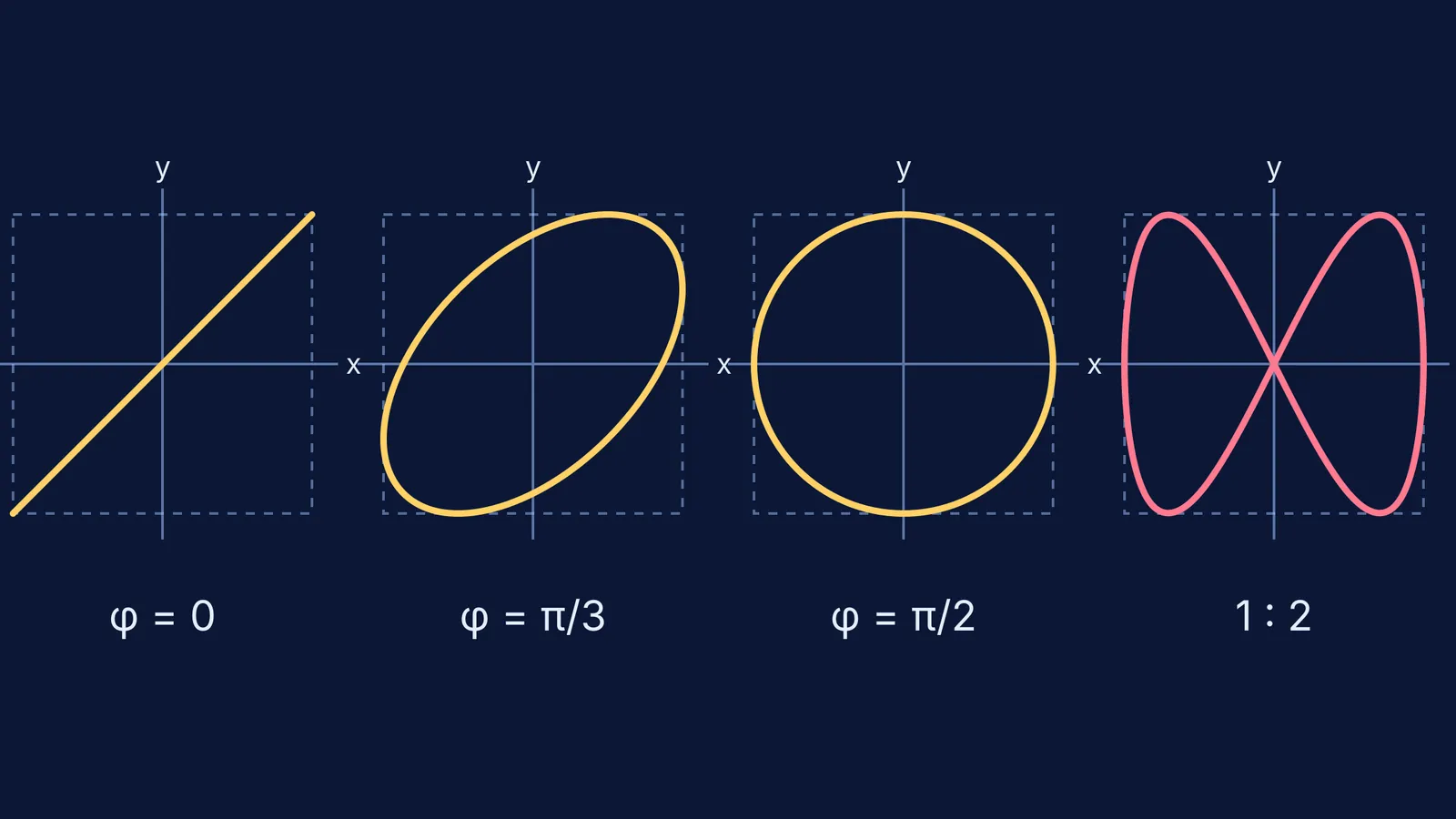
Run one SHM along x and one along y at the same time: x = A sin ωt and y = B sin(ωt + φ). The particle sits at (x, y), so it moves on a curve in the plane.
A University of Mosul lecture on Lissajous figures puts it simply: when an object undergoes two perpendicular simple harmonic motions, its path is a curve called a Lissajous figure, and the shape depends on the amplitudes, the frequencies and the phase difference.
The curves are named after Jules Antoine Lissajous, who studied them in 1857, although Nathaniel Bowditch had already investigated the same family in 1815, according to Wikipedia's article on the Lissajous curve.
Check the directions first: two SHMs along the same line add up to one SHM, not a curve, as in adding two SHMs with the phasor method.
How do you find the equation of the path?
Eliminate t. Three steps do it:
From the first equation, sin ωt = x/A, so cos ωt = ±√(1 − x²/A²).
Expand the second: y/B = (x/A) cos φ + cos ωt sin φ.
Move (x/A) cos φ to the left, square both sides and simplify.
You get x²/A² + y²/B² − (2xy/AB) cos φ = sin²φ. Two perpendicular SHMs of the same frequency always give an ellipse, and the straight line and the circle are special cases of it, as the Mosul lecture concludes.
When is the path a straight line, a circle or an ellipse?
Put values of φ into the equation:
φ = 0: (x/A − y/B)² = 0, so y = (B/A)x, a straight line with positive slope.
φ = π: y = −(B/A)x, a straight line with negative slope.
φ = π/2: x²/A² + y²/B² = 1, an ellipse with its axes along x and y.
φ = π/2 and A = B: x² + y² = A², a circle of radius A.
Any other φ: an ellipse tilted to the axes, fitting inside a 2A by 2B box.
The Mosul lecture draws each case. Unsure where φ comes from? See writing an SHM equation from initial conditions.
Why does a 1:2 frequency ratio give a figure-eight?
Now let y oscillate twice as fast: x = A sin ωt and y = B sin 2ωt. Use sin 2ωt = 2 sin ωt cos ωt and substitute sin ωt = x/A:
y² = (4B²/A²) x² (1 − x²/A²).
Read the equation. y = 0 at x = 0 and at x = ±A, so the curve passes through the origin and reaches both side edges of its box. Near the origin y is roughly ±(2B/A)x, so two branches cross there and you get two loops: a figure-eight lying on its side. The highest points, y = ±B, are at x = ±A/√2.
The phase changes the 1:2 shape too. With y = B cos 2ωt, the identity cos 2ωt = 1 − 2 sin²ωt gives y = B(1 − 2x²/A²), a parabola that the particle traces back and forth. Wikipedia lists this parabola as a 1:2 Lissajous figure.
What path does x = 3 sin ωt, y = 4 sin 2ωt trace?
Take x and y in cm.
Compare frequencies: 2ω against ω gives a 1:2 ratio, so the answer is not a line, circle or ellipse.
Eliminate t: sin ωt = x/3, so y = ±8(x/3)√(1 − x²/9).
Square: y² = (64/9) x² (1 − x²/9).
Check the box: x runs from −3 cm to 3 cm and y from −4 cm to 4 cm. y = 0 at x = 0 and x = ±3 cm, and y = ±4 cm at x = ±3/√2 ≈ ±2.1 cm.
Count touches: twice on the top edge, once on each side edge. That 2:1 matches y moving twice as fast.
Answer: a figure-eight lying on its side, crossing itself at the origin.
Before you write the answer, check these:
Same frequency? Read φ off the ellipse equation.
Different frequencies? Eliminate t with a double-angle identity, then check zeros and highest points.
Direction? Put t = 0.
These shapes make more sense when you watch them form. The Fermi Simulation Lab has interactive simulations for ideas that are easier to see than to read. When you want more practice, the Fermi Problem Library has worked problems with a step-by-step solver that explains the reasoning rather than printing an answer.
Next, see how displacement, velocity and acceleration differ in phase in SHM.


