

On this page
Suppose two simple harmonic motions act on the same particle along the same line, say x₁ = A₁ sin(ωt + φ₁) and x₂ = A₂ sin(ωt + φ₂). Trigonometric identities work but are slow. The phasor method turns the problem into adding two arrows.
What is the resultant of two SHMs in the same direction?
The sum of two SHMs with the same frequency along the same line is also an SHM with that frequency; only the amplitude and phase change (Mini Physics: phasors and superposition).
A phasor is an arrow whose length is the amplitude and whose angle is the initial phase. Both arrows share the same ω and rotate together, so freeze them at t = 0 and add them as vectors: the sum's length is the resultant amplitude and its angle is the resultant phase (Mini Physics).
The cosine rule gives the resultant amplitude: A = √(A₁² + A₂² + 2A₁A₂ cos δ), where δ = φ₂ − φ₁ is the phase difference (Mini Physics).
The resultant phase comes from the components: tan φ = (A₁ sin φ₁ + A₂ sin φ₂) / (A₁ cos φ₁ + A₂ cos φ₂).
How do you add two SHMs using phasors, step by step?
Write both motions with the same function, both sine or both cosine. Use cos ωt = sin(ωt + π/2) and −sin ωt = sin(ωt + π).
Draw each phasor from the origin: length A₁ at angle φ₁, length A₂ at angle φ₂.
Add the horizontal components, X = A₁ cos φ₁ + A₂ cos φ₂, and the vertical components, Y = A₁ sin φ₁ + A₂ sin φ₂.
Find A = √(X² + Y²), and read the angle φ from the signs of X and Y.
Write the answer as x = A sin(ωt + φ).
If phase as an angle feels shaky, start with the reference circle and phase in SHM.
Worked numericals: amplitude and phase of the resultant
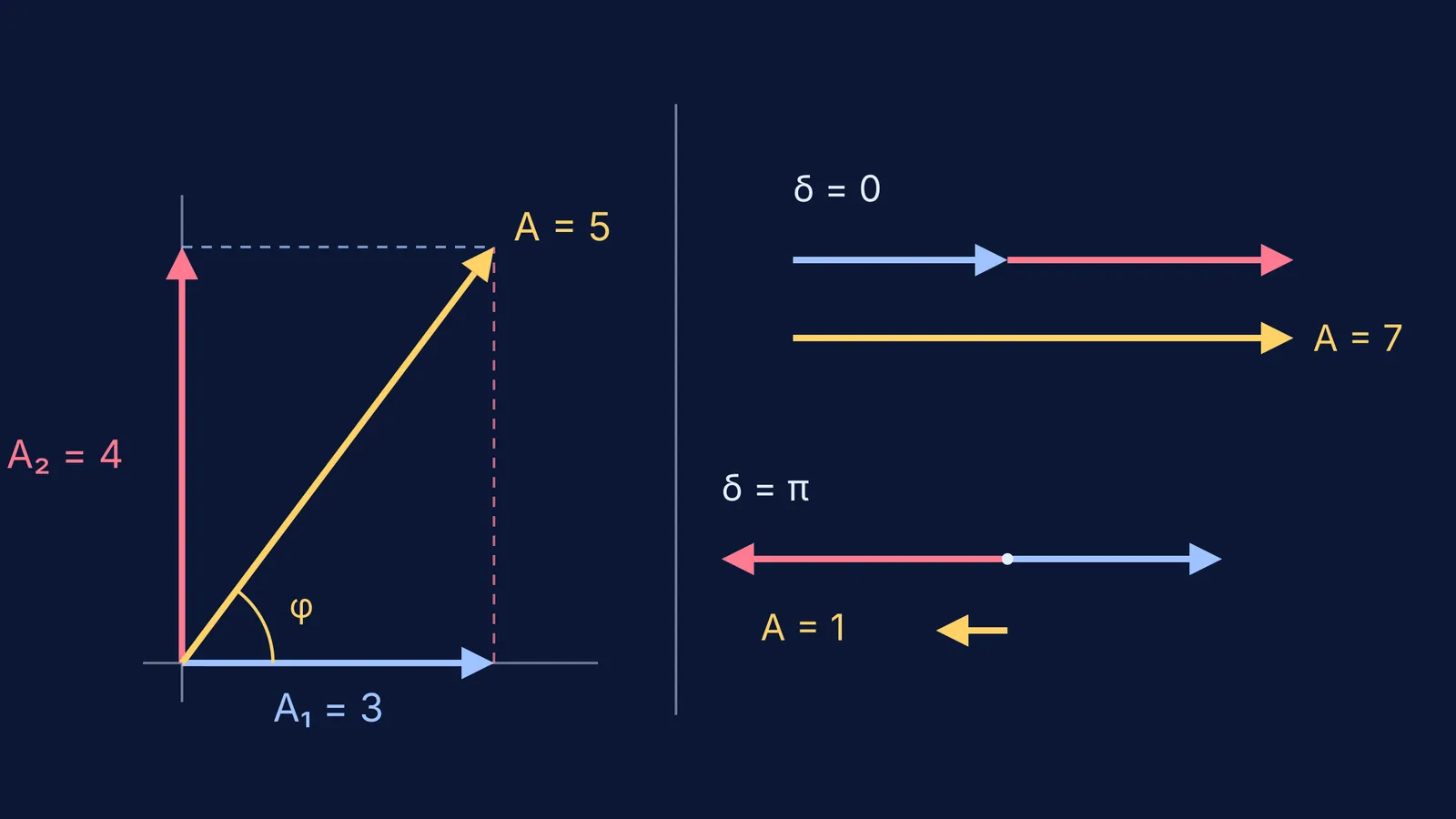
Example 1, sine plus cosine: x₁ = 3 sin ωt and x₂ = 4 cos ωt, in cm. First rewrite x₂ = 4 sin(ωt + π/2), so δ = 90° and cos δ = 0. Then A = √(9 + 16) = 5 cm. The components are X = 3 and Y = 4, so tan φ = 4/3 and φ ≈ 53°. The resultant is x = 5 sin(ωt + 53°) cm, the case drawn at the top of this post.
Example 2, equal amplitudes: x₁ = 4 sin ωt and x₂ = 4 sin(ωt + π/3), in cm. When the amplitudes are equal, the resultant amplitude is 2A cos(δ/2) (OpenStax University Physics, interference of waves). Here that gives 8 cos 30° = 4√3 ≈ 6.93 cm. Two equal arrows form a rhombus, so the resultant bisects them and φ = 30°.
Example 3, the quadrant trap: x₁ = sin ωt and x₂ = 2√2 sin(ωt + 3π/4), in cm. X = 1 + 2√2 cos 135° = 1 − 2 = −1, and Y = 2√2 sin 135° = 2. So A = √5 ≈ 2.24 cm. The calculator says tan⁻¹(−2) = −63.4°, but X is negative and Y is positive, so the arrow lies in the second quadrant: φ = 180° − 63.4° = 116.6°. Check with the formula: 1 + 8 + 2(1)(2√2)(−1/√2) = 9 − 4 = 5, which matches.
What happens when the two SHMs are in phase or opposite in phase?
In phase (δ = 0, 2π, …): cos δ = 1, so A = A₁ + A₂ and the resultant has the same phase as both motions. This is the largest amplitude possible, which is called constructive interference (UNSW Physclips: phasor addition). For example, 3 sin ωt + 4 sin ωt = 7 sin ωt.
Opposite in phase (δ = π): cos δ = −1, so A = |A₁ − A₂| and the resultant takes the phase of the larger motion. This is the smallest amplitude possible, called destructive interference (UNSW Physclips). For example, 3 sin ωt + 4 sin(ωt + π) = sin(ωt + π). If the amplitudes are equal, the resultant amplitude is zero and the particle stays at rest (OpenStax).
Every other phase difference lands between these limits: |A₁ − A₂| ≤ A ≤ A₁ + A₂. The same algebra gives the cos δ term in intensity in interference, and the same arrows add voltages in phasors and impedance for JEE.
A checklist before you write the final answer
Same ω and same line? If not, this method does not apply.
Both written as sine, with δ measured from the same reference?
Negative amplitudes turned into a phase of π?
A between |A₁ − A₂| and A₁ + A₂?
φ in the quadrant your sketch shows?
If your amplitude comes out right but your phase keeps going wrong, the Fermi Problem Library has worked problems with a step-by-step solver that explains the reasoning rather than printing an answer, so you can find the line where your angle went off.


