On this page
Here is what JEE (Advanced) asks on complex numbers and quadratics beyond JEE (Main), two original problems and a practice plan.
What does the JEE Advanced syllabus say about complex numbers and quadratics?
The official JEE (Advanced) 2026 syllabus lists, under Algebra: "Algebra of complex numbers, addition, multiplication, conjugation, polar representation, properties of modulus and principal argument, triangle inequality, cube roots of unity, geometric interpretations." The next paragraph reads: "Statement of fundamental theorem of algebra, Quadratic equations with real coefficients, relations between roots and coefficients, formation of quadratic equations with given roots, symmetric functions of roots." The document says it is unchanged from 2025. The 2027 syllabus is not yet published (as of 19 November 2026), so prepare from this list and recheck later.
JEE (Advanced) 2027 will be held on 23 May 2027 (Sunday), organised by IIT Delhi, according to the official JEE (Advanced) website. One of the eligibility criteria is being among the top 2,50,000 successful candidates in the B.E./B.Tech. paper of JEE (Main) 2027. JEE (Advanced) 2026 had two compulsory papers of three hours each (2026 Information Brochure). Question types and marking can change each year; see our explainer on JEE Advanced question types.
What is beyond JEE Main in this unit?
NTA's JEE (Main) 2027 syllabus covers the Argand diagram, algebra of complex numbers, modulus and argument, quadratic equations, relations between roots and coefficients, nature of roots and forming quadratics with given roots. Set against it, these items are named only in the Advanced list:
polar representation and the principal argument
the triangle inequality
cube roots of unity
geometric interpretations
the statement of the fundamental theorem of algebra
symmetric functions of roots
If your basics are shaky, start with our Class 11 guide to complex numbers and quadratic equations.
How do Advanced problems combine these ideas?
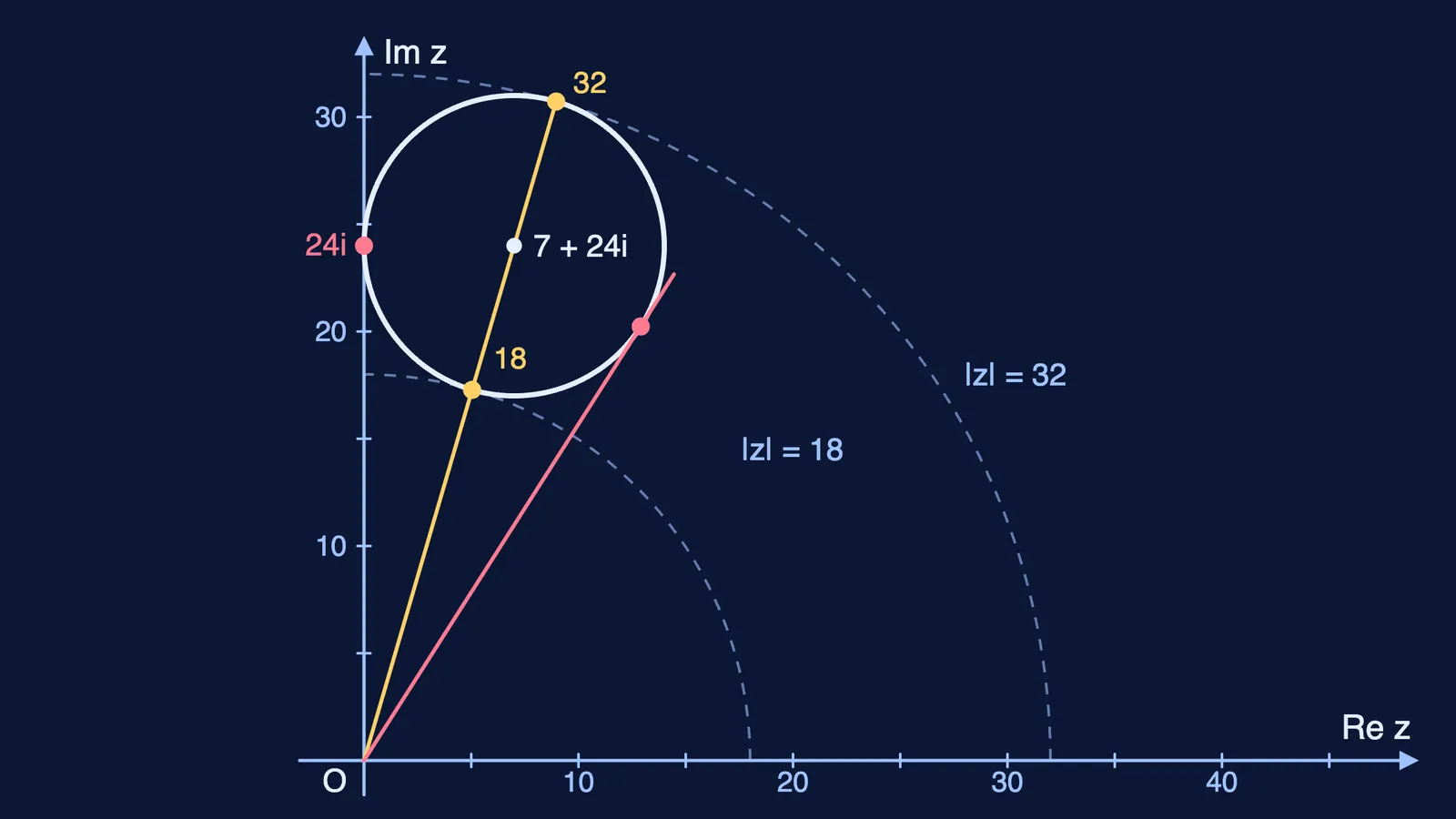
Example 1: a circle on the Argand plane, multiple correct. z moves on |z − (7 + 24i)| = 7. Which are true? (A) The largest |z| is 32. (B) The smallest |z| is 18. (C) The largest principal argument of z is π/2. (D) The smallest principal argument θ has tan θ = 24/7.
The centre C = 7 + 24i has |C| = 25. By the triangle inequality, 25 − 7 ≤ |z| ≤ 25 + 7, with equality where the line OC meets the circle. So (A) and (B) are true.
The argument is largest or smallest where a line from O touches the circle. Each tangent has length √(25² − 7²) = 24.
The real part of C equals the radius, so the circle touches the imaginary axis at 24i. That point has argument π/2, so (C) is true.
The other tangent, the mirror image of the imaginary axis in OC, touches at (8064 + 12648i)/625, where tan θ = 527/336. So (D) is false: 24/7 is the centre's direction.
Answer: A, B and C. Mark only options you have checked; see our explainer on partial marking in multiple-correct questions.
Limiting case: shrink the radius to 0 and both ranges collapse to |z| = 25 and arg z = arg C, as they must.
Example 2: symmetric functions, numerical answer. α and β are the roots of x² − 3x + 4 = 0. Find α⁵ + β⁵.
α + β = 3 and αβ = 4. Write Sₙ = αⁿ + βⁿ. Since each root satisfies x² = 3x − 4, Sₙ = 3Sₙ₋₁ − 4Sₙ₋₂.
S₀ = 2, S₁ = 3, S₂ = 1, S₃ = −9, S₄ = −31, S₅ = −57.
Answer: −57.
Check: S₂ = (α + β)² − 2αβ = 1 matches. The discriminant is −7, so the roots are conjugates with |α|² = αβ = 4. The triangle inequality gives |S₅| ≤ 2⁵ + 2⁵ = 64, and 57 passes.
How should you practise for JEE Advanced?
A four-week plan:
Week 1: polar form, principal argument in all four quadrants, powers.
Week 2: geometry on the Argand plane: circles, perpendicular bisectors and rotation, each drawn to scale before you compute.
Week 3: cube roots of unity and symmetric functions, including the recurrence for power sums.
Week 4: timed mixed sets; sort every error as wrong formula, algebra slip or missed case.
Stuck at the same step every time? The Fermi Problem Library has worked problems with a step-by-step solver that explains the reasoning rather than printing an answer.
Can you solve these practice questions?
ω is a non-real cube root of unity. Find (4 + 7ω + 4ω²)⁵. Answer: 243ω², since the bracket equals 3ω.
Form the quadratic with real coefficients that has (5 + i)/(1 − i) as a root. Answer: x² − 4x + 13 = 0, since the root is 2 + 3i.
z satisfies |z − 2| = |z − 6i|. Find the least value of |z|. Answer: 4√10/5, at z = −4/5 + (12/5)i.